Files
The Files tab is where you manage your R scripts, data files, and folders. Think of it as a lightweight file manager built right into the app. You can create new scripts, organize them into folders, edit text files, and even run R scripts directly without switching tabs.
Browsing your files
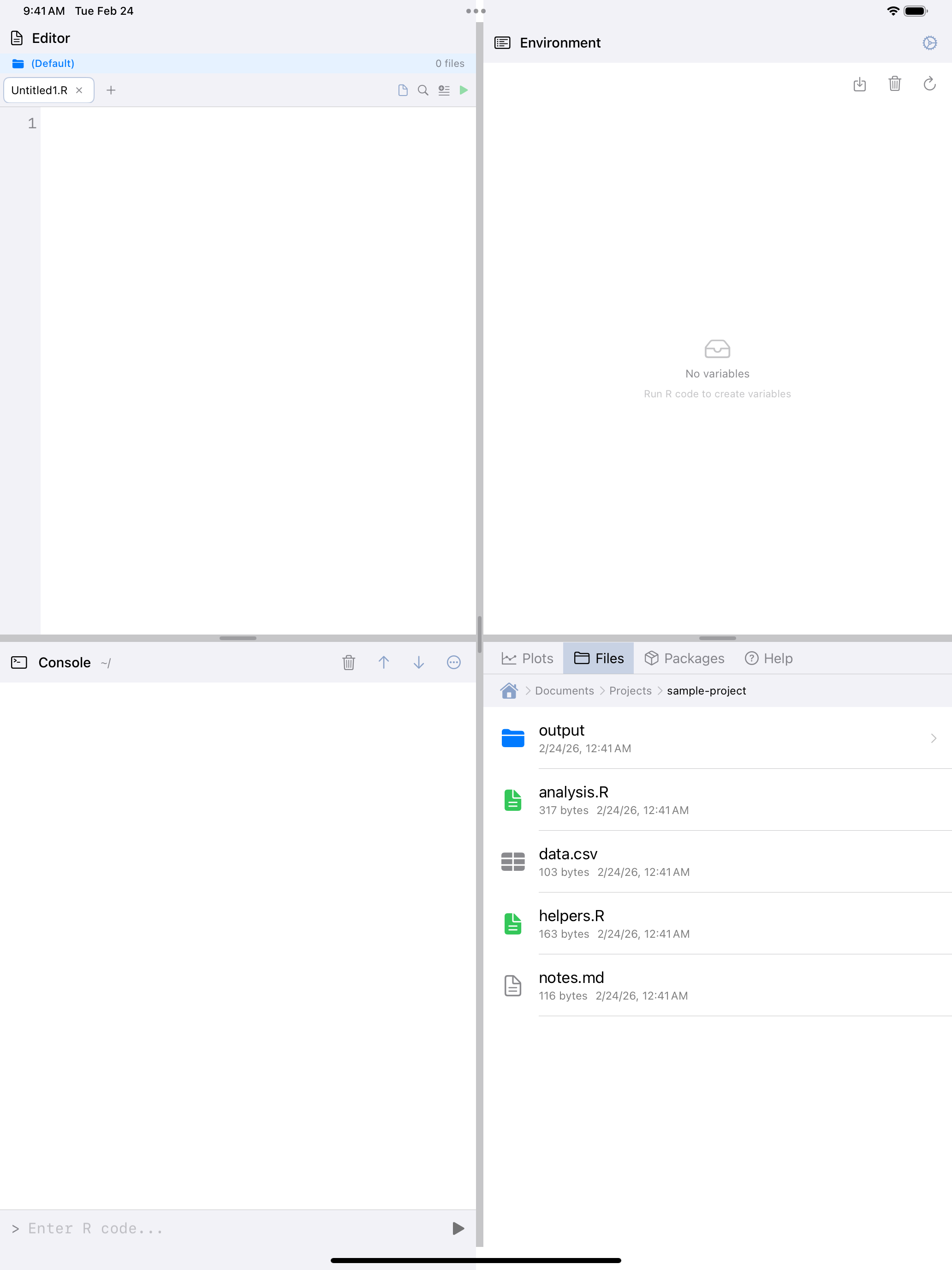
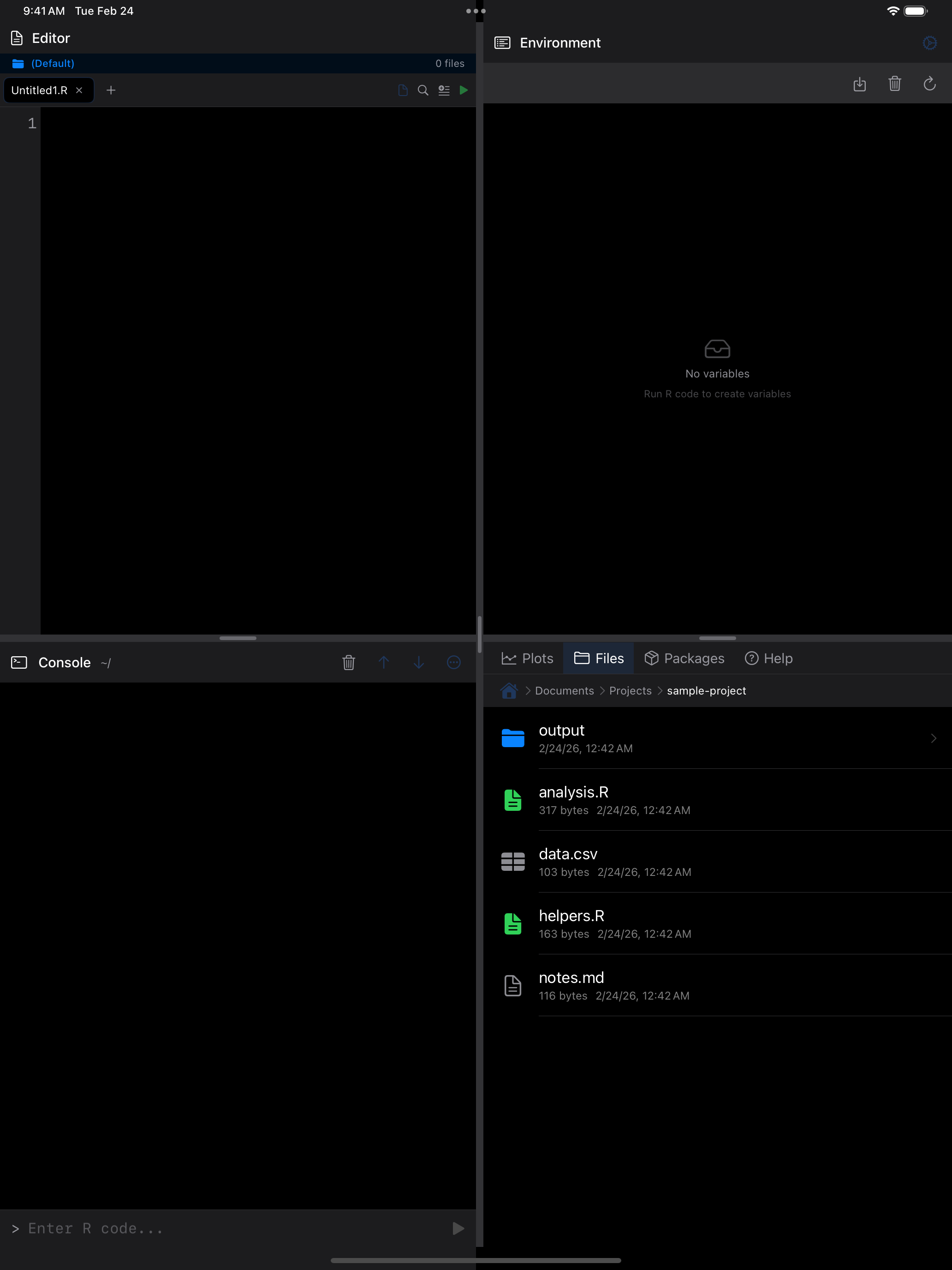
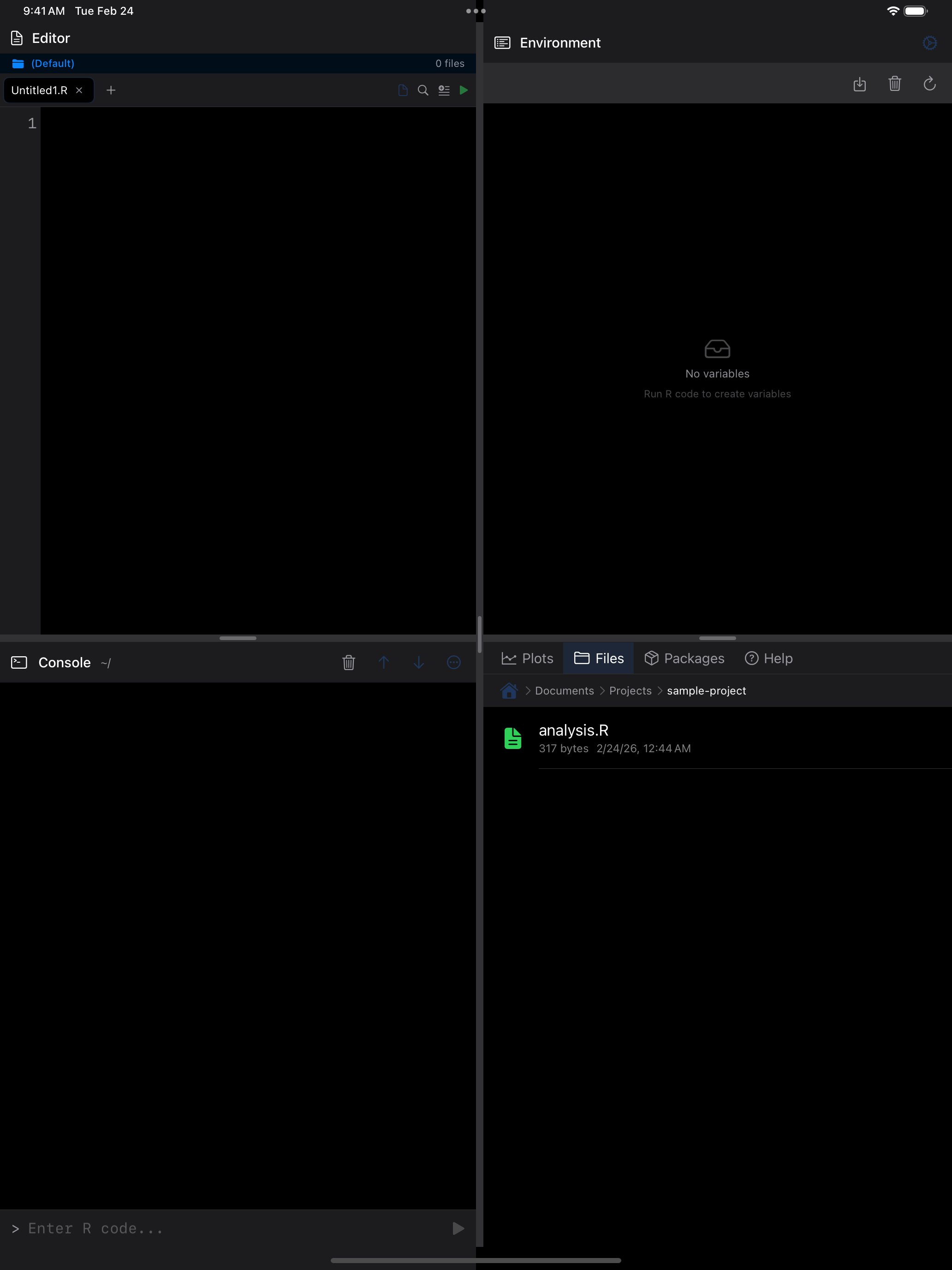
When you open the Files tab, you will see the contents of your Documents folder. Folders show a chevron on the right; tap one to open it. At the top, a breadcrumb trail shows where you are in the folder hierarchy, and you can tap any breadcrumb to jump back to that level. Tap the home icon to return all the way to the root.
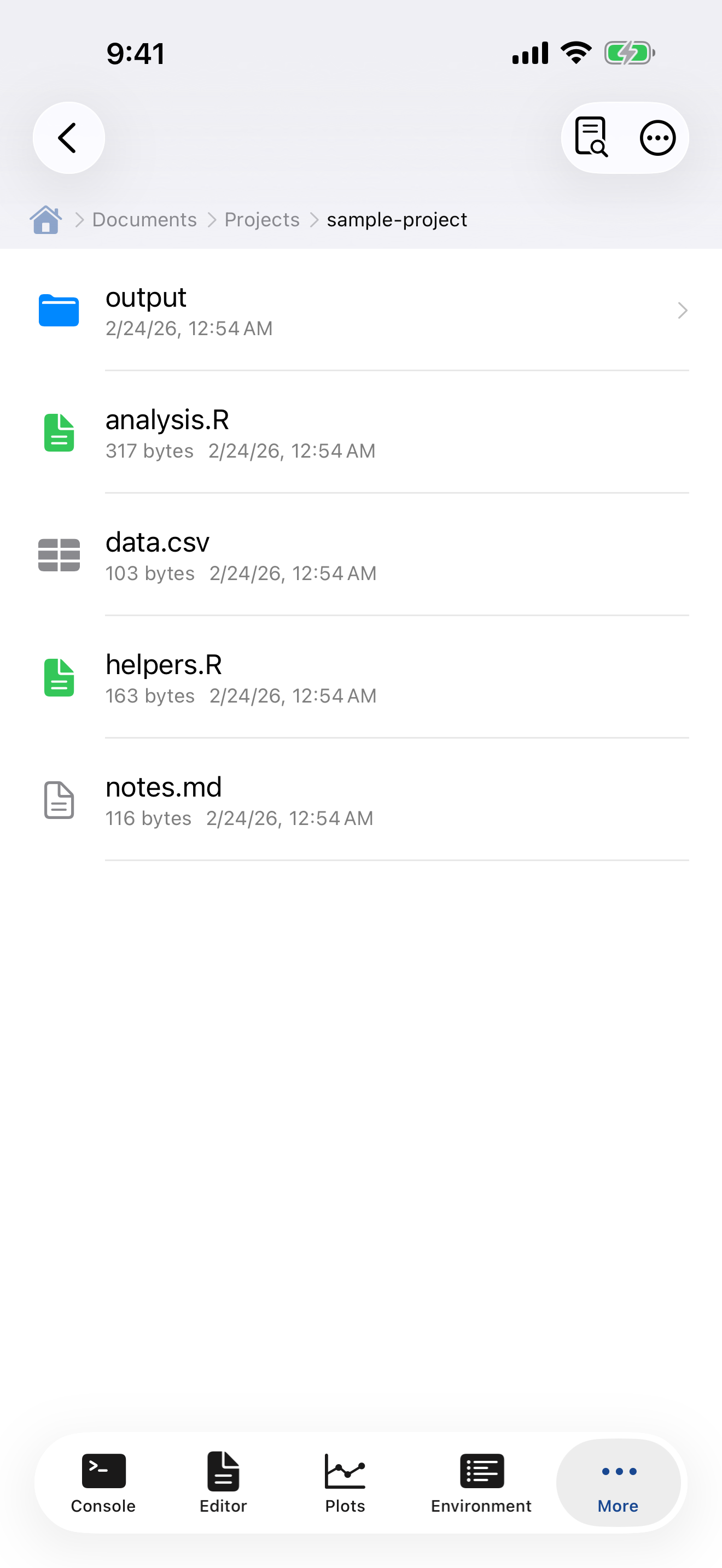

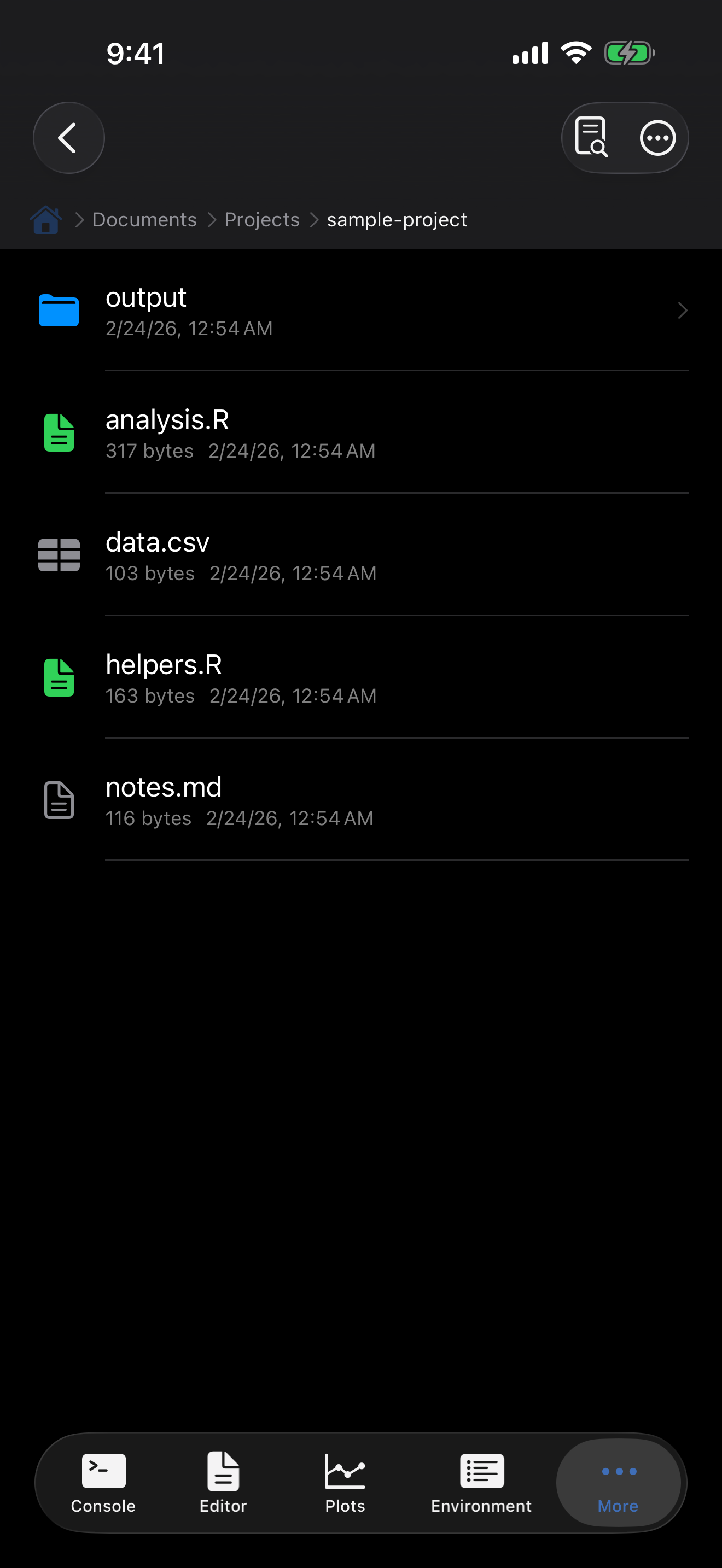
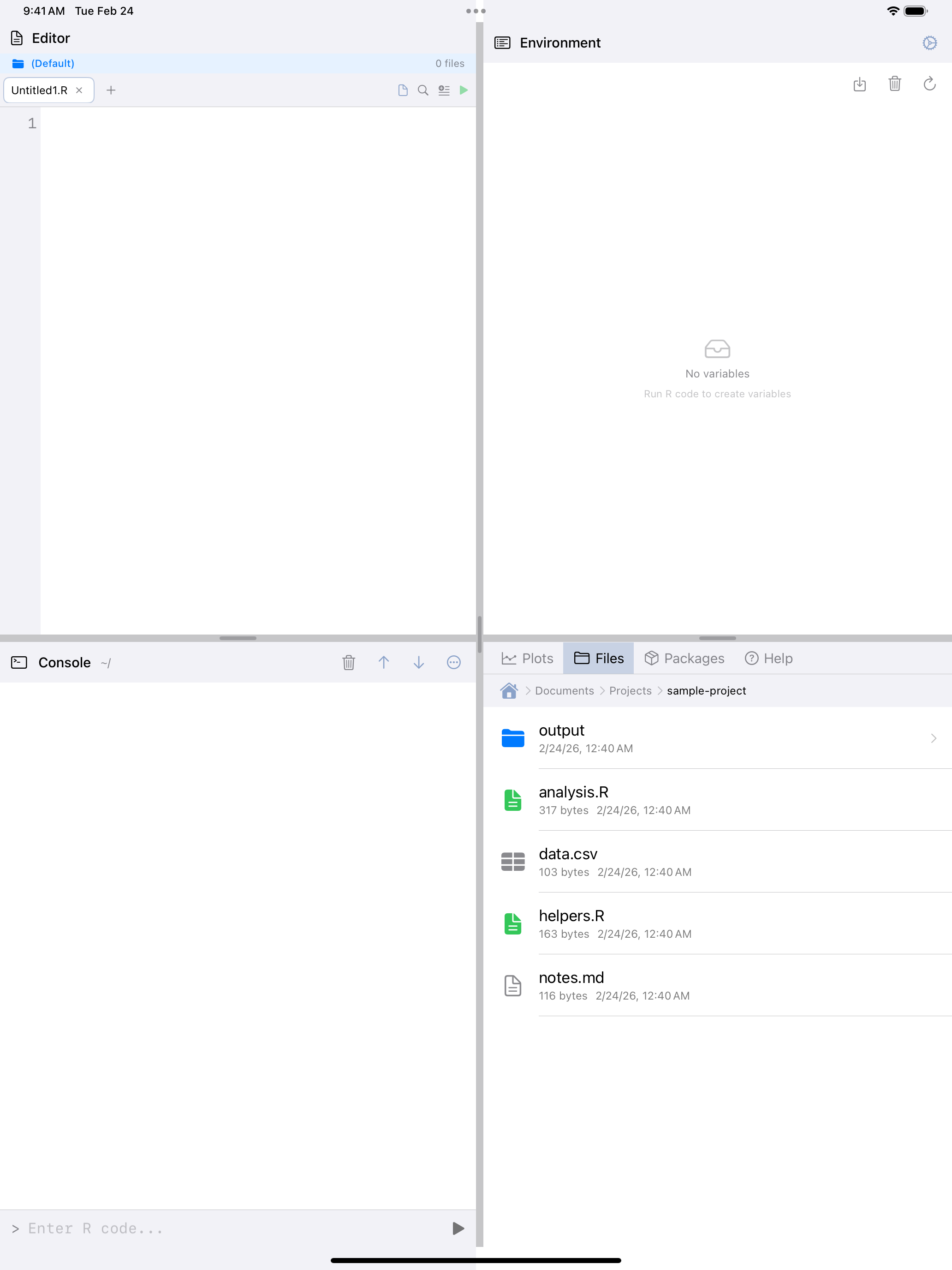
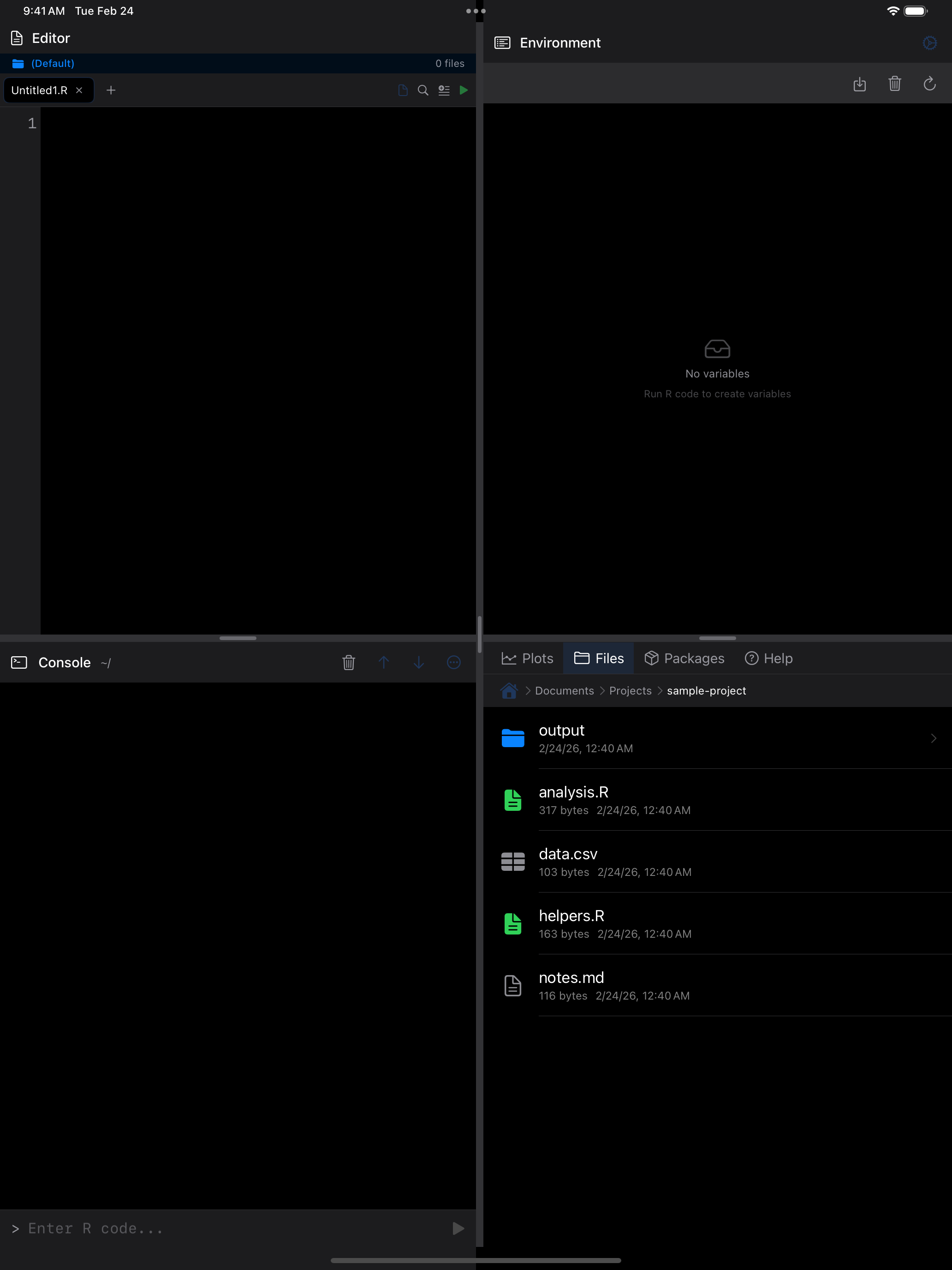
Each file row shows the file name, its size, and when it was last modified. R scripts (.R files) get a green icon so they are easy to spot, while folders are blue and other file types are gray.
Projects
Your files are organized into projects inside the Documents/Projects/ folder. When you first launch webRios, a (Default) project is created automatically. This is where your files live unless you create additional projects.
To create a new project, switch to the Projects tab and tap the + button. Each project gets its own folder on disk, keeping scripts and data files neatly separated. You can switch between projects at any time and the Editor tab will show the active project name in its header.
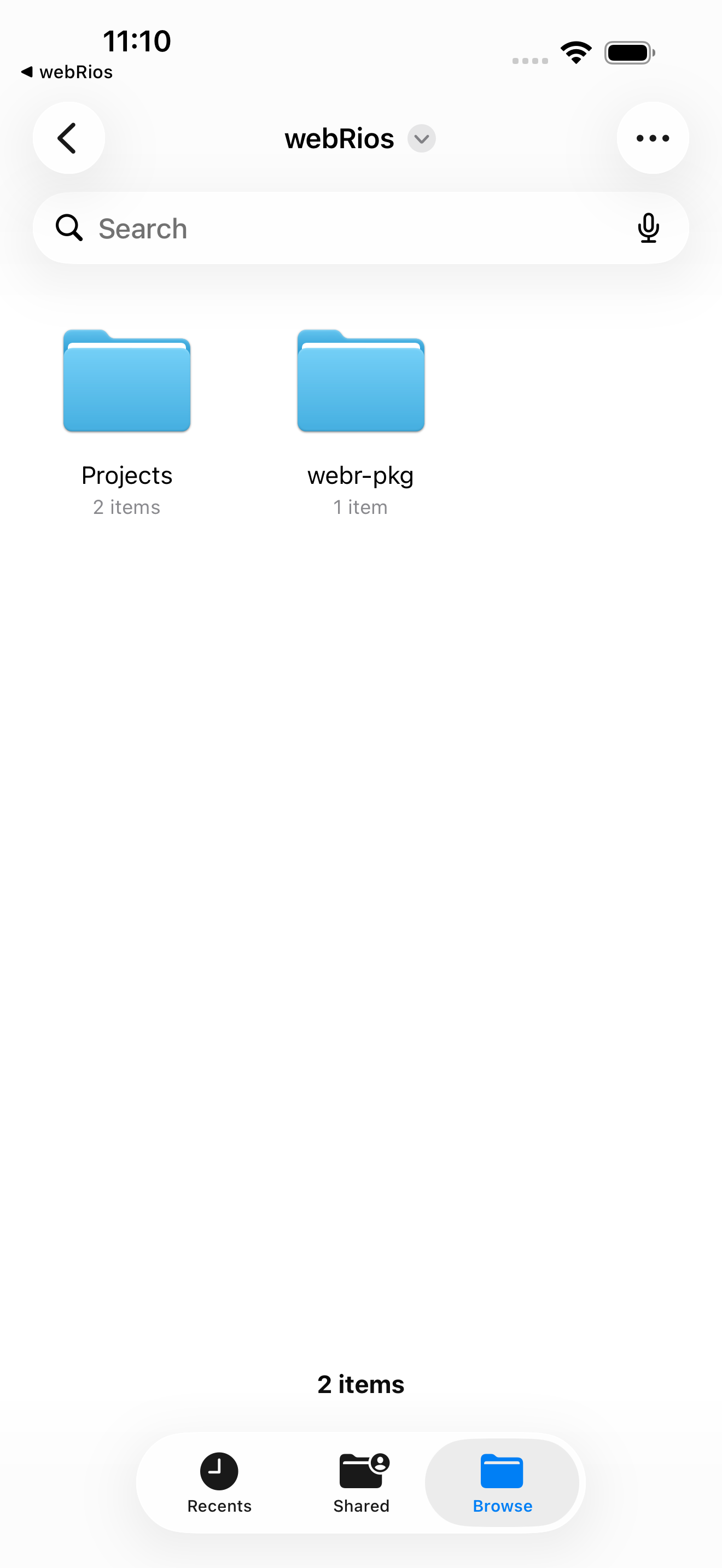
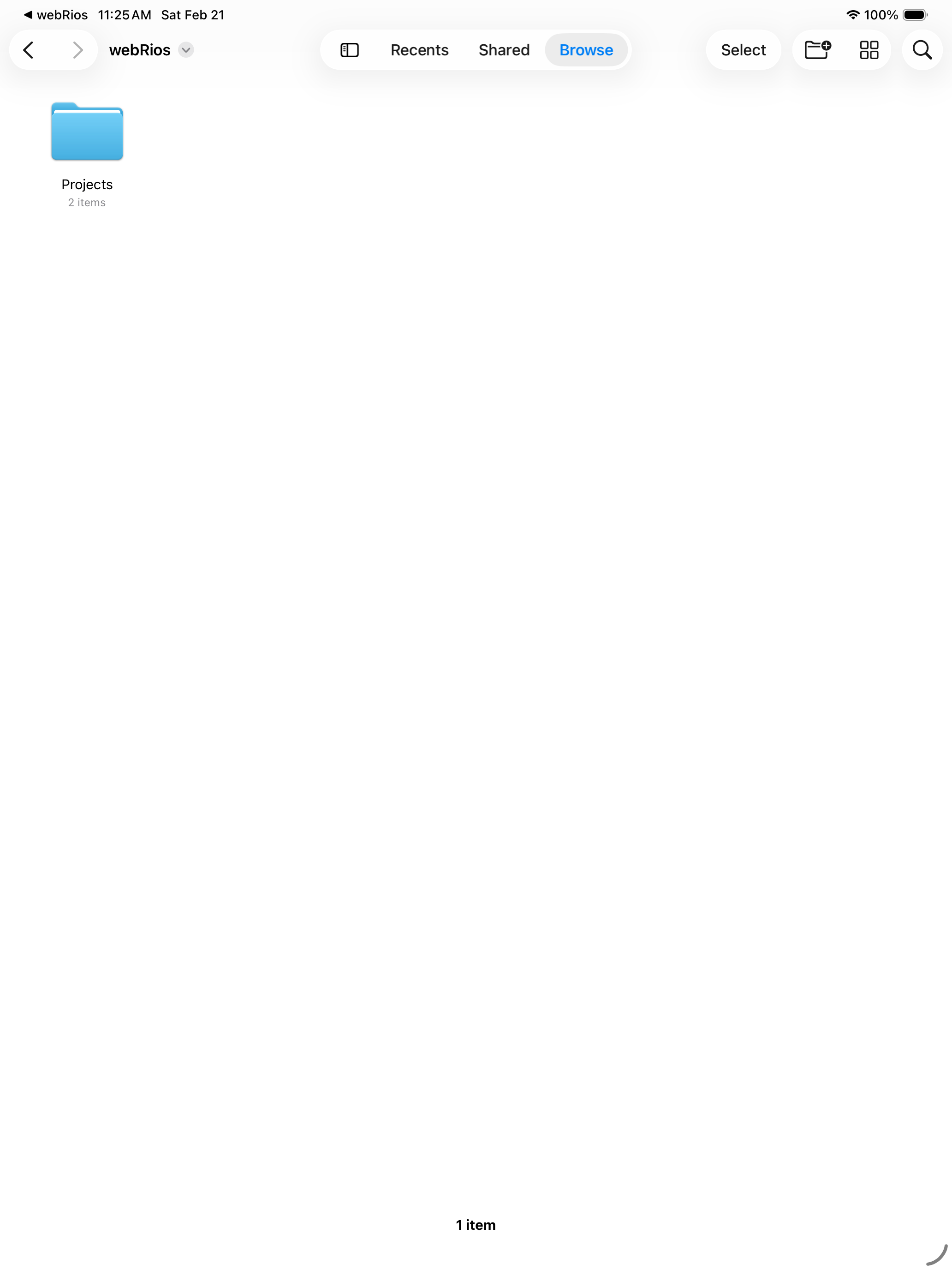
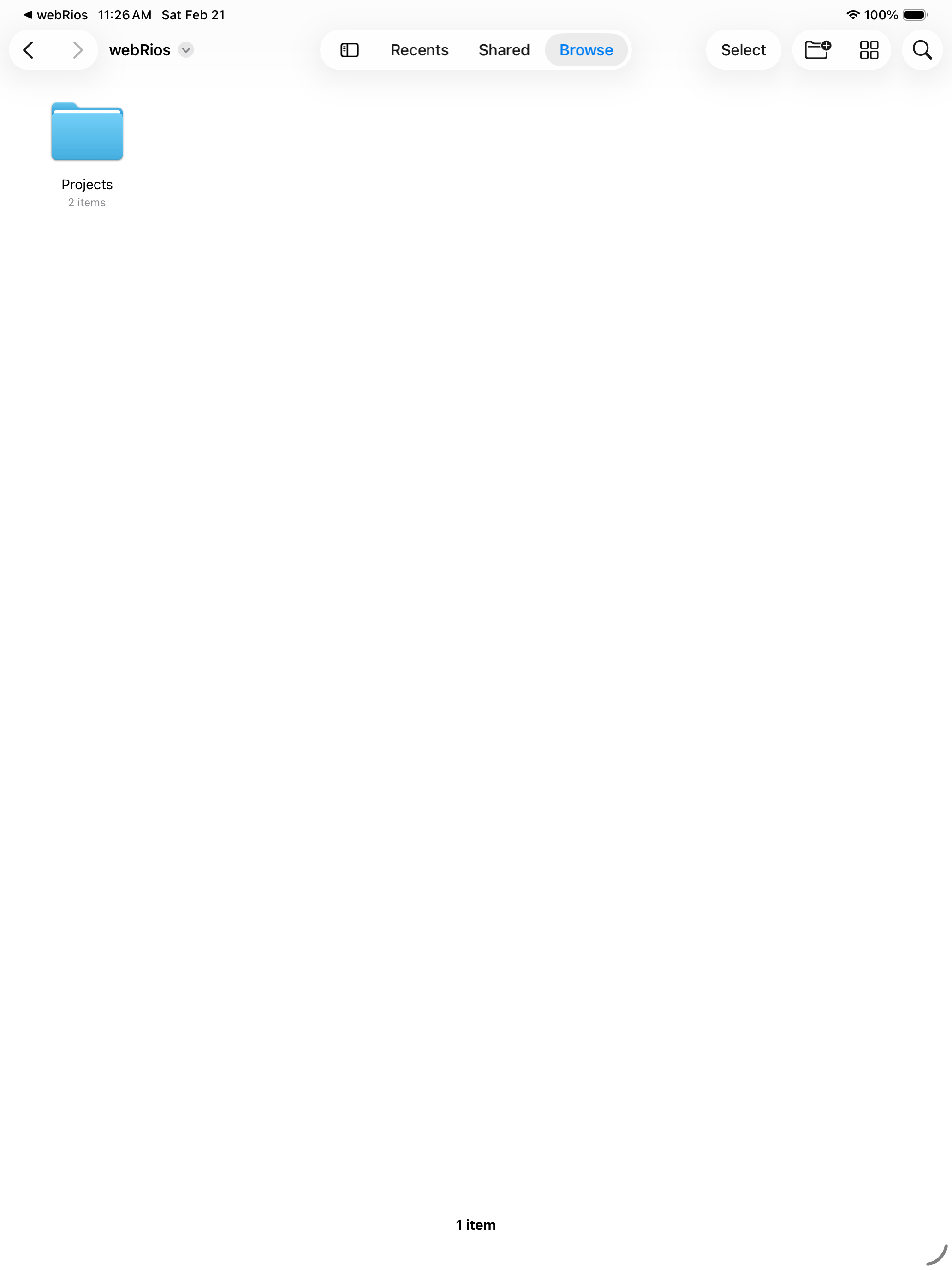
Because projects are stored in your app’s Documents container, they are also visible in the iOS Files app under On My iPhone (or On My iPad) > webRios. This means you can use Files to copy data into a project folder, share scripts with AirDrop, or back up your work to iCloud Drive.
Creating files and folders
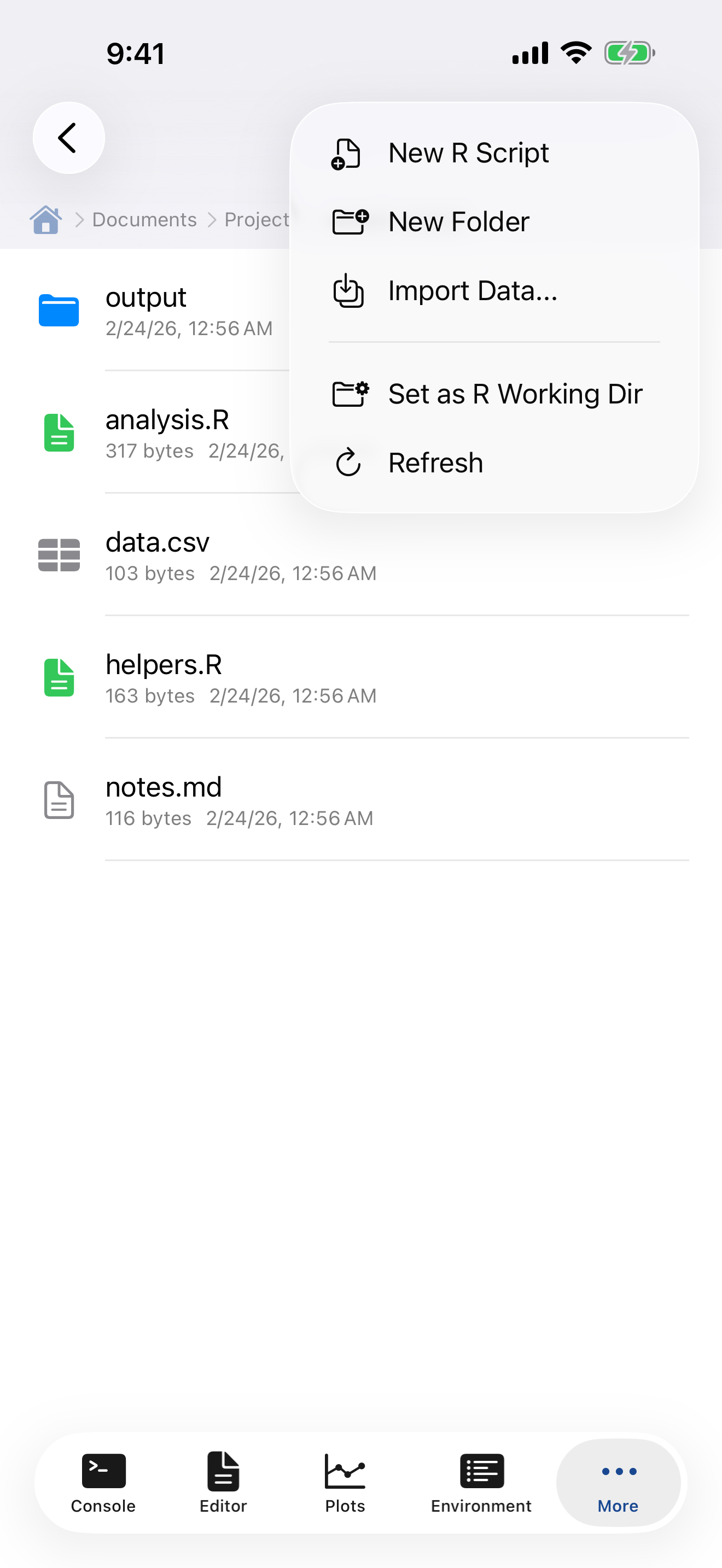
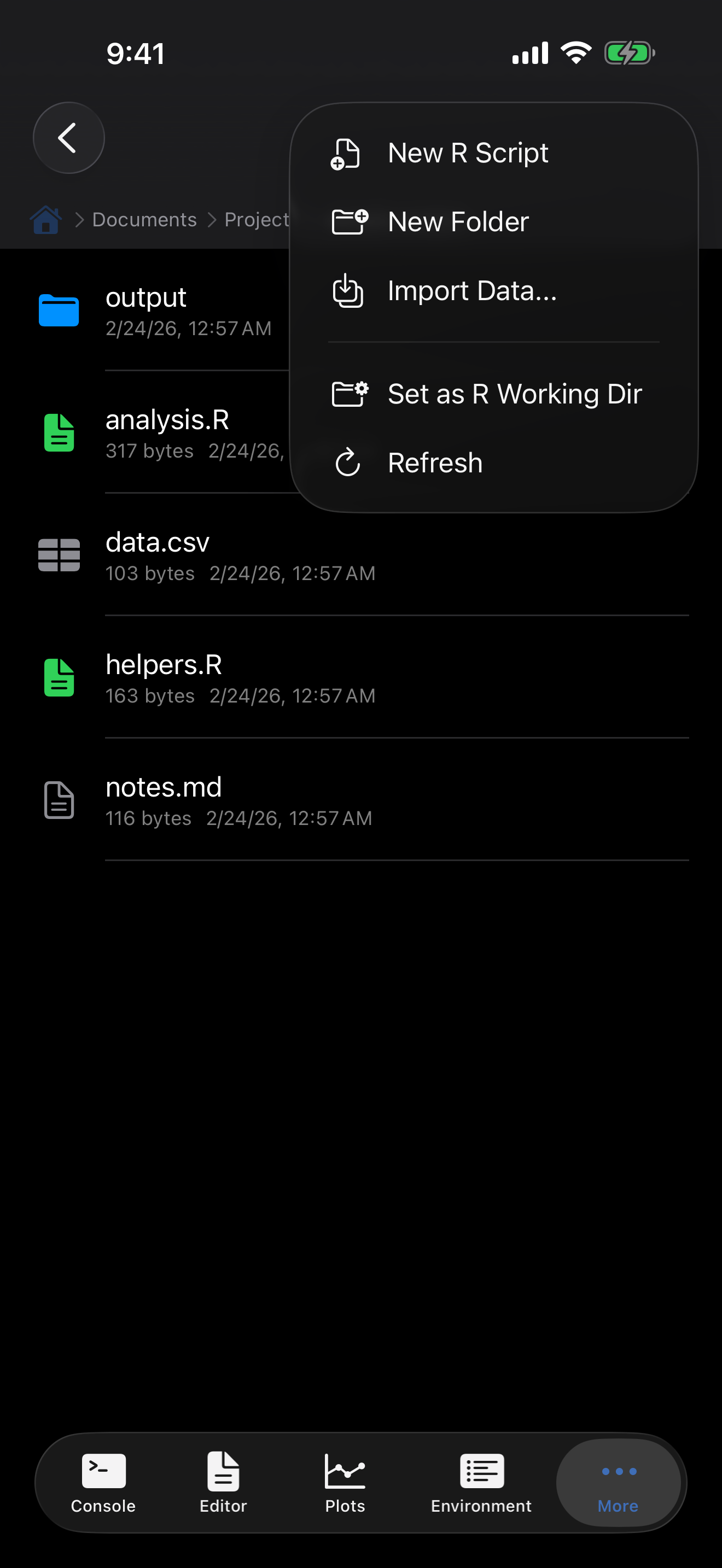
Tap the menu button (...) in the top-right corner to see your options:
- New R Script: creates a new
.Rfile in the current folder. You will be asked to name it, and the.Rextension is added automatically if you leave it off. - New Folder: creates a subfolder to help keep things organized.
- Import Data: opens the data import wizard, which can help you bring CSV files into your R environment.
Once you create a new script, it opens in the built-in editor right away so you can start writing code.
Data Import Wizard
The Import Data option in the create menu opens a guided wizard that walks you through importing a data file into your R session. It supports CSV, TSV, and JSON files.
Step 1: Select a file
Choose Browse Files to pick a file from your device, or Load Sample Data to try the wizard with a built-in dataset. Once loaded, you will see the detected format, row count, and a raw preview of the file contents.
Step 2: Configure parsing options
For CSV and TSV files, you can adjust how the data is parsed:
| Option | Choices | Description |
|---|---|---|
| Name | (text field) | The R variable name for the imported data. Must be a valid R identifier. |
| Heading | Yes / No | Whether the first row contains column names. |
| Separator | Comma, Semicolon, Tab, Pipe | The delimiter between fields. |
| Decimal Mark | Period, Comma | How decimal numbers are written (varies by locale). |
| Quote Character | Double, Single, None | Character used to quote text fields. |
| Comment Character | None, #, %, ! |
Lines starting with this character are skipped. |
| na.strings | (text field) | Text that should be treated as NA. |
| Strings as factors | On / Off | Whether text columns become factors instead of character vectors. |
A live data preview updates as you change settings, so you can confirm the parsing looks right before importing.
For JSON files, only the variable name is configurable (the file must contain an array of objects).
Step 3: Review
See the final data preview along with the exact read.csv() or fromJSON() R code that will be executed. The generated code is displayed in a monospaced box and is copyable if you want to use it in your own scripts.
Step 4: Import
Tap Import and the wizard runs the generated R code. On success, you can tap View Data to open the result directly in the Data Frame Viewer.
The Data Import Wizard generates standard R code behind the scenes. If you need more control (like read.csv2() or custom readr functions), you can always import data manually from the Console.
Editing text files
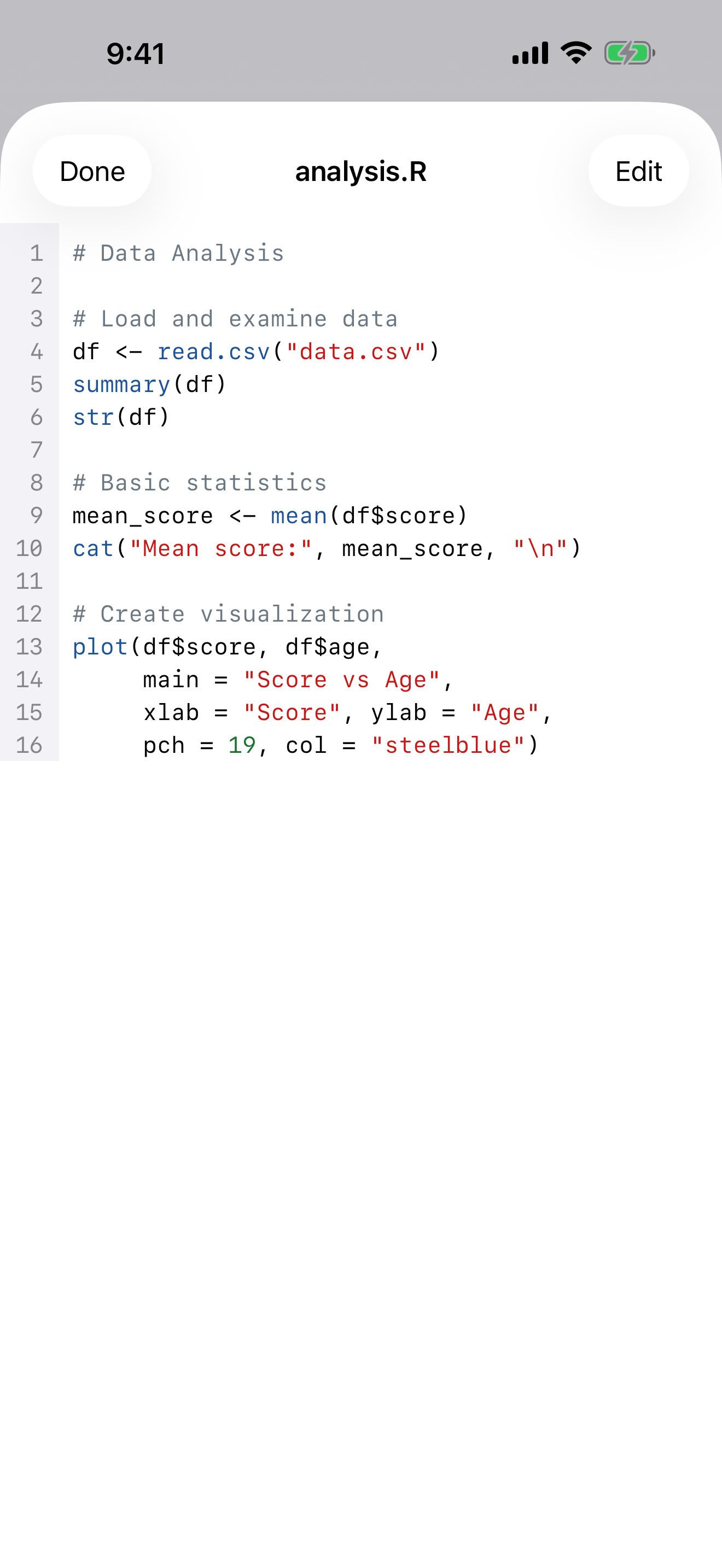
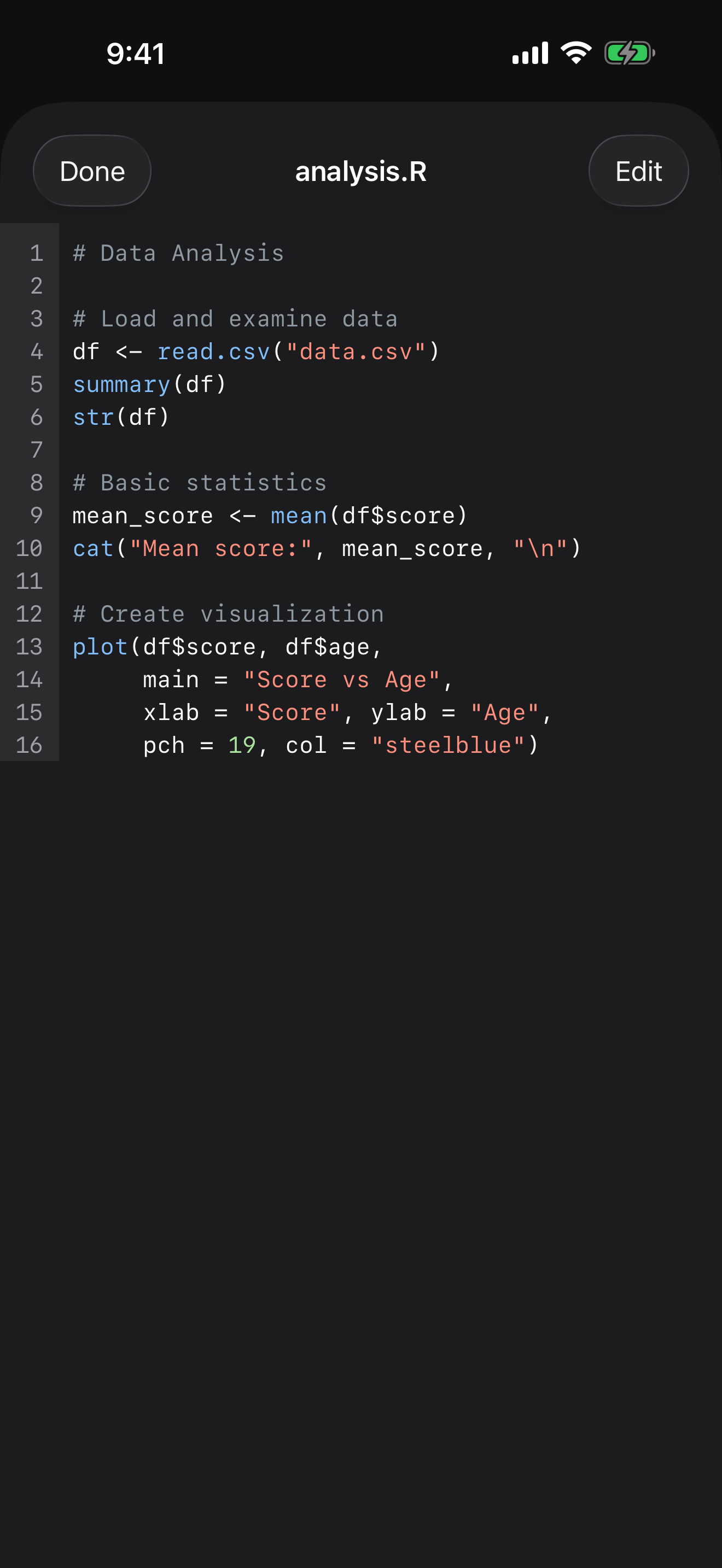
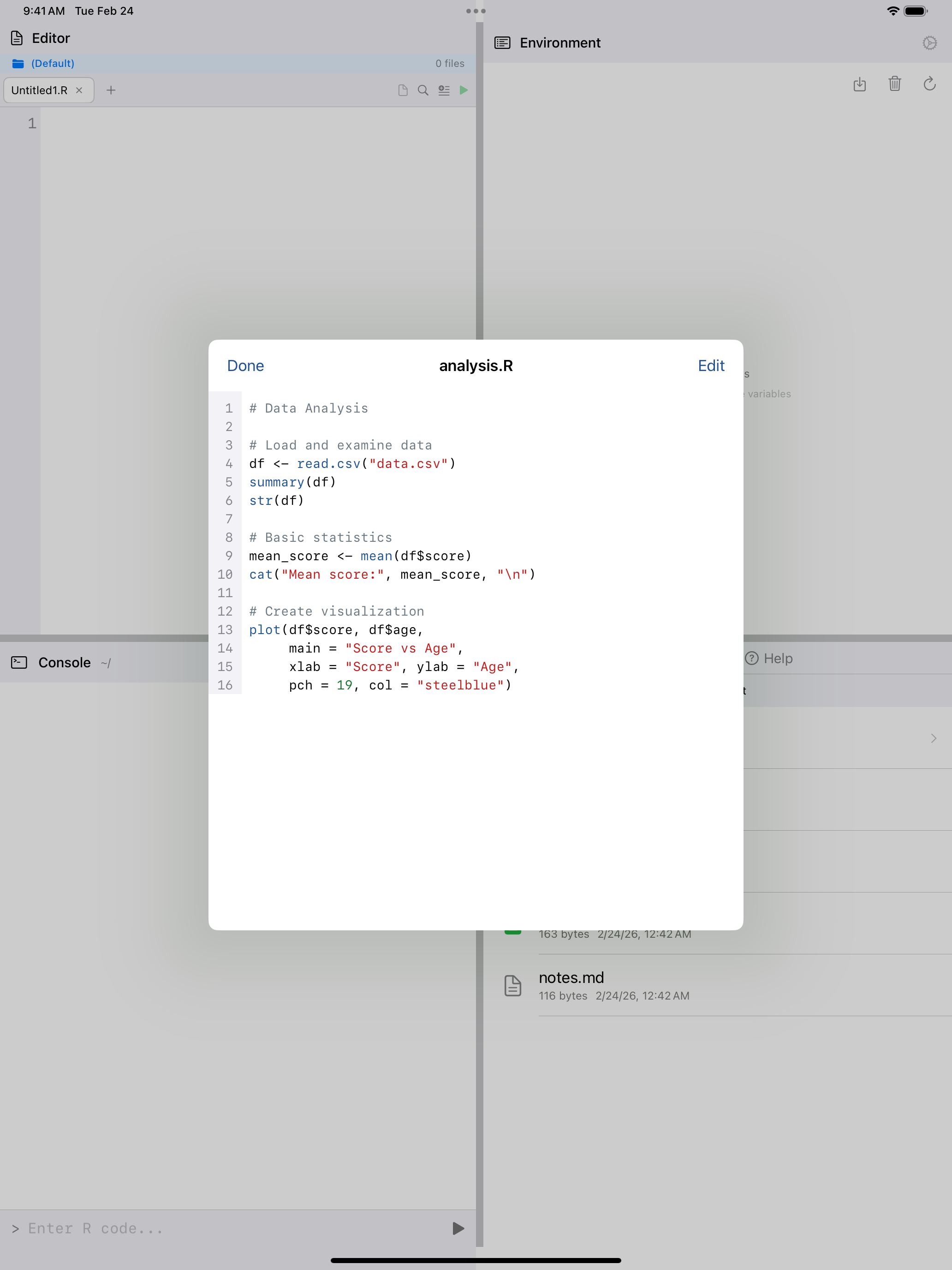
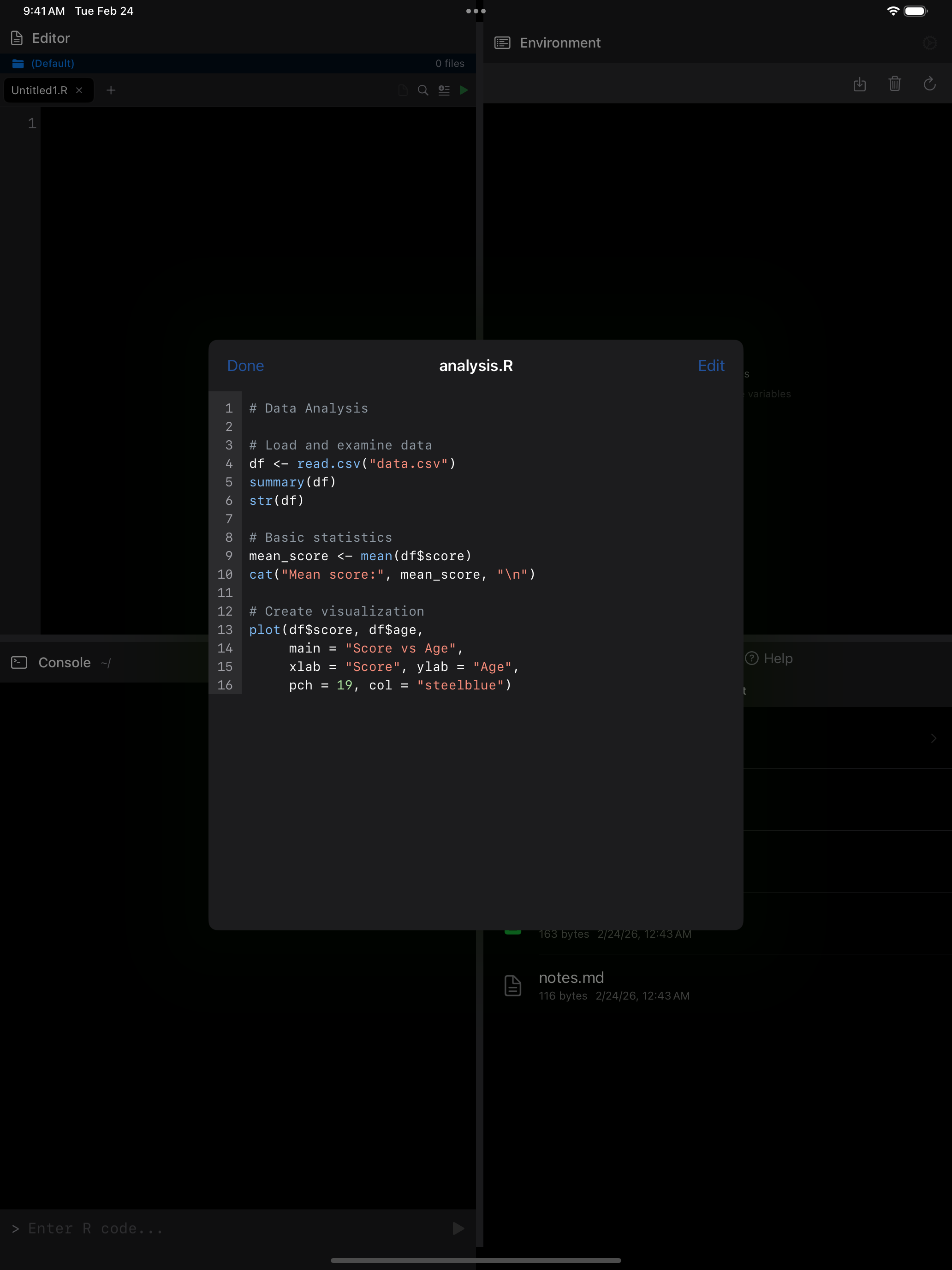
Tap any text-based file (.R, .txt, .csv, .json, .md) to open it in the file viewer. You will see the contents with line numbers and, for R files, syntax highlighting.
To make changes, tap the Edit button in the top-right corner. This switches to an editable text field where you can type freely. When you are done, tap Save to write your changes, or Cancel to discard them.
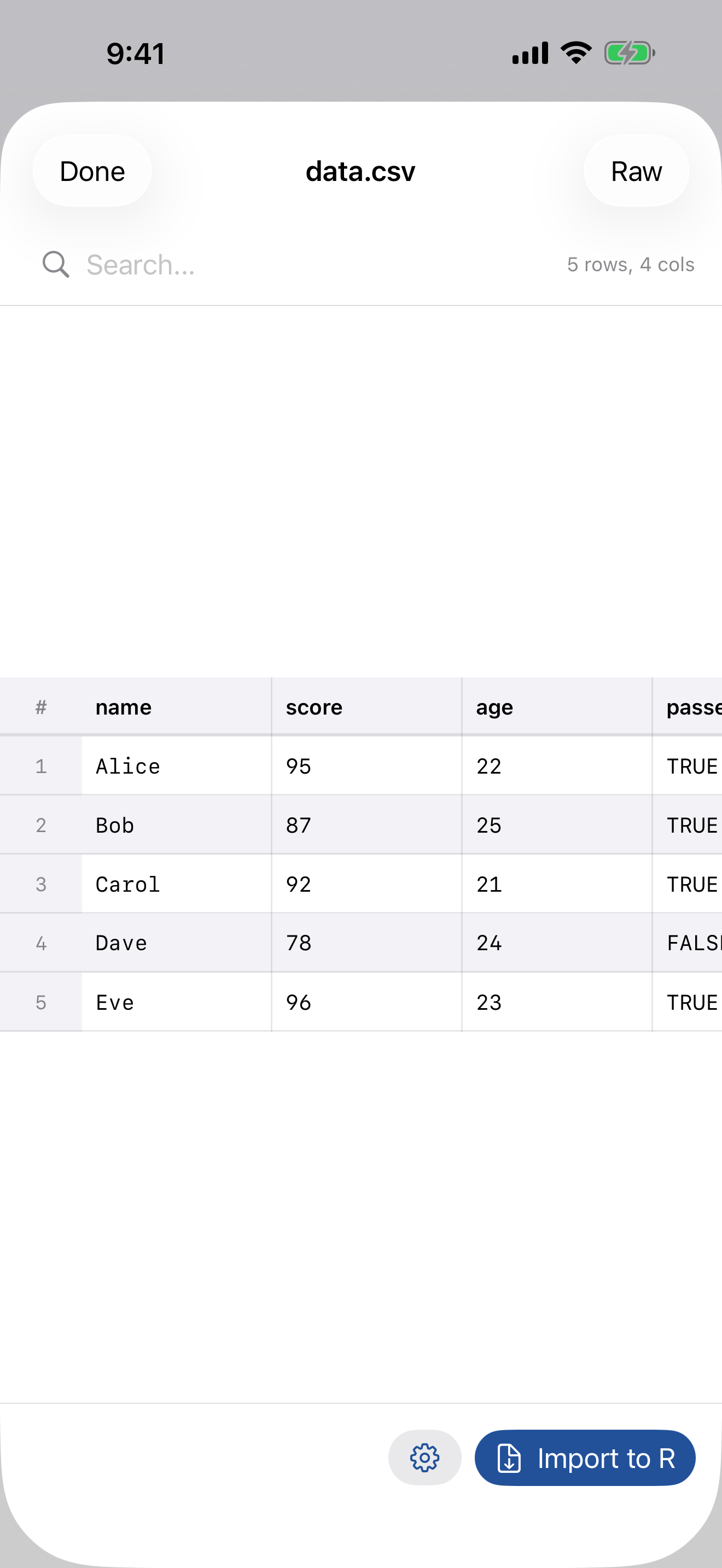
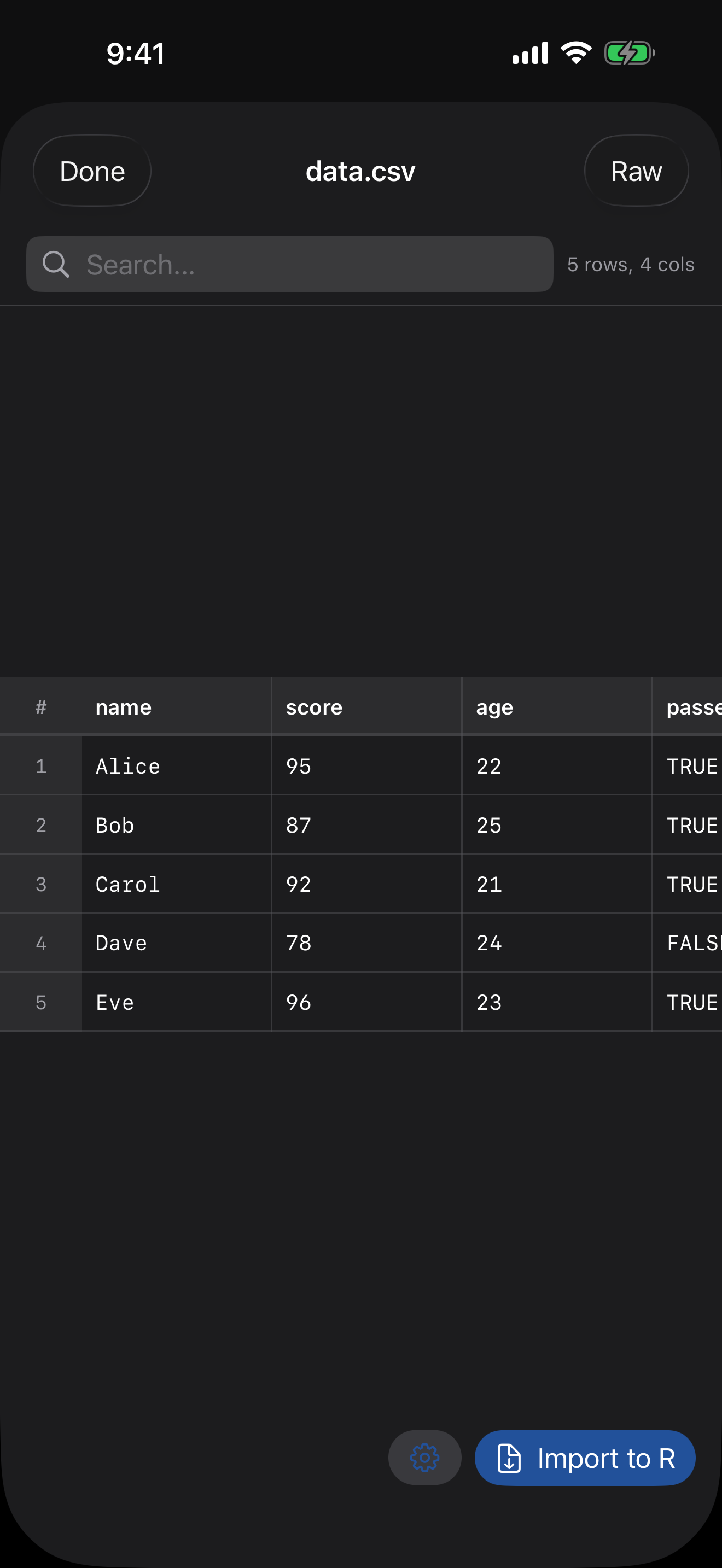
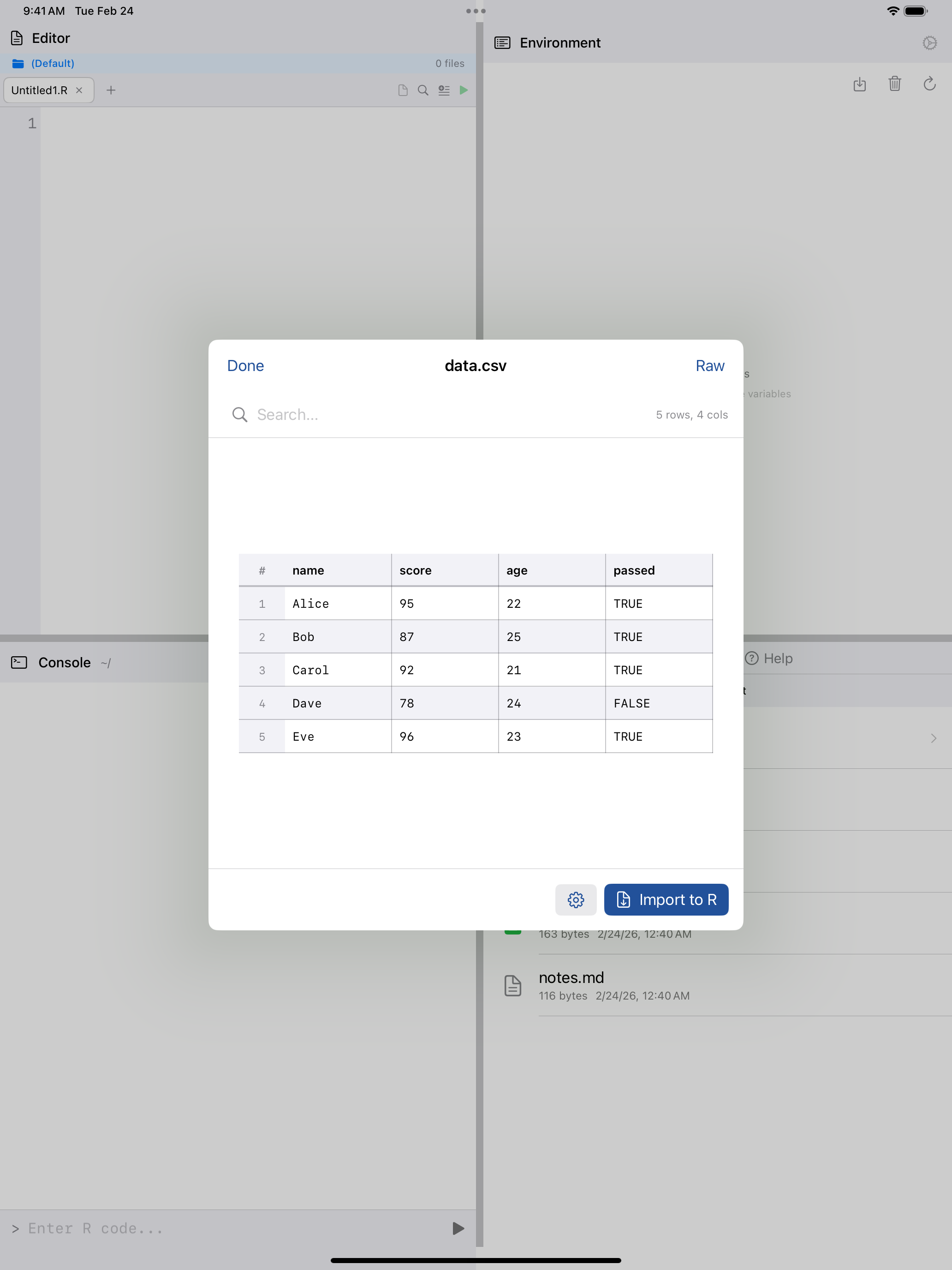
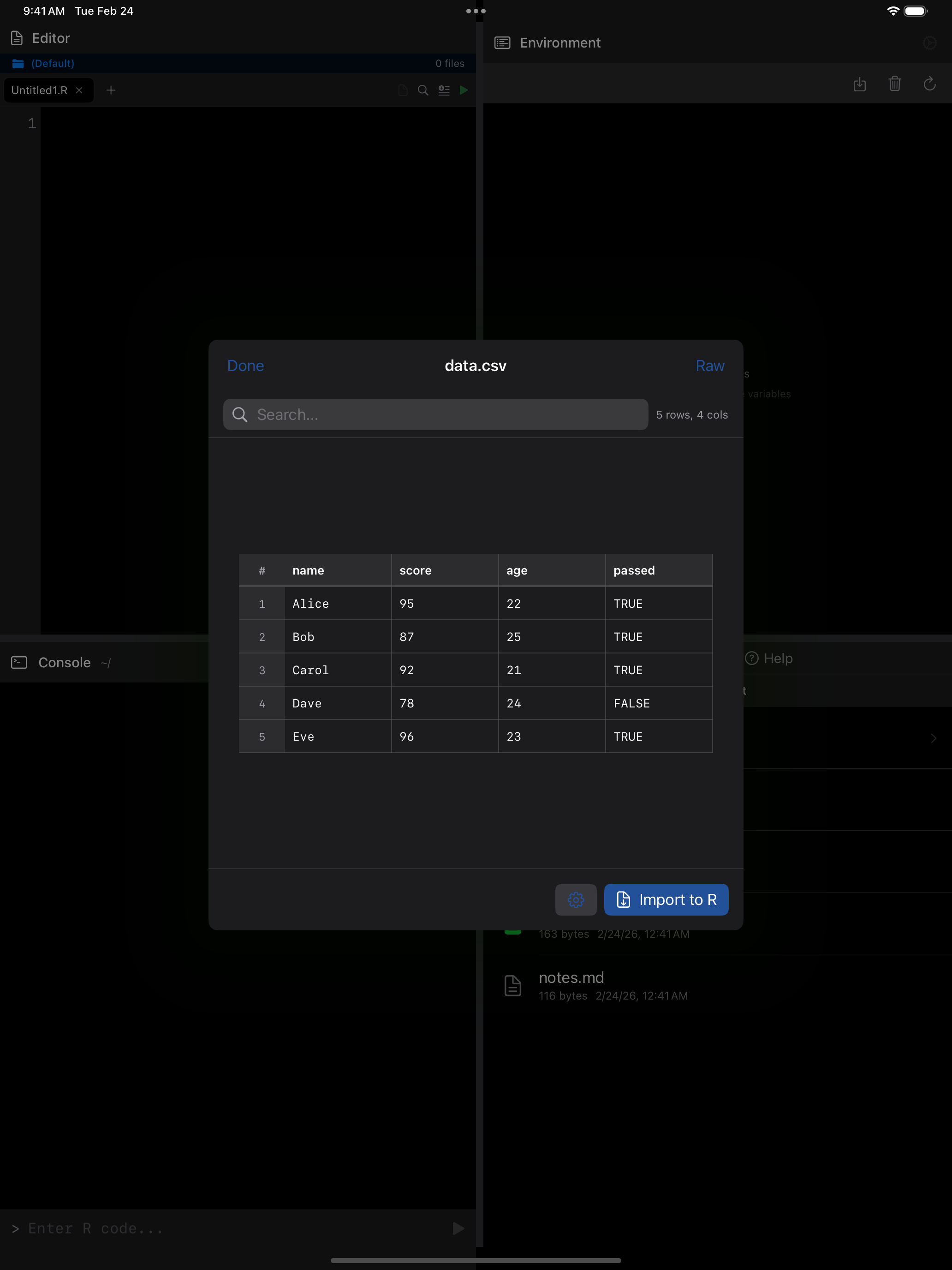
CSV files get special treatment: they open in a formatted table view by default, making it easy to scan rows and columns. You can switch to the raw text view using the Raw button, and toggle back with Table.
Image files (PNG, JPEG) open in a scrollable preview so you can view plots or graphics you have saved.
Renaming and deleting
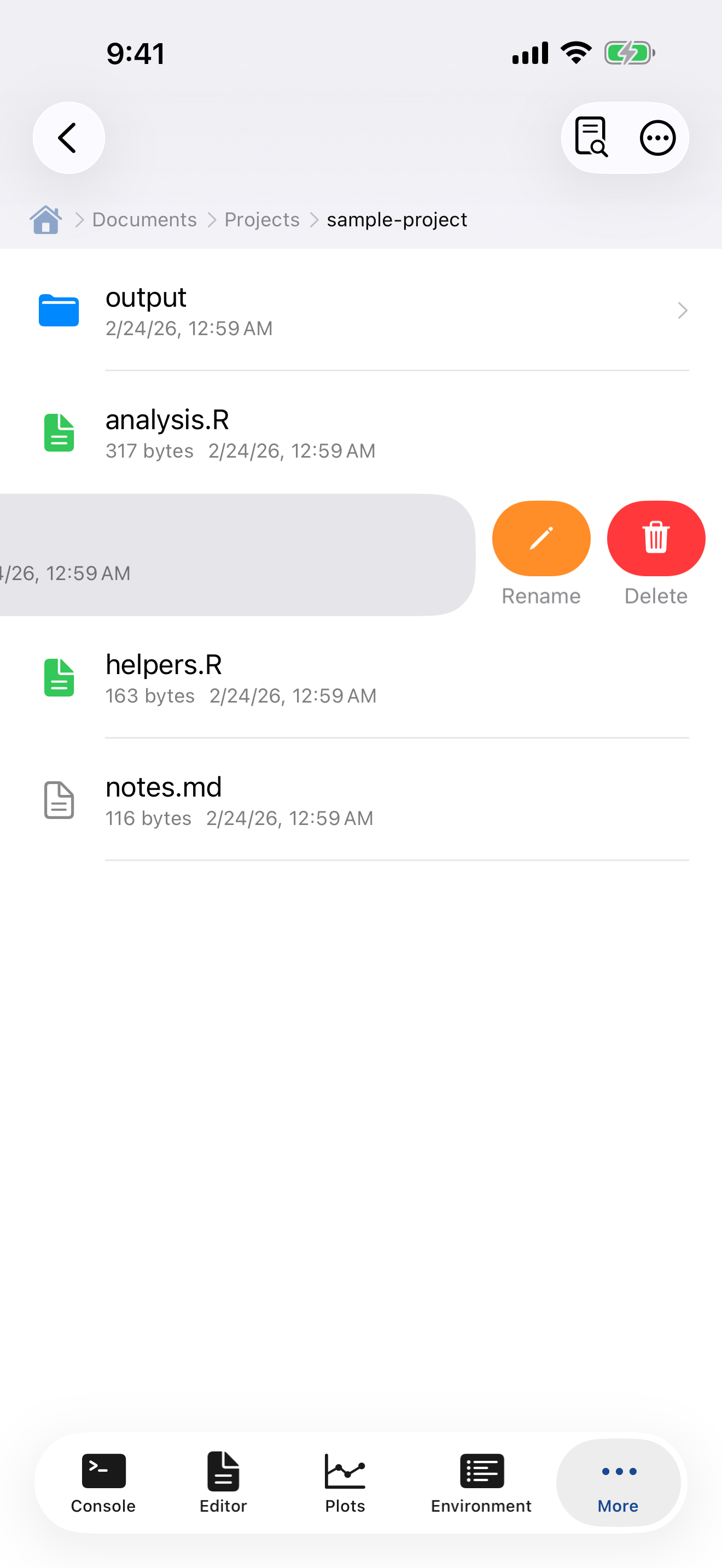
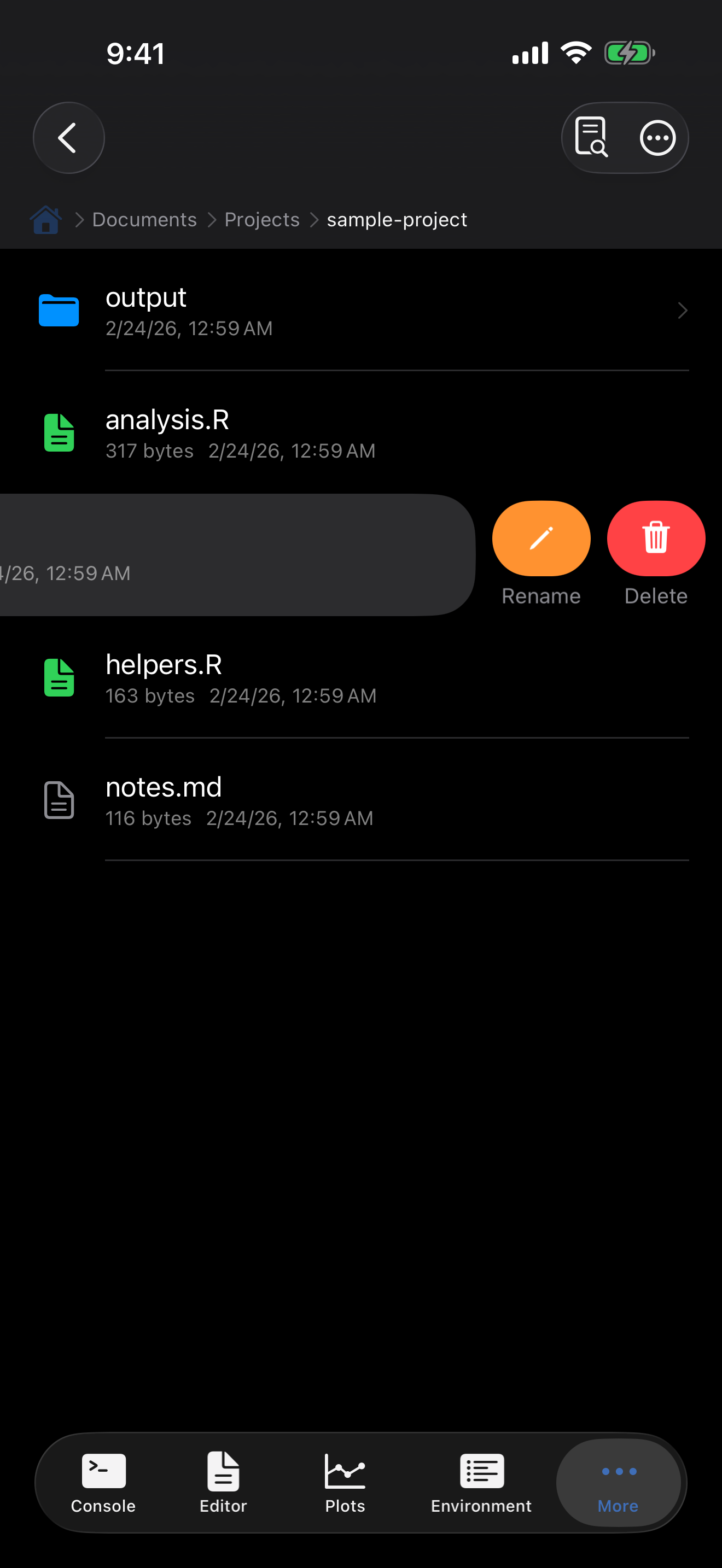
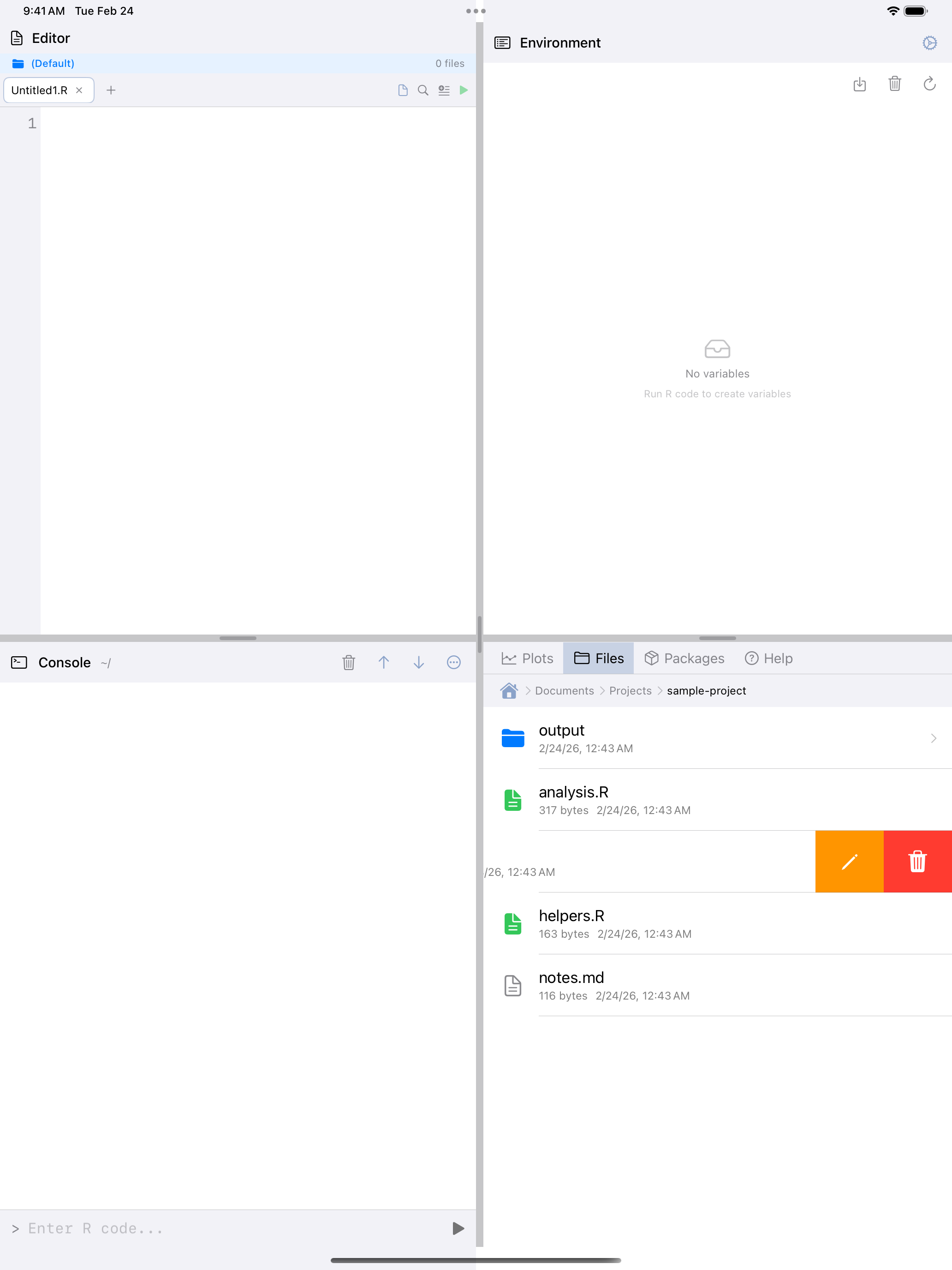
You can manage files with swipe gestures, just like in other iOS apps:
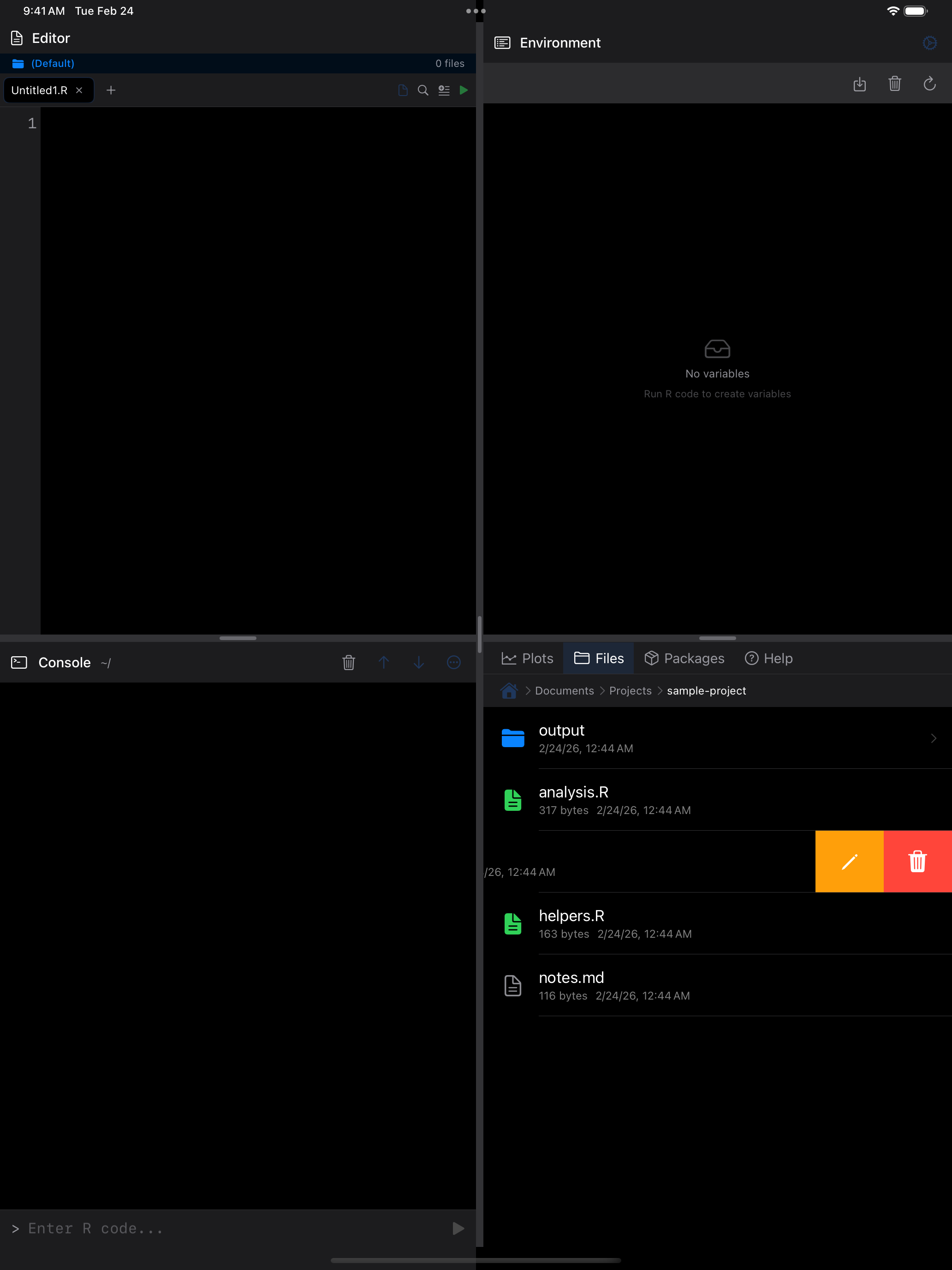
- Swipe left on a file or folder to see the Delete (red) and Rename (orange) buttons.
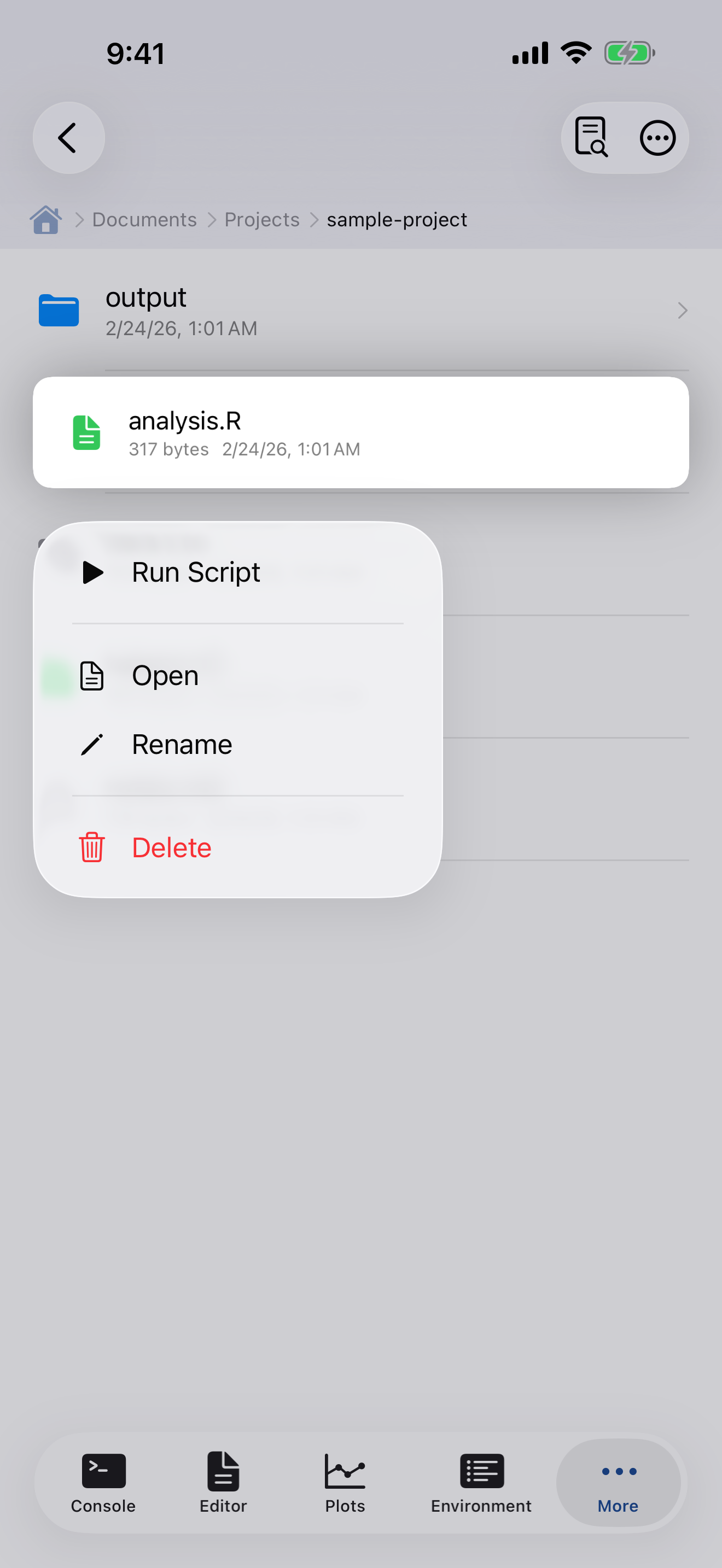
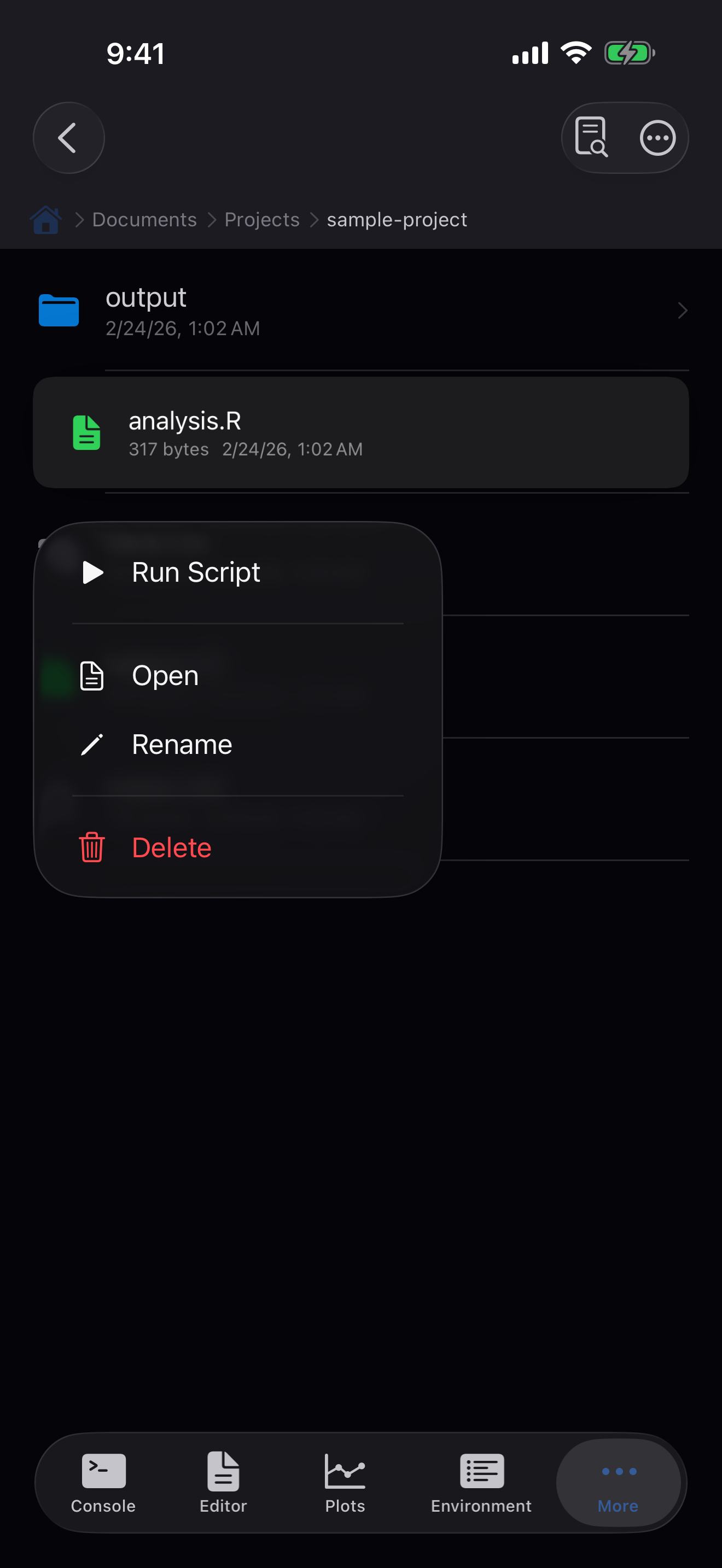
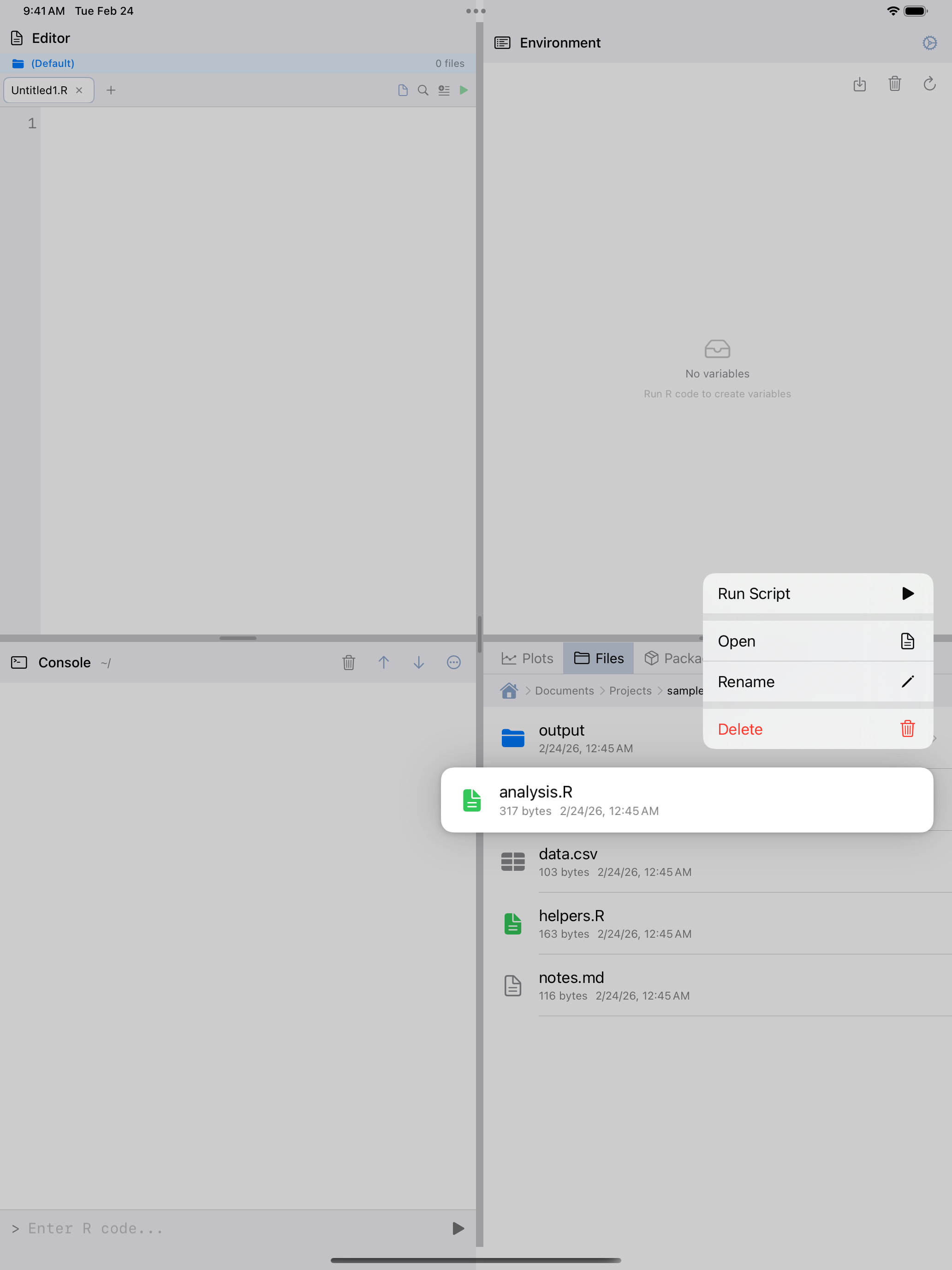
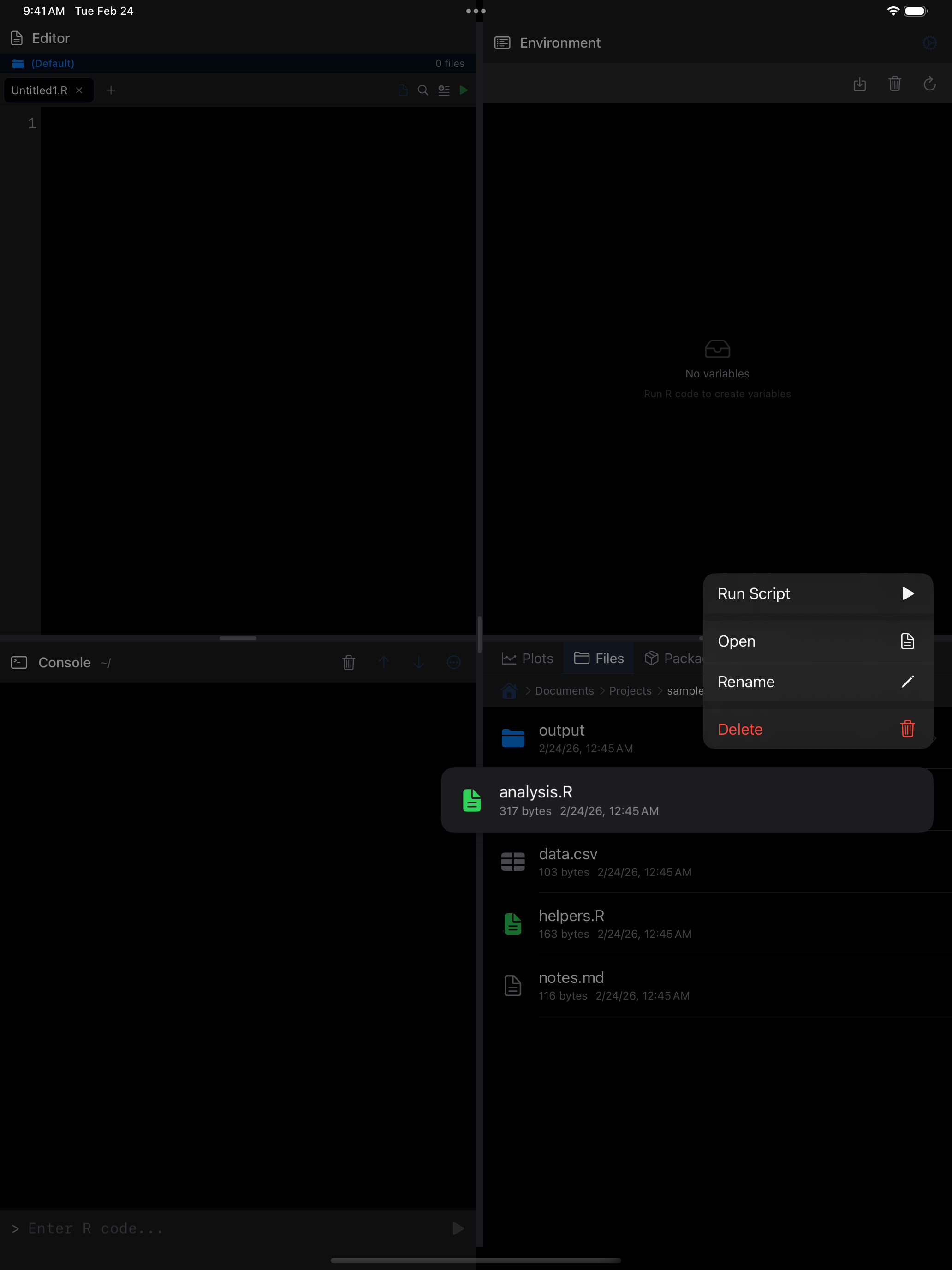
- Long-press a file for a context menu with the same options, plus the ability to Run Script for R files.
Deleting is permanent. You will get a confirmation prompt, but there is no trash or undo after that.
Searching for files
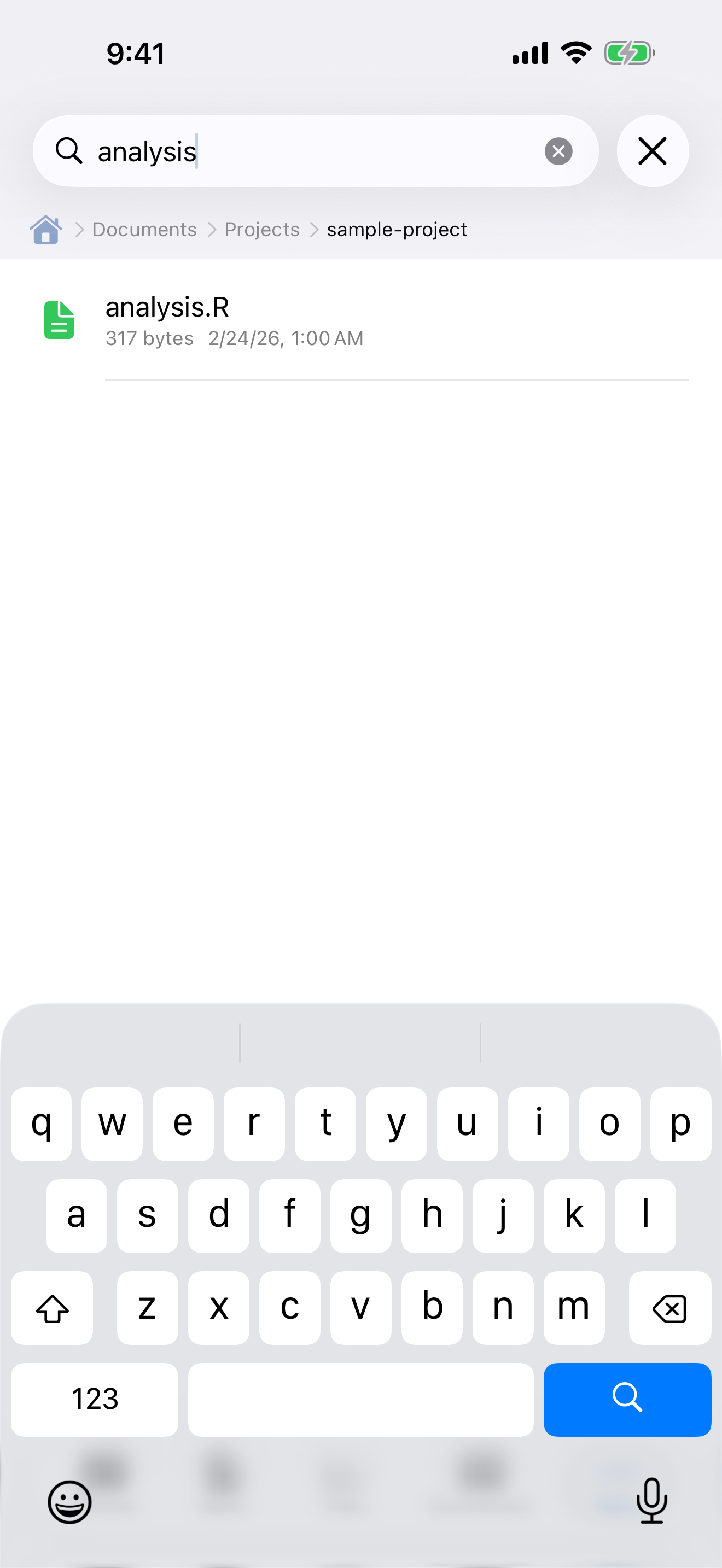
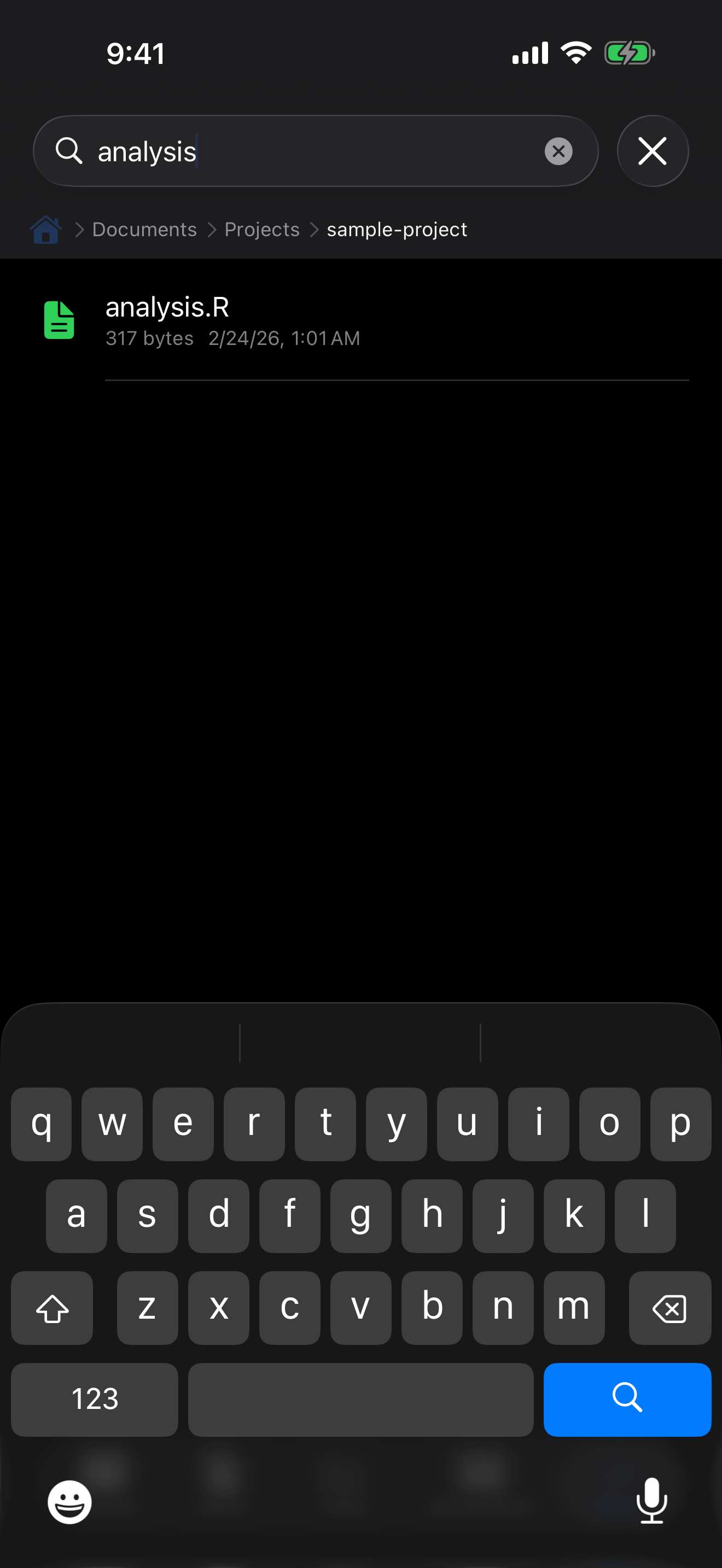
Use the search bar at the top of the file list to filter by file name. This searches within the current folder, narrowing the list as you type.
For deeper searches, tap the magnifying glass icon in the toolbar to open Search in Files. This lets you search for text inside your files across all folders, which is useful when you cannot remember which script contains that function you wrote last week.
Running R scripts
There are two ways to run an R script directly from the Files tab:
- Long-press the file and choose Run Script from the context menu.
- Open the file, then use the Editor’s run functionality.
When you run a script this way, the code is sent to the R console and executed as if you had typed it line by line. Any output appears in the Console tab, and plots show up in the Plots tab.
Setting the R working directory
By default, R’s working directory might not match the folder you are browsing. If your script needs to read a data file using a relative path (like read.csv("data.csv")), you will want to set the working directory first.
Navigate to the folder that contains your data files, then tap the menu (...) and choose Set as R Working Dir. This runs setwd() behind the scenes so that R knows where to look for files.
Set the working directory before running scripts that read or write data files. This way your R code can use simple file names like "data.csv" instead of full paths.
Supported file types
The built-in editor can open and edit any text-based file. R scripts, plain text, CSV, JSON, and Markdown are all fair game. Image files open in a preview viewer. Other file types will show in the list but may not be viewable directly in the app.
Pull down on the file list to refresh if you have made changes outside the app (for example, through the iOS Files app).