Console
The Console is where you interact with R directly. Type a command, tap play, see the result. It is the quickest way to try ideas and explore data without writing a full script.
Your R Command Line
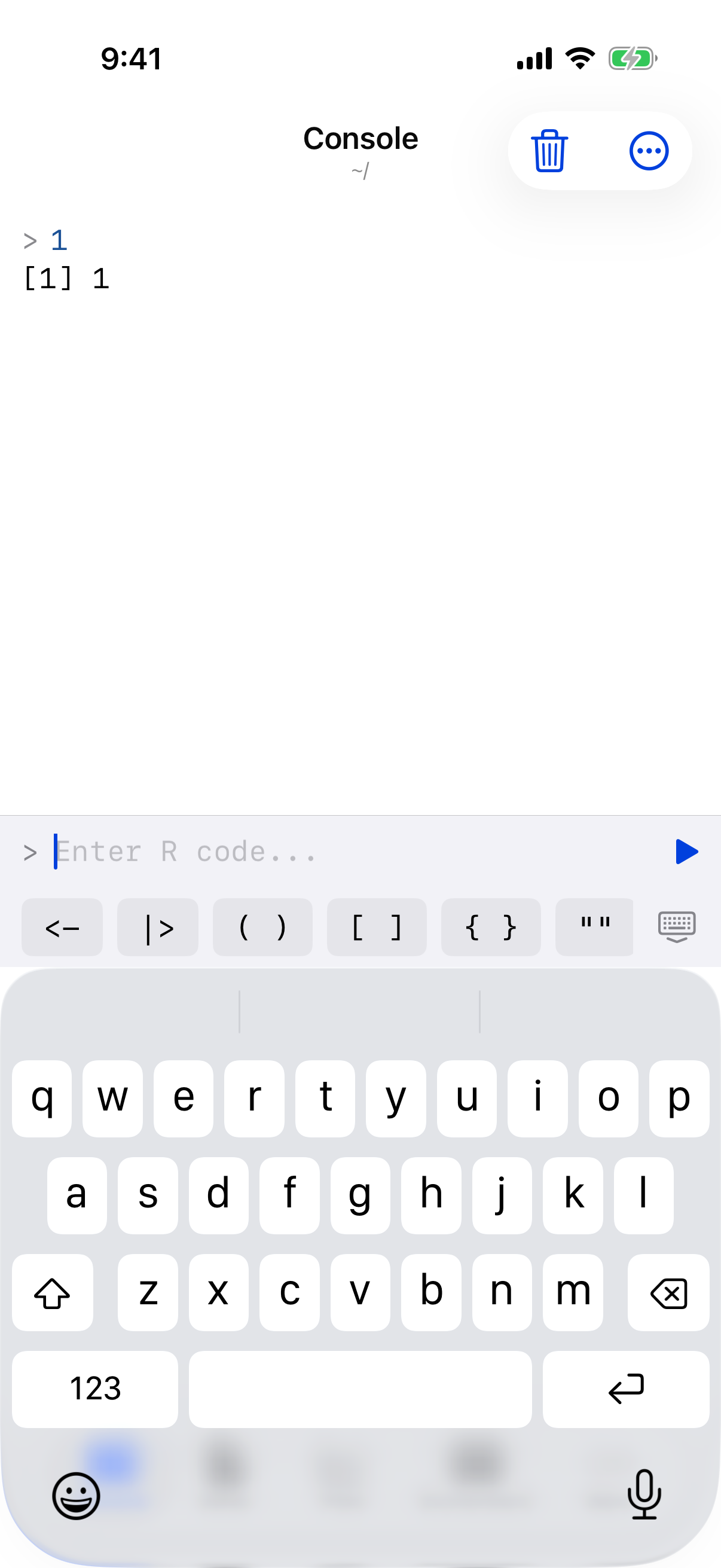
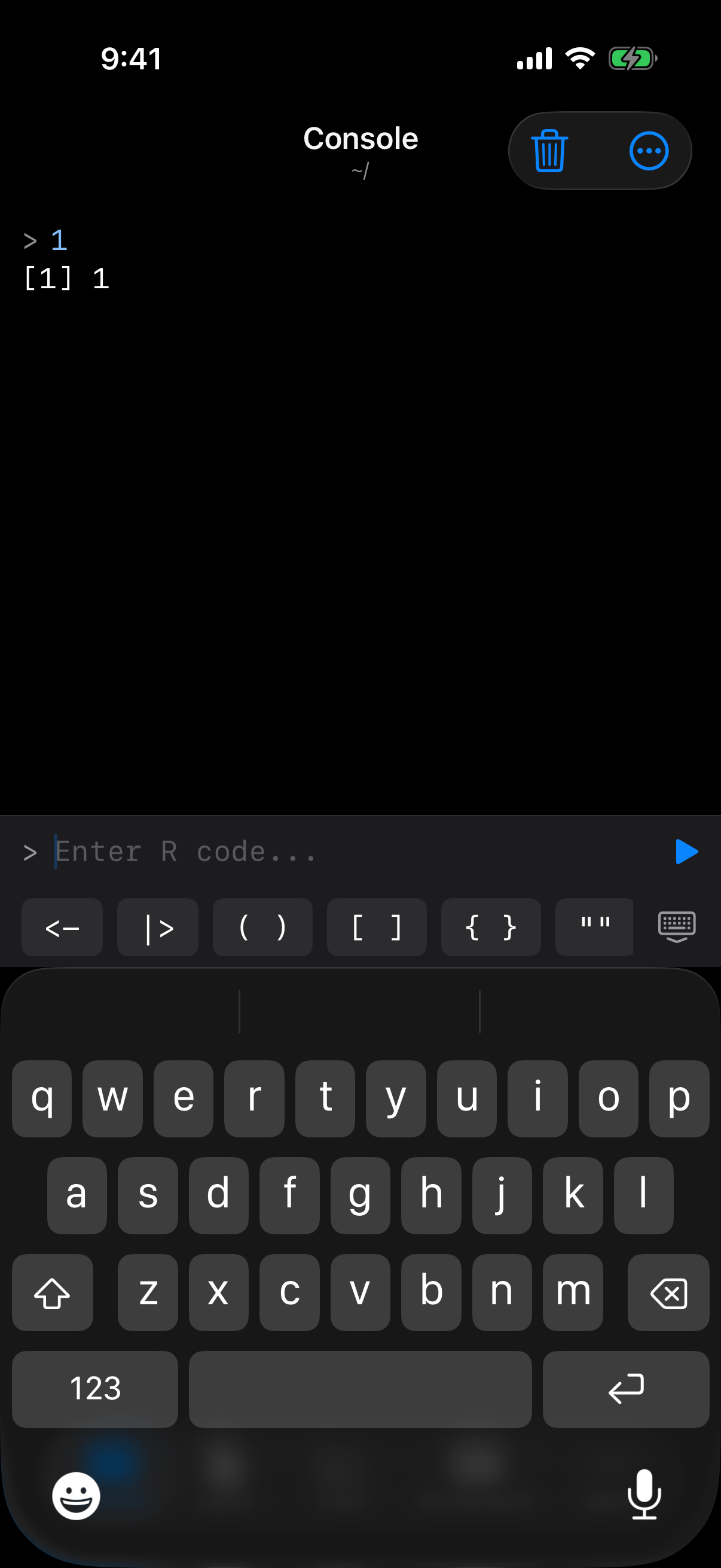
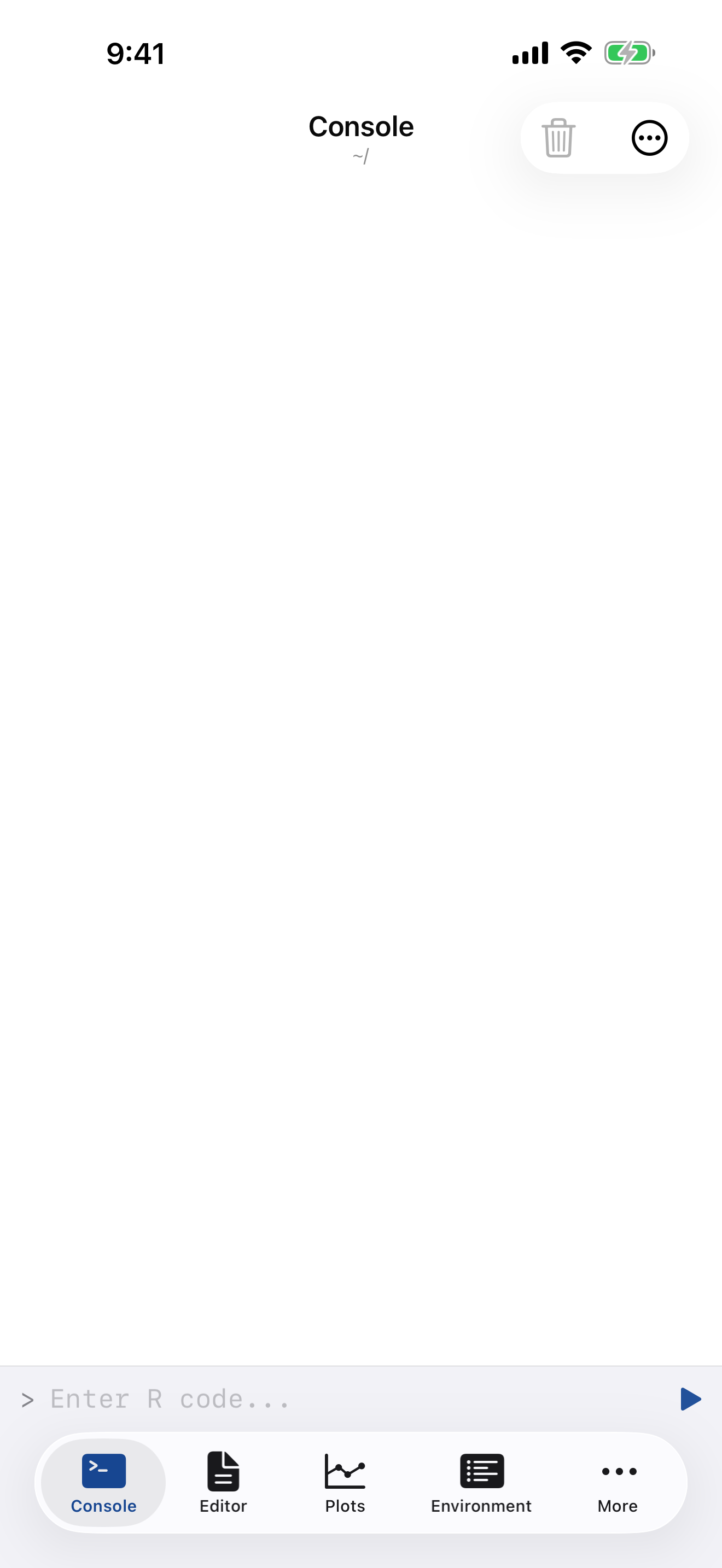
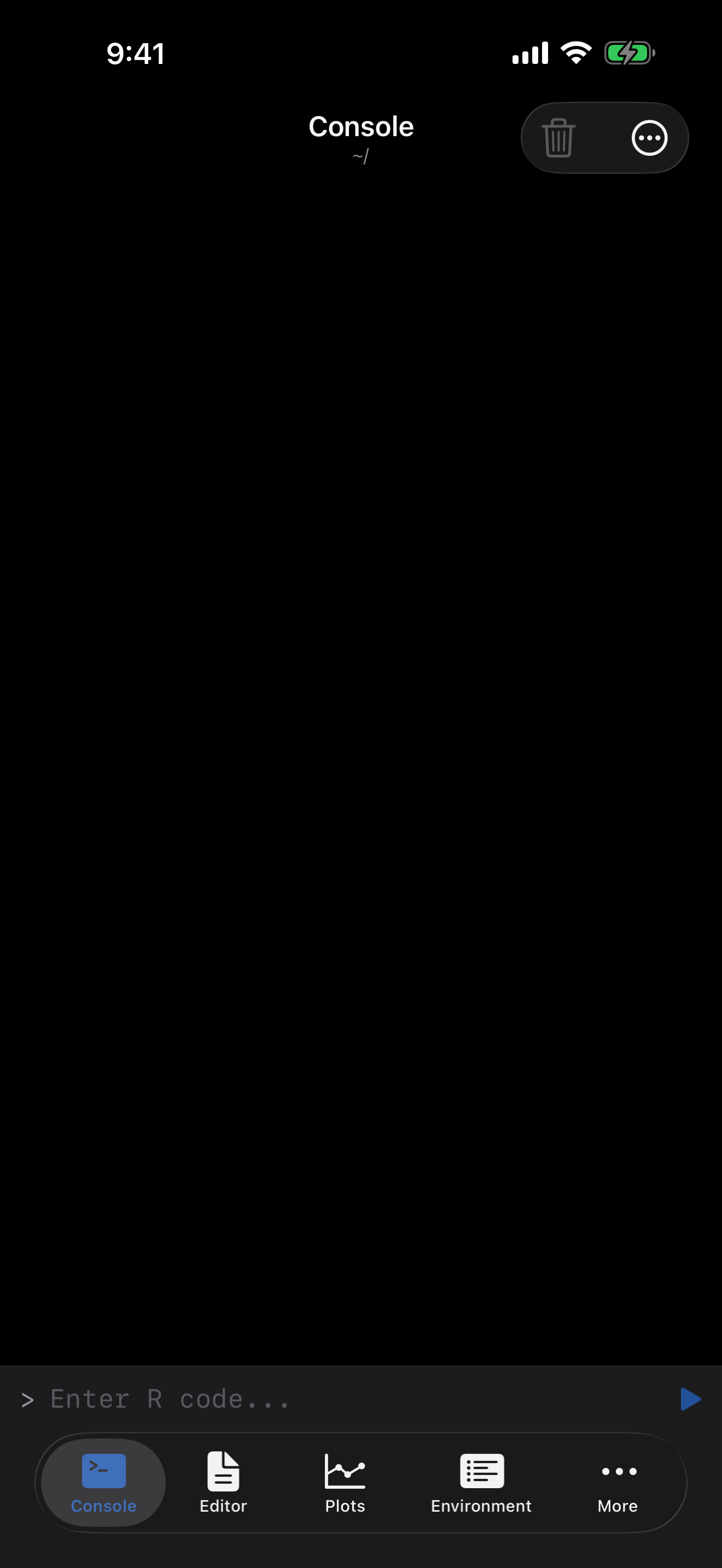
When webR finishes loading, you will see a prompt at the bottom of the screen waiting for input. Type any valid R expression, tap the play button (or press Return on an external keyboard), and the result appears immediately above.
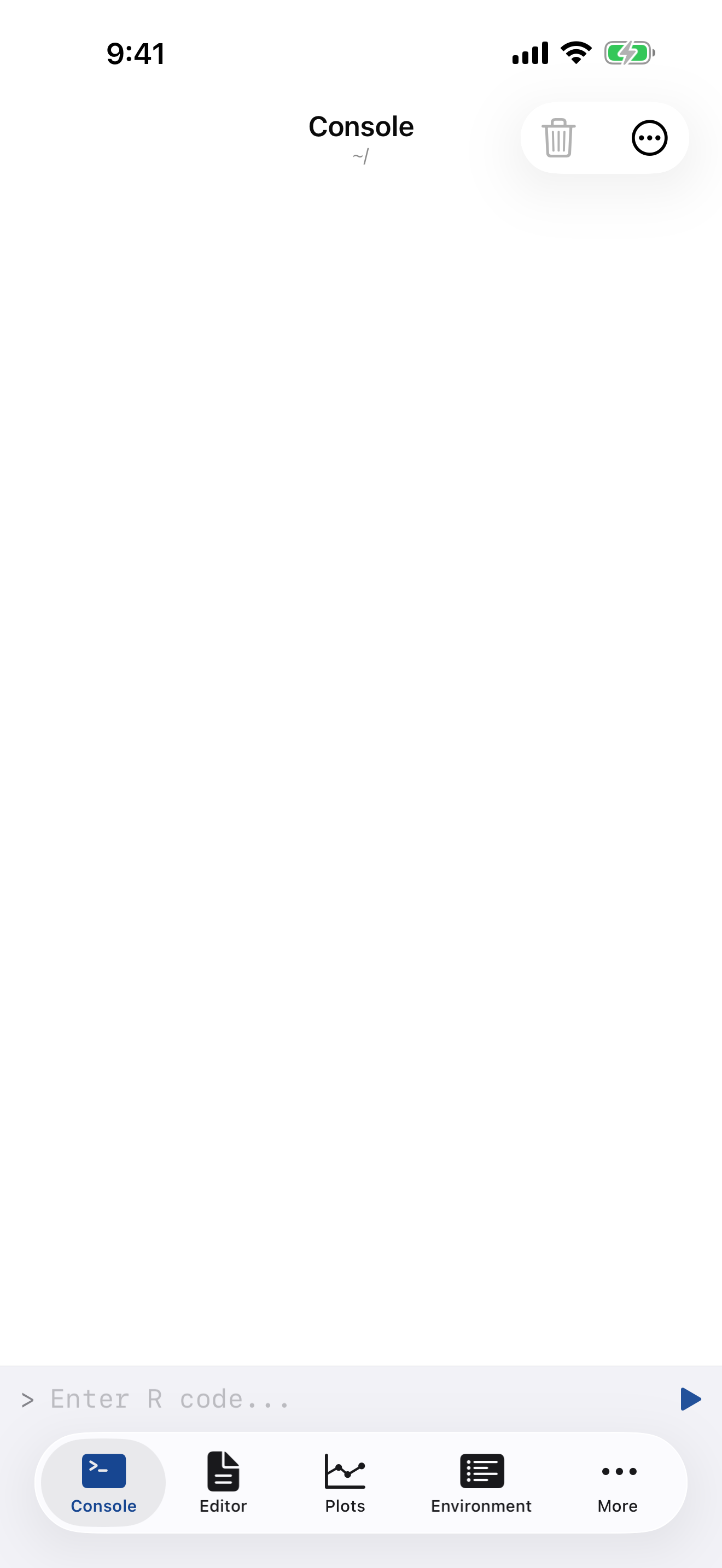
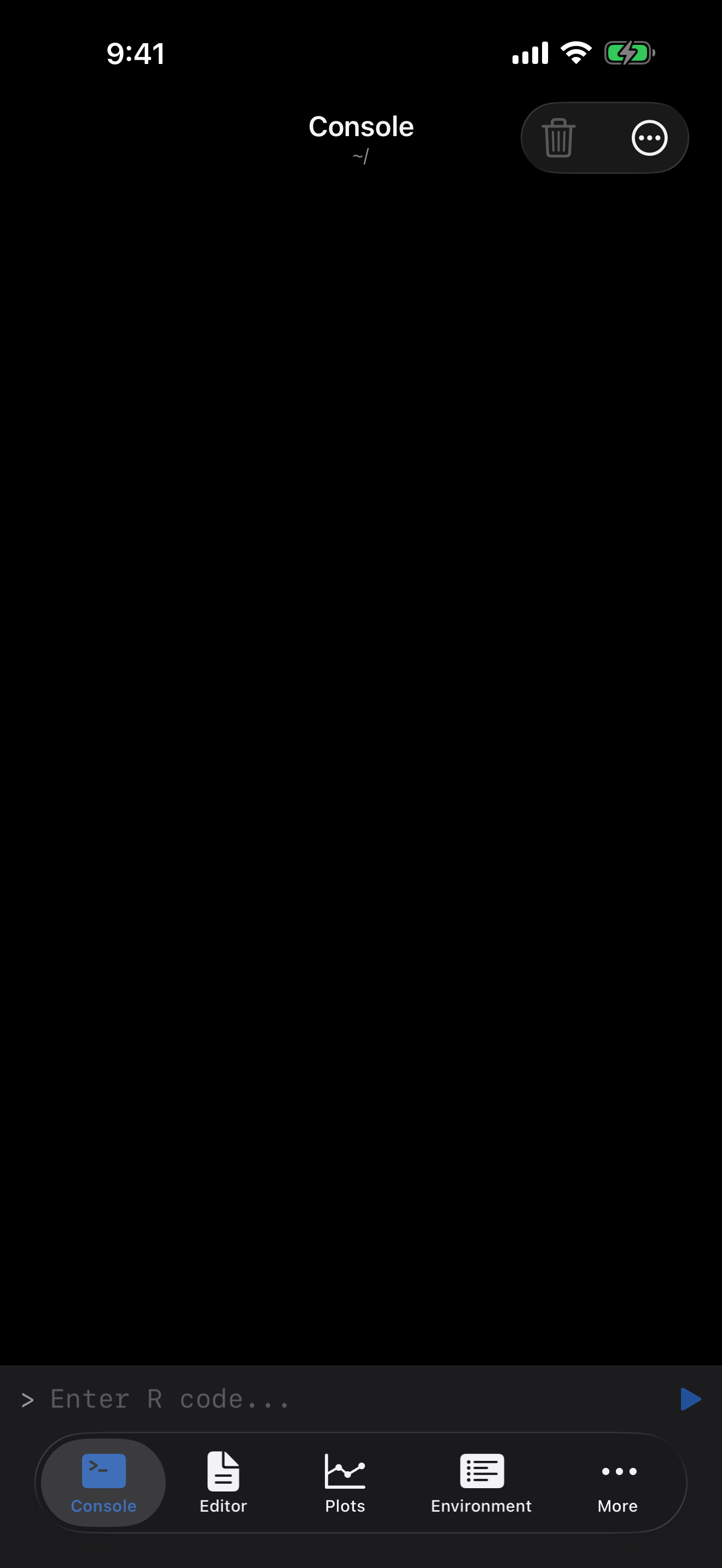
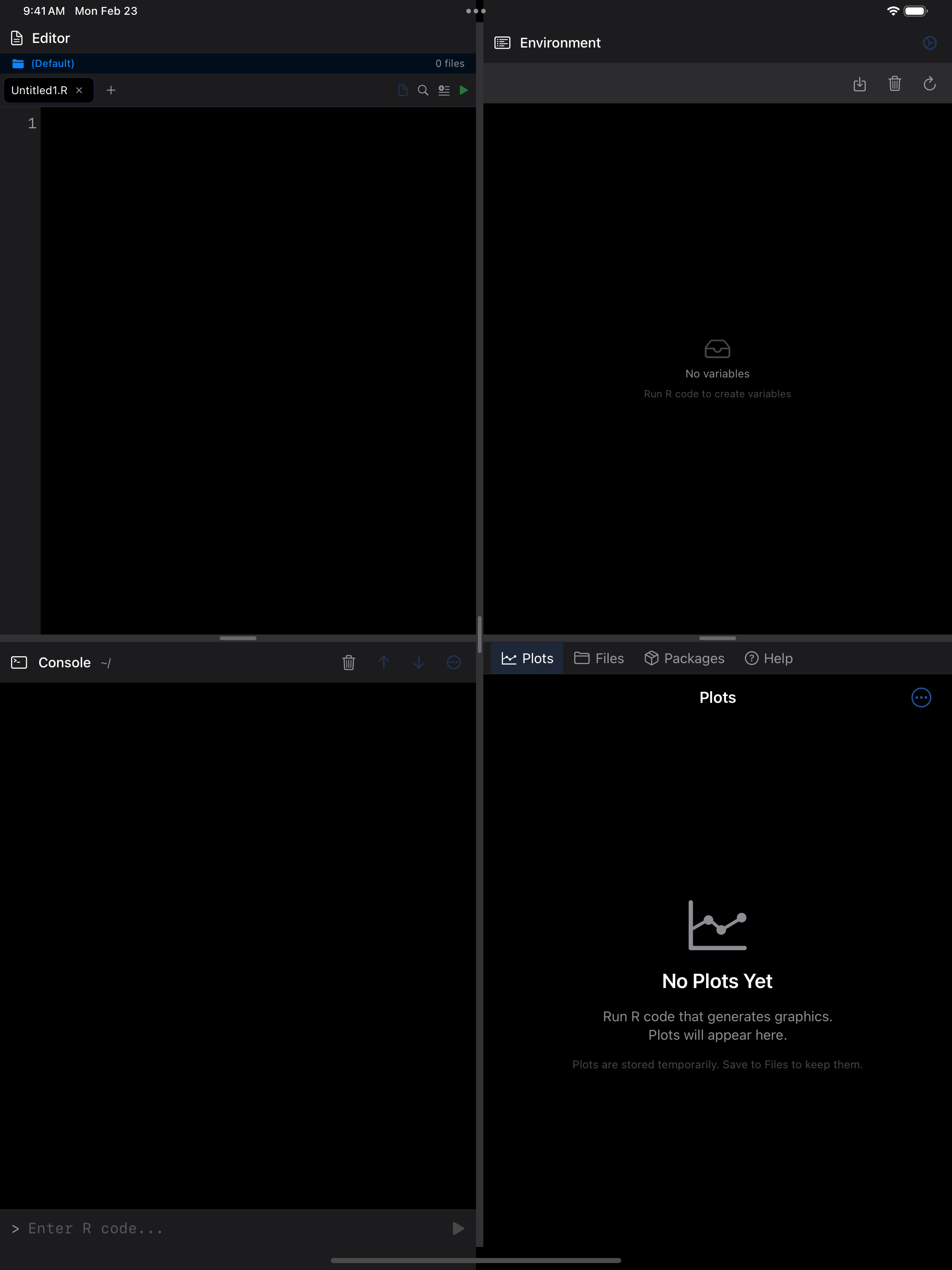
What you are seeing above:
- Output area: the scrollable region that shows everything R has printed, color-coded by type
- Input field: the text field at the bottom preceded by
>, where you type R code - Run button: the blue play icon that executes whatever is in the input field
- R keyboard toolbar: a scrollable strip of common R operators that appears when the keyboard is open
An empty console shows a short welcome card: the R version that is ready, four commands you can run with a tap (summary(cars), plot(cars), hist(rnorm(100)) and ?mean), and Open an example script, which opens a getting-started script in the Editor. The card goes away once you run something.
You can paste or type several lines at once. R runs them in order and prints every visible result, as desktop R’s console does.
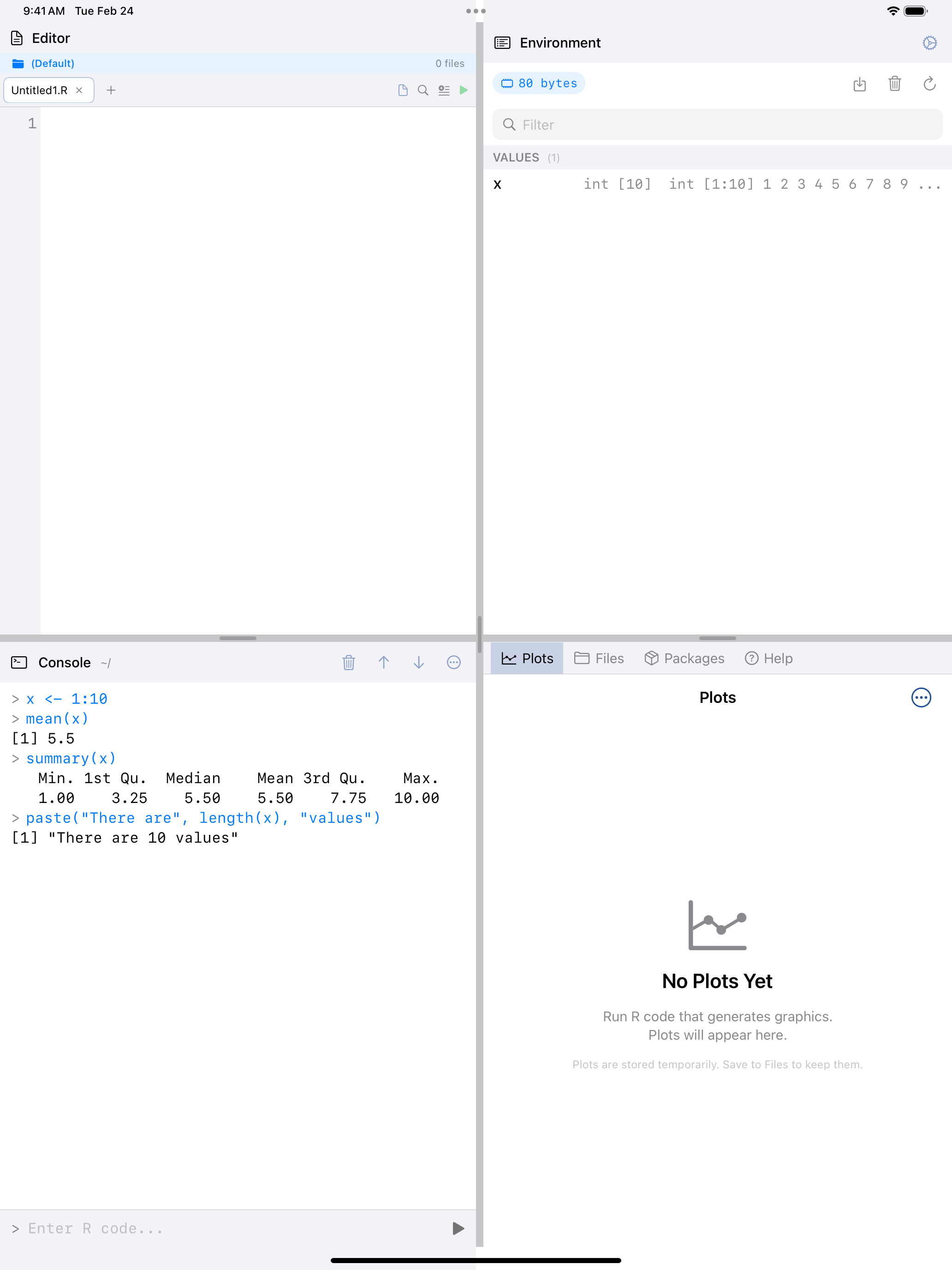
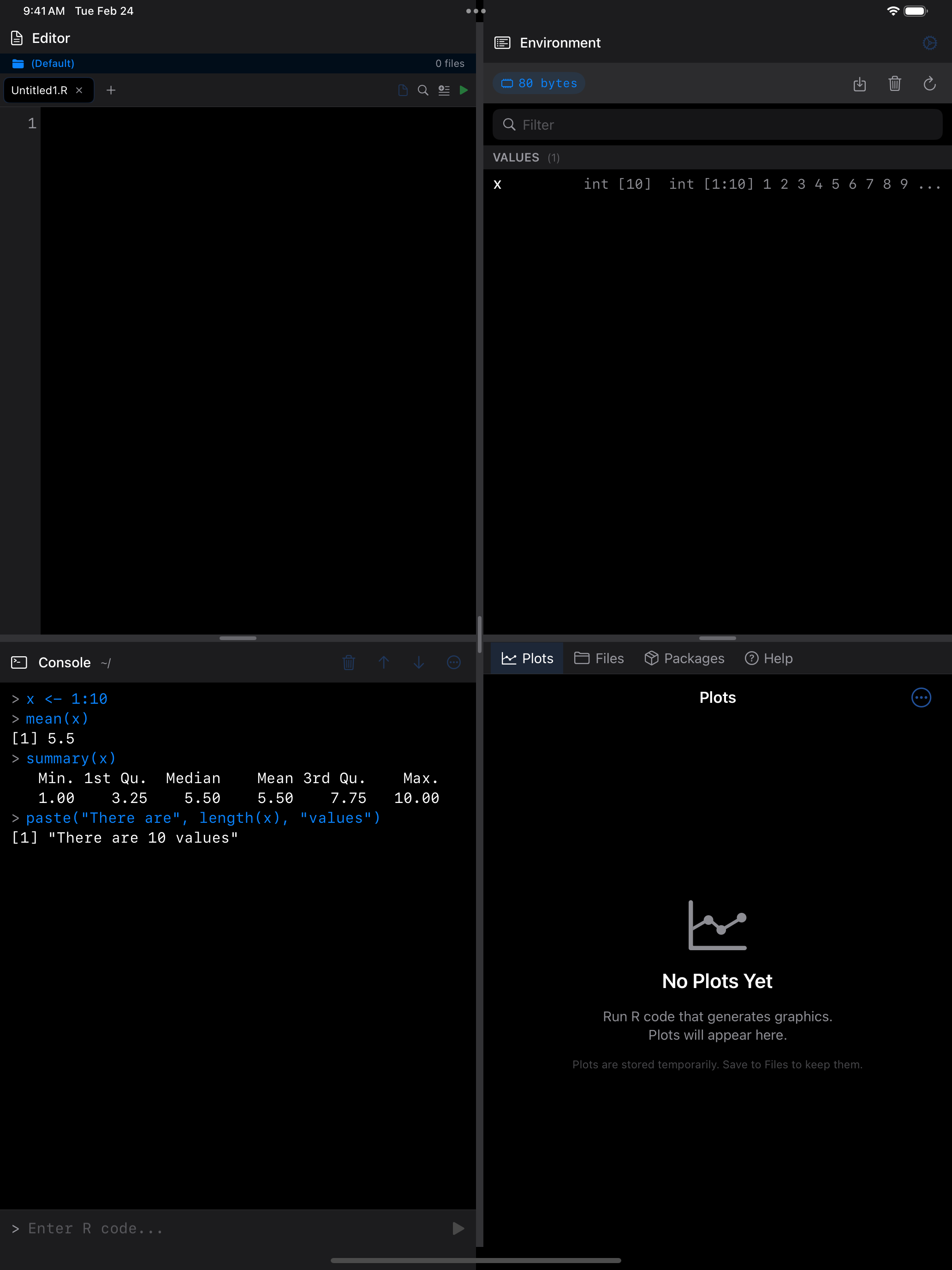
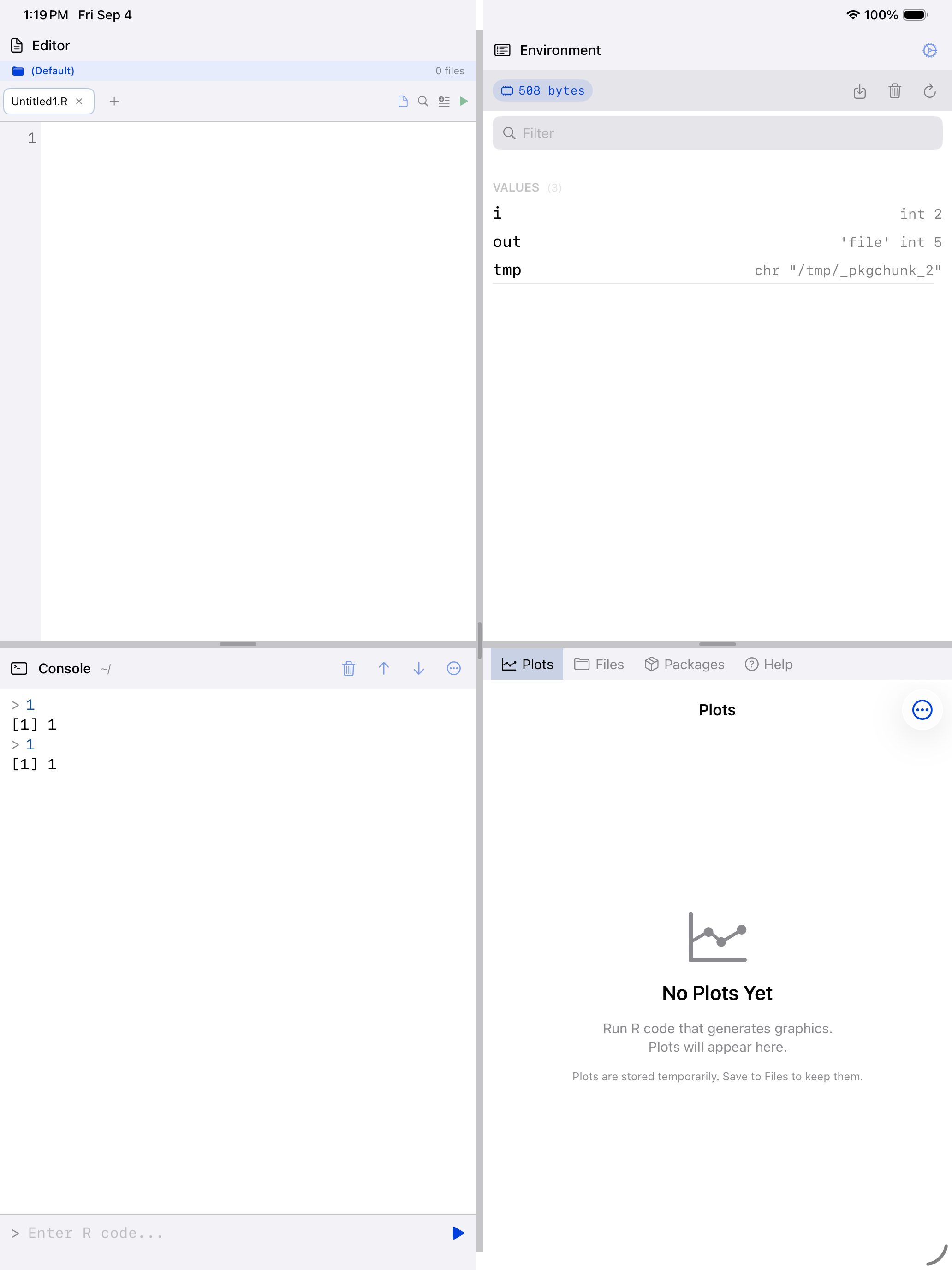
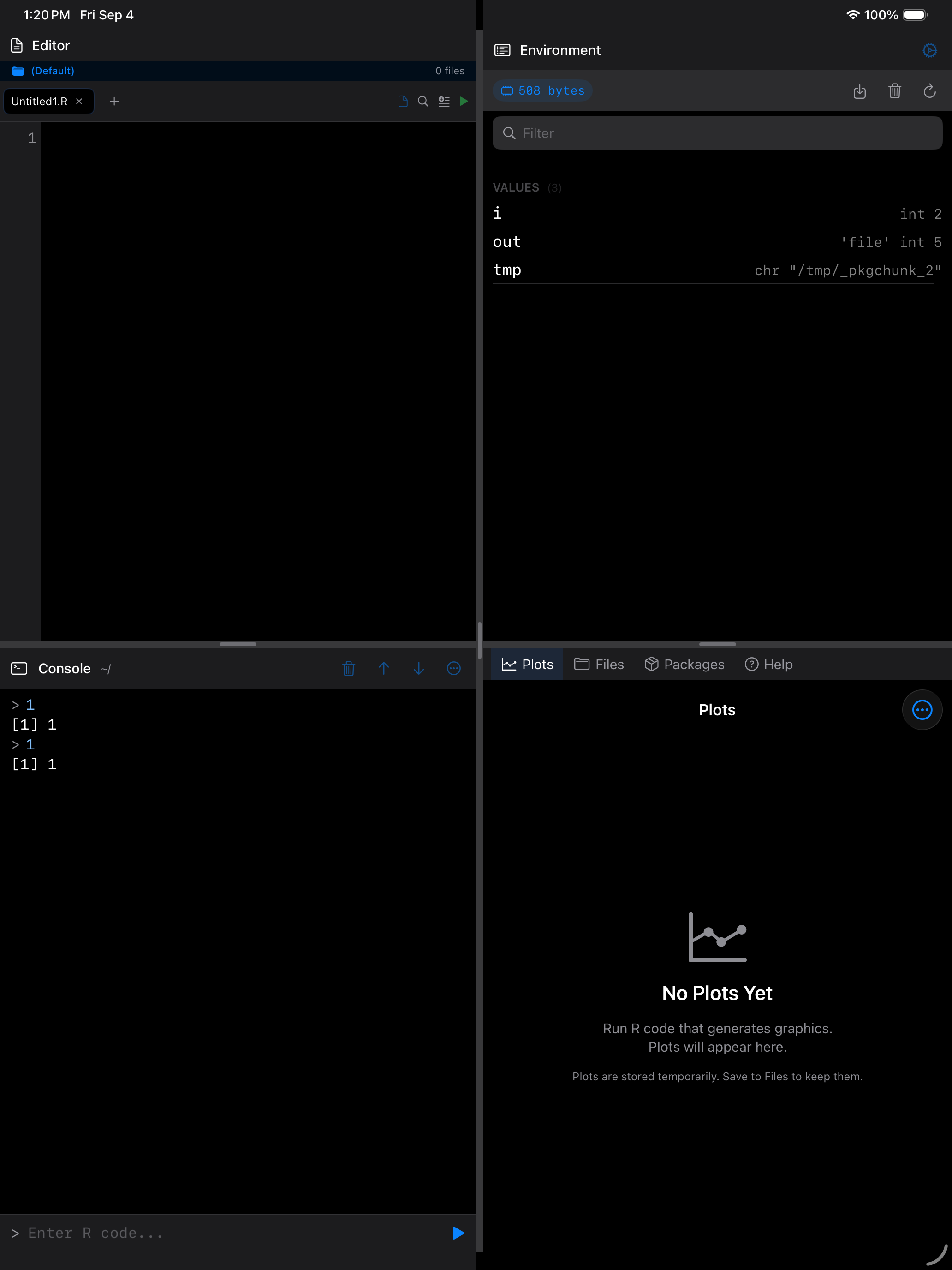
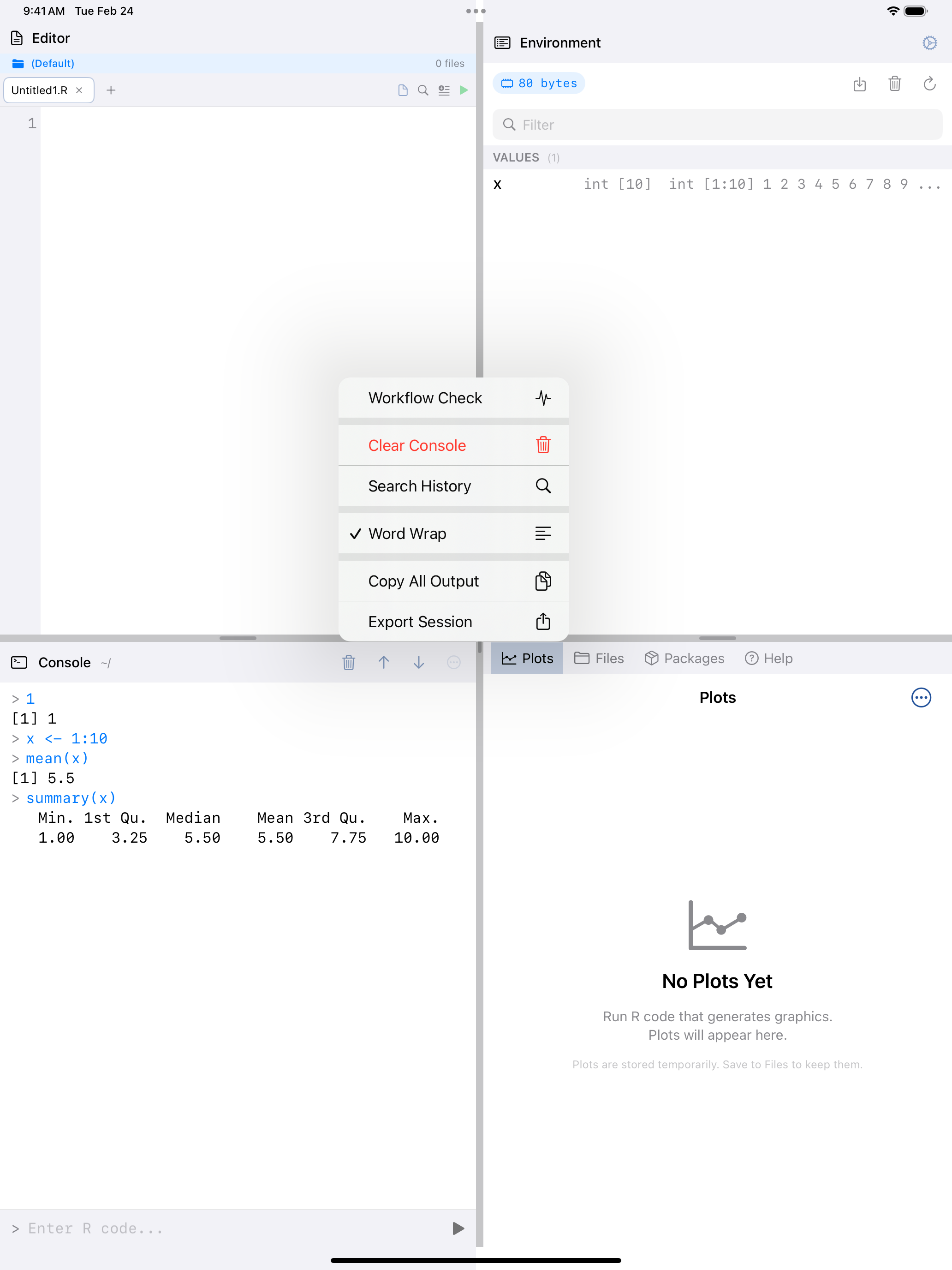
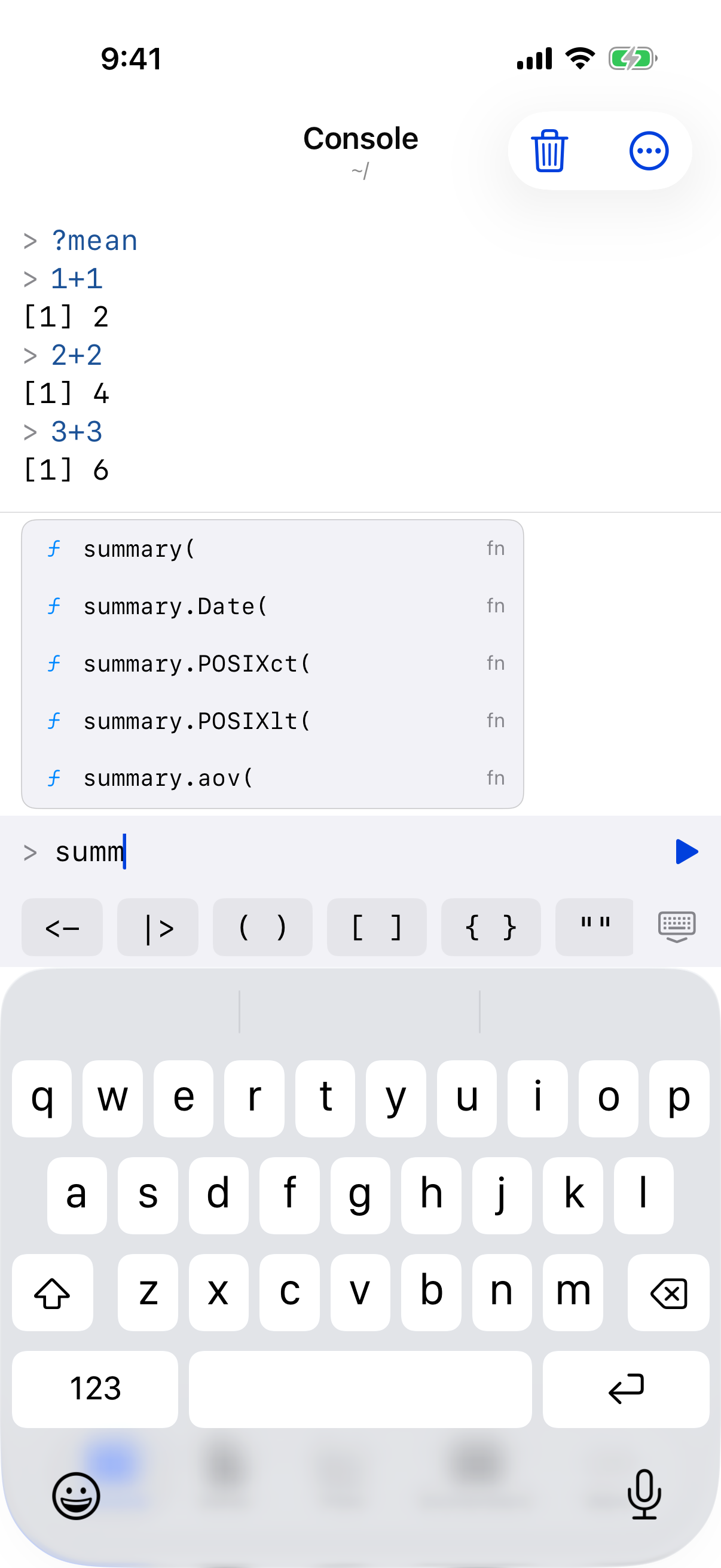
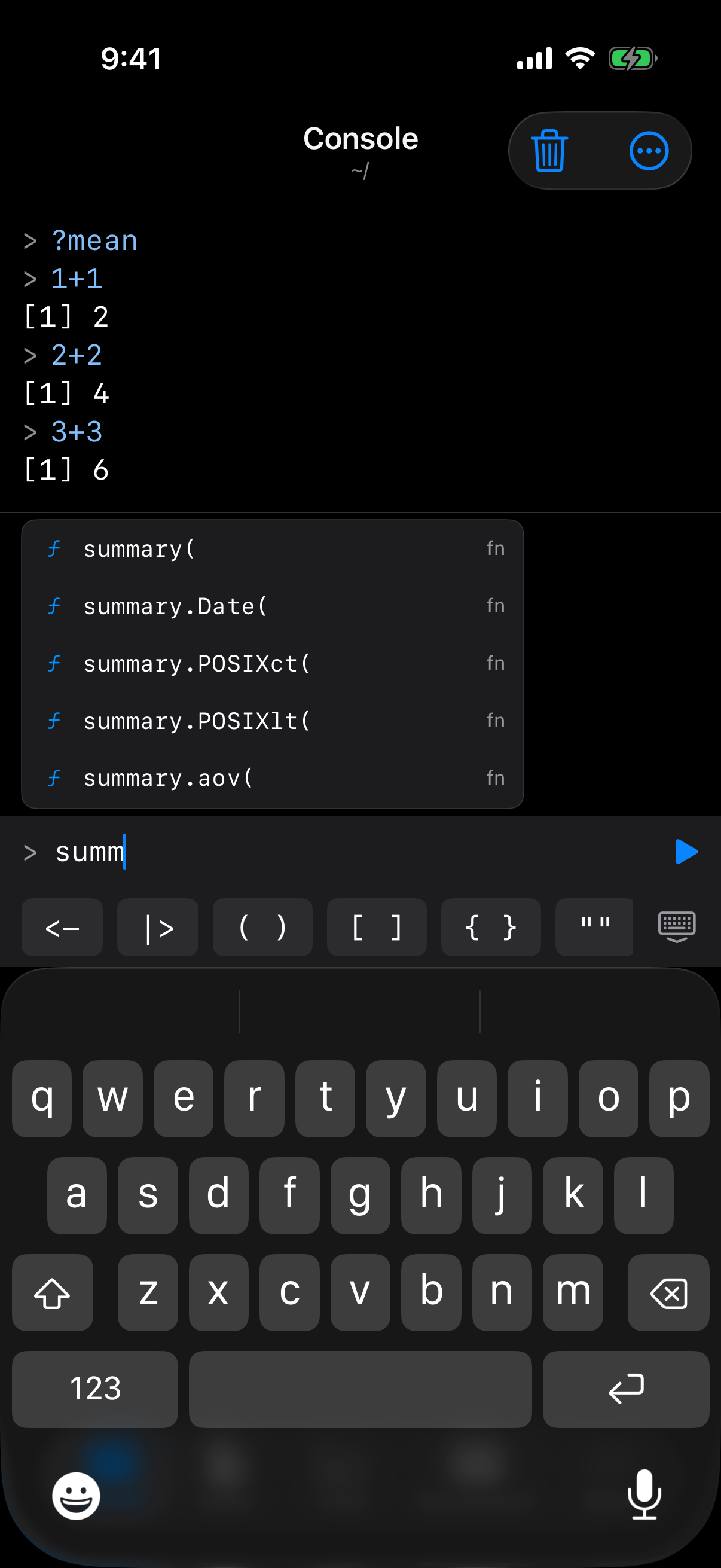
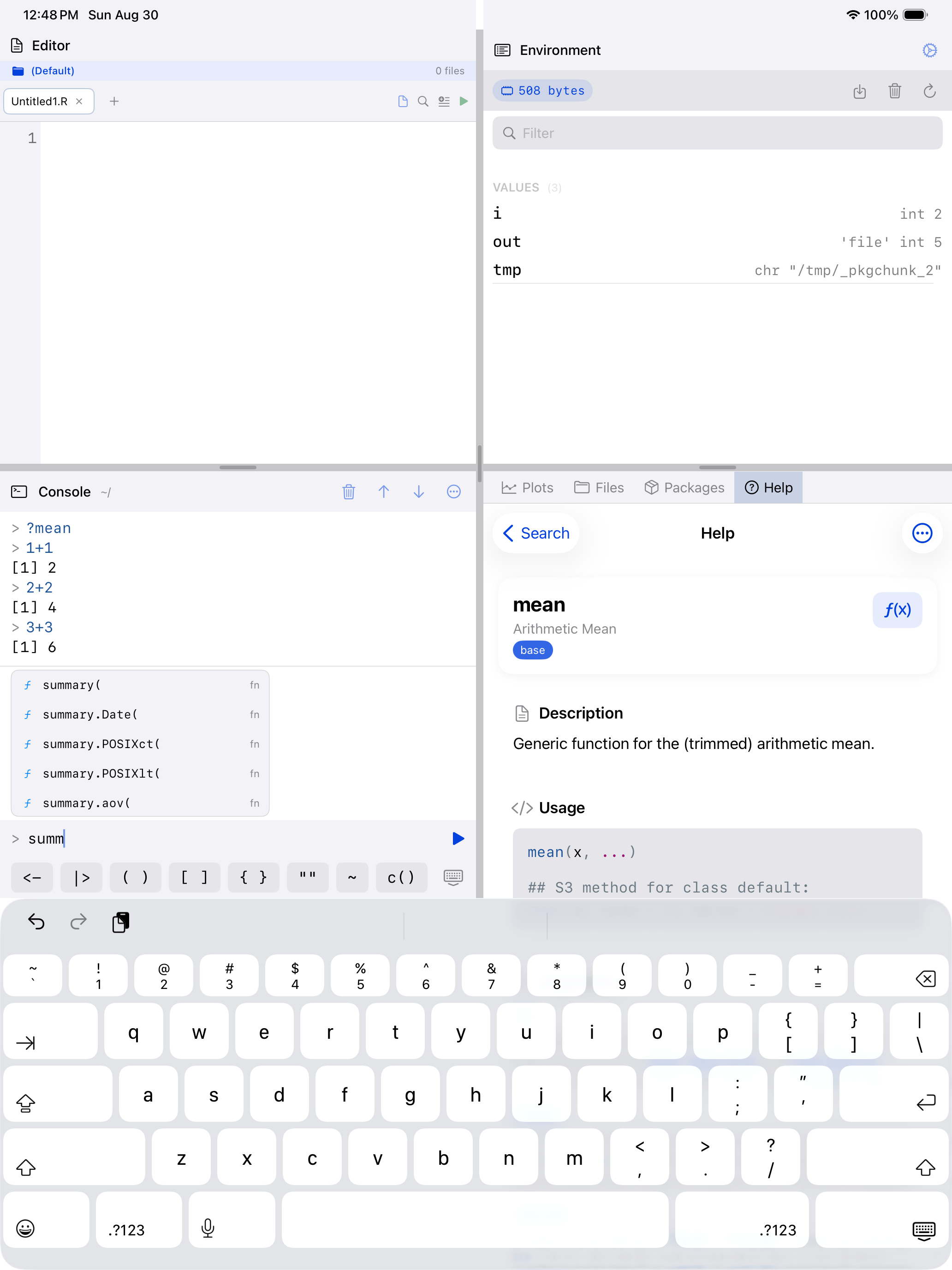
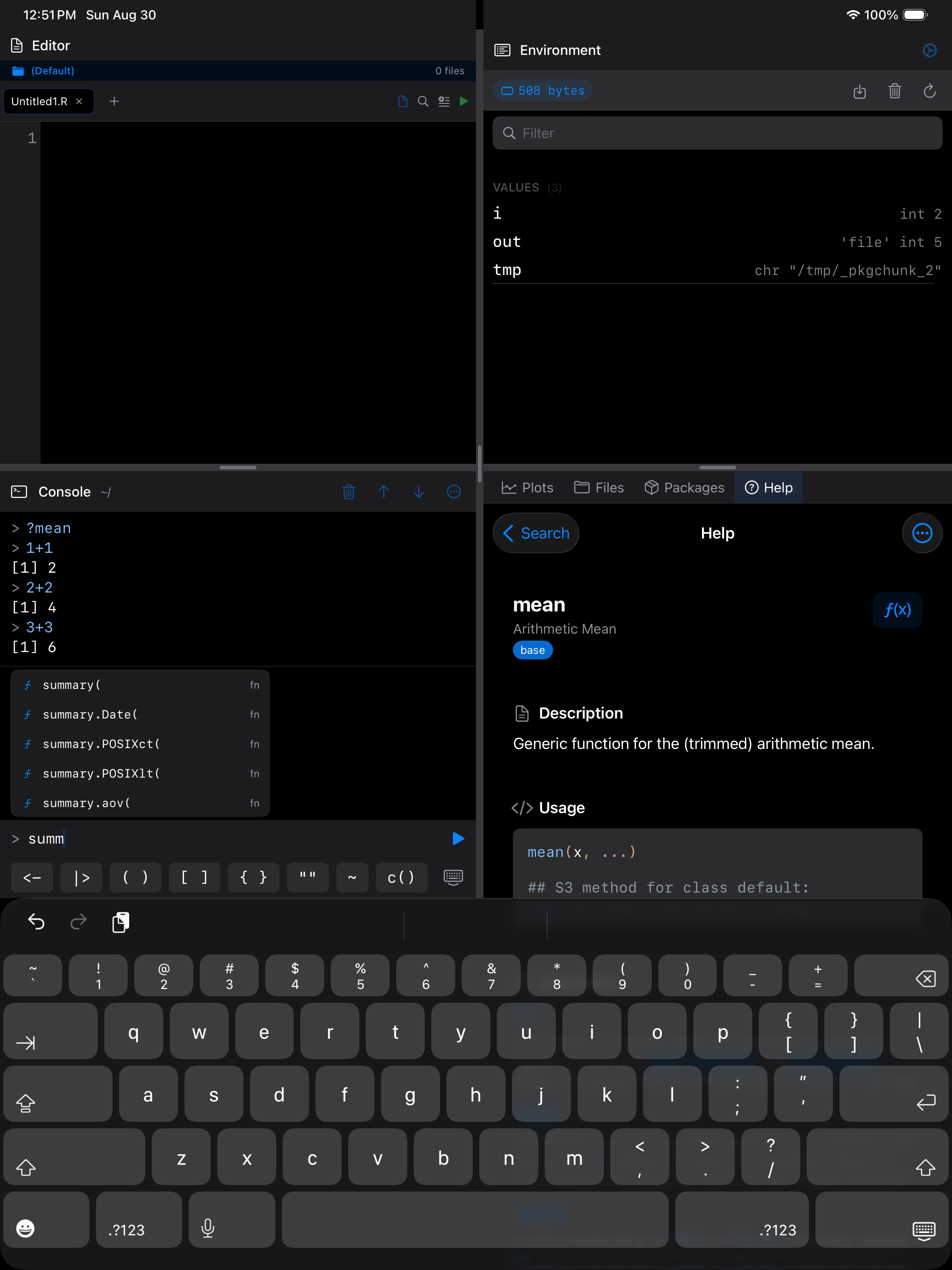
Here is what a short session looks like. Each line is typed into the input field and run one at a time:
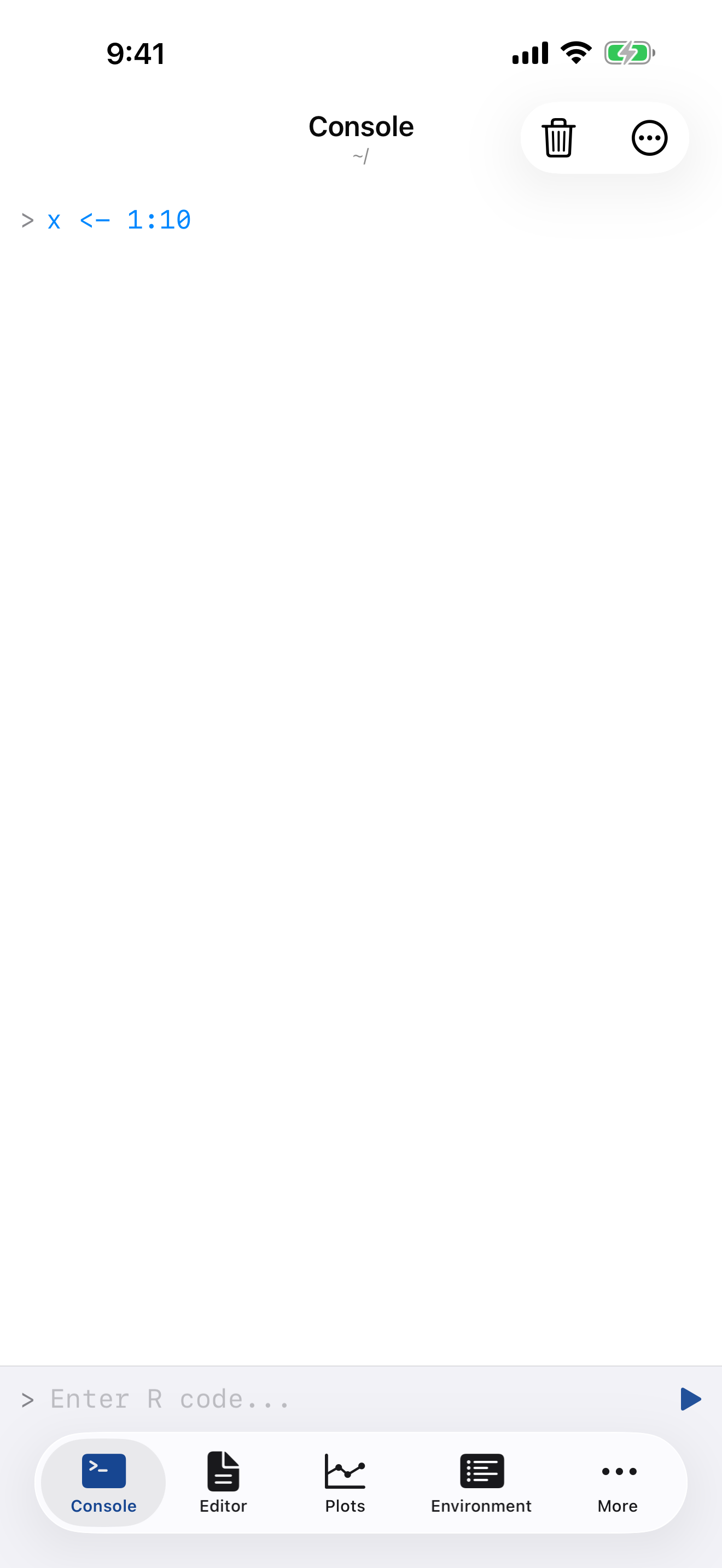
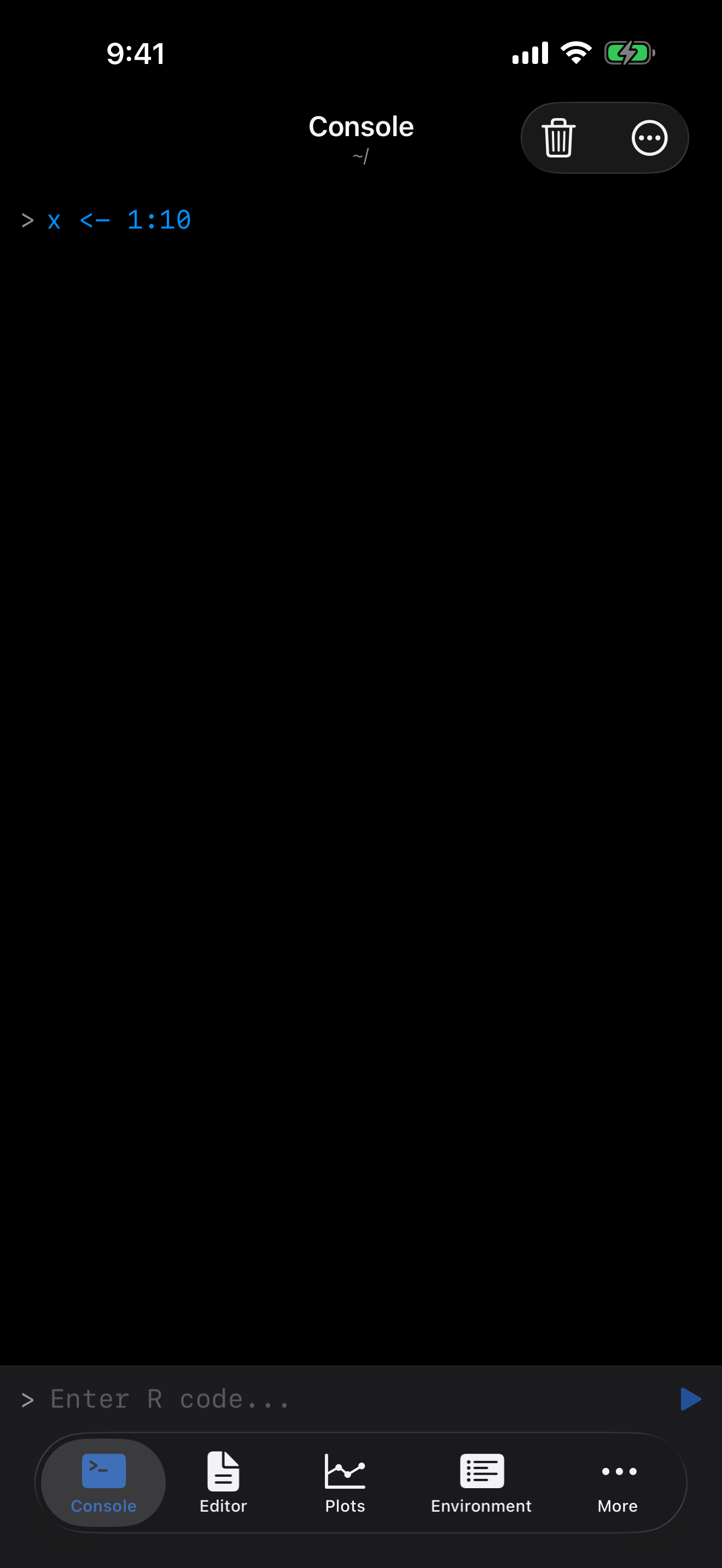
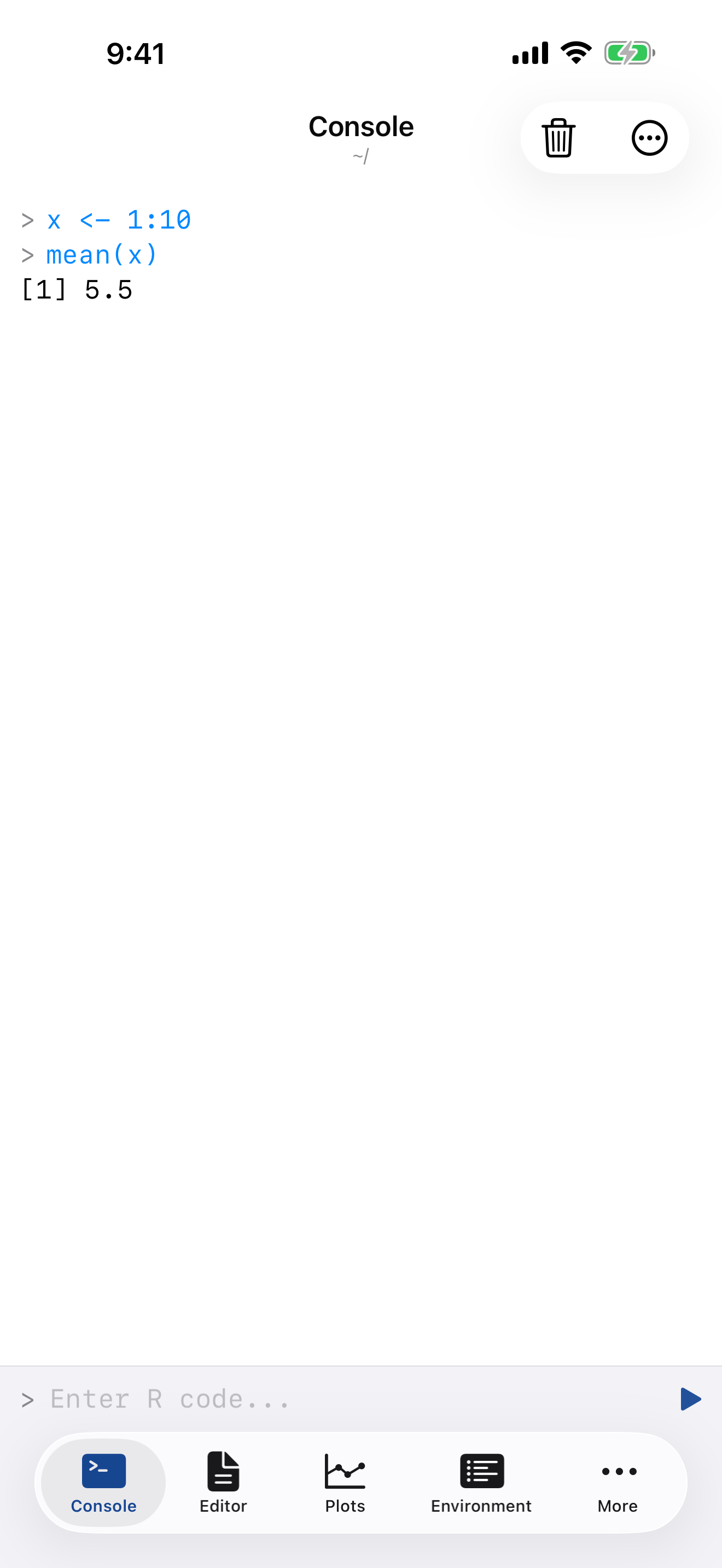
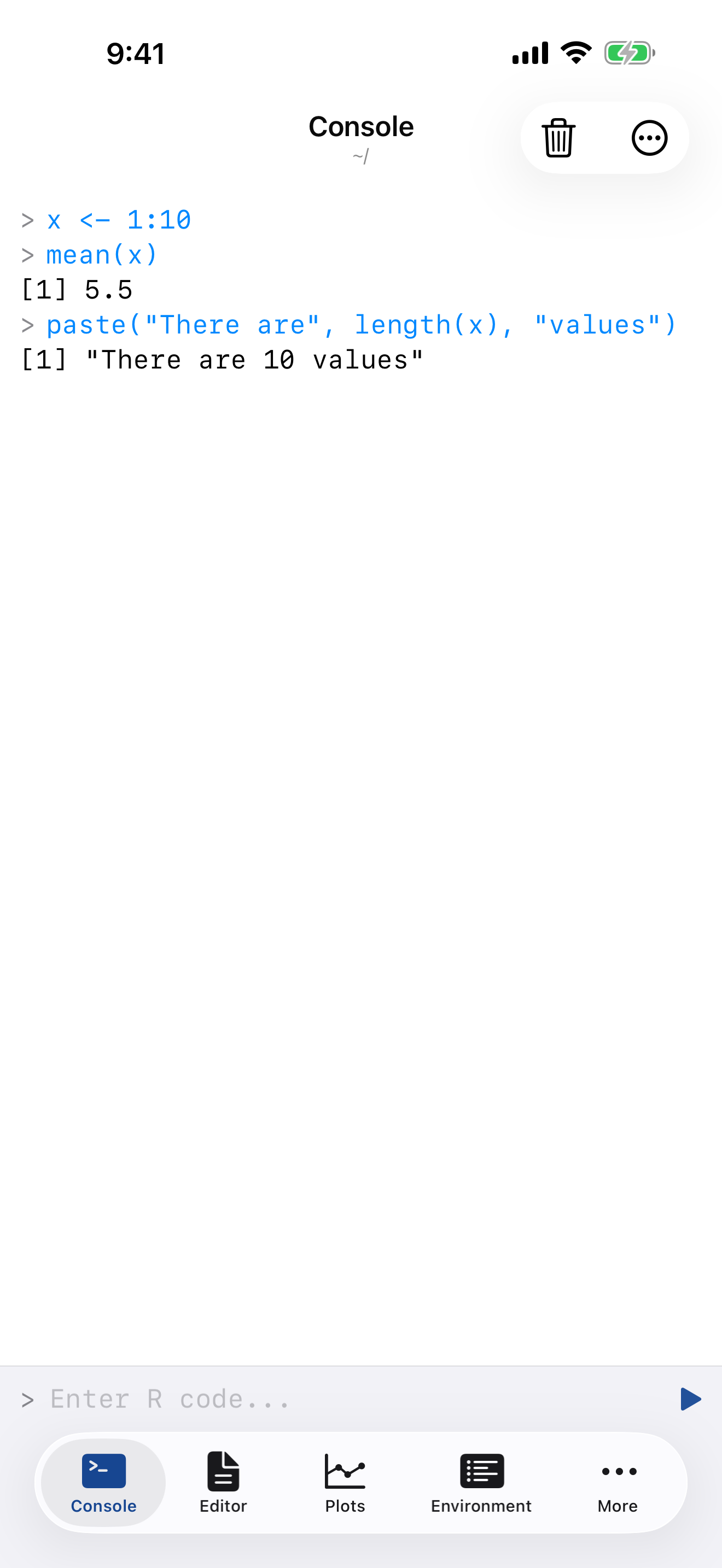
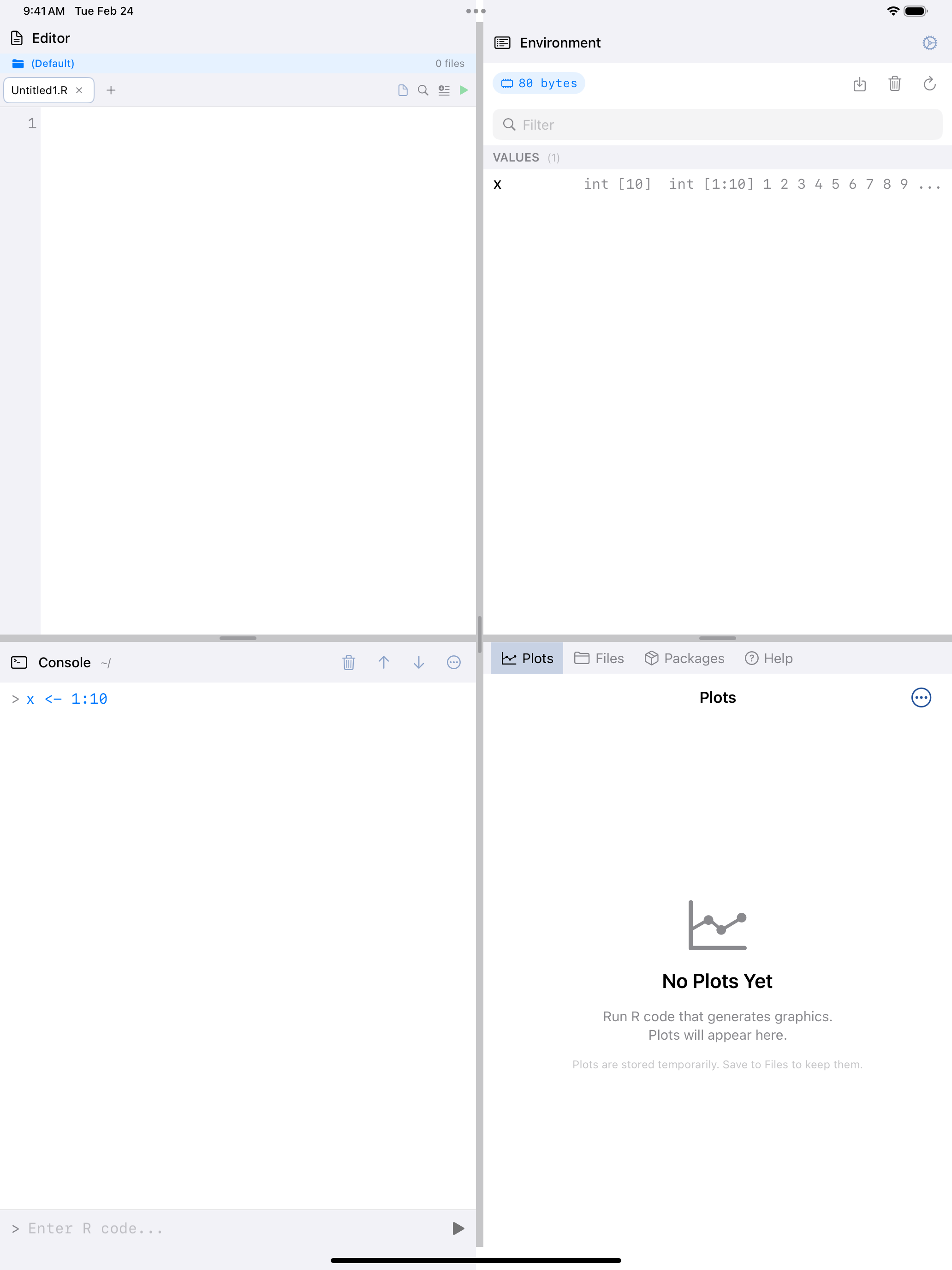
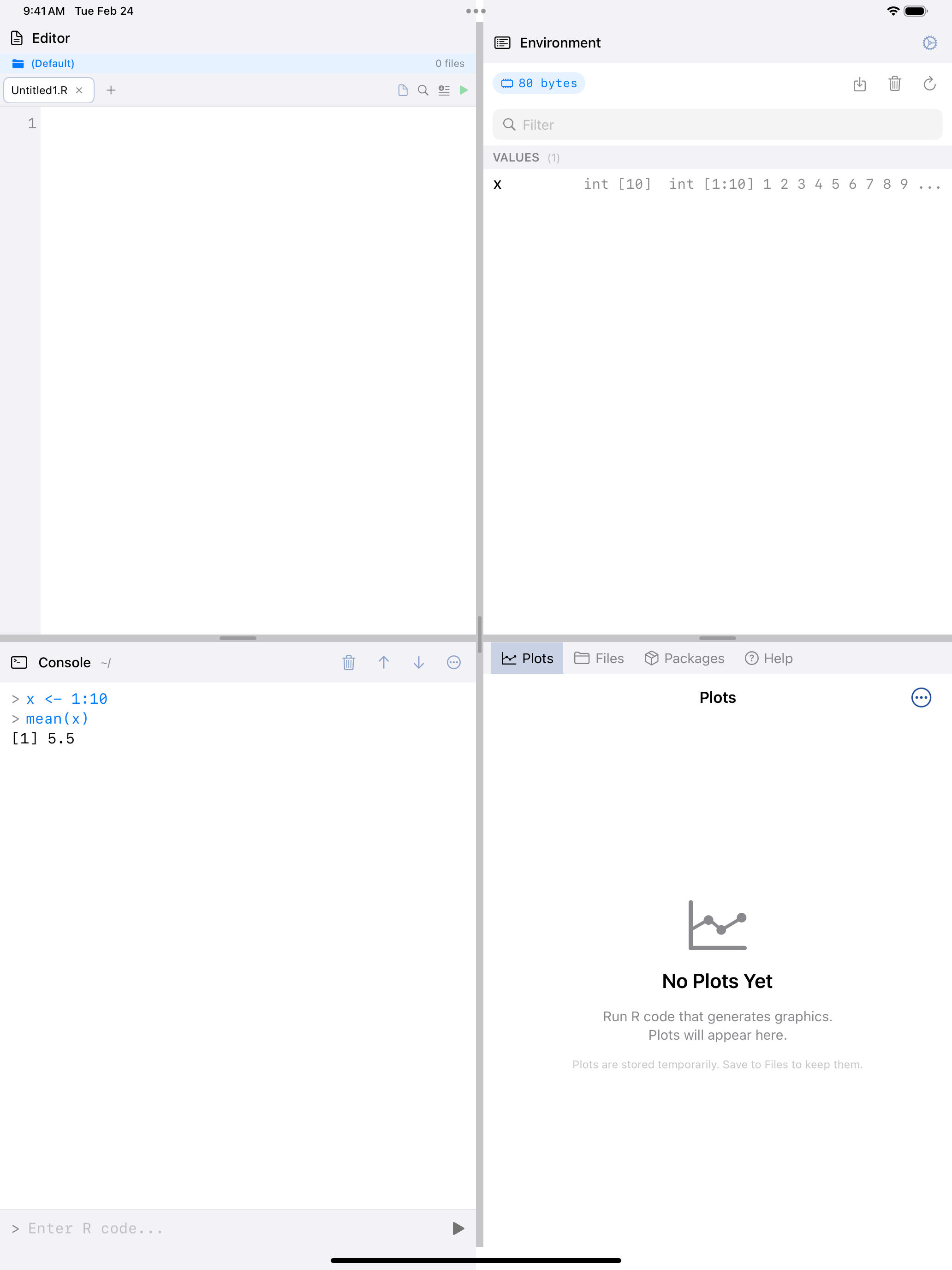
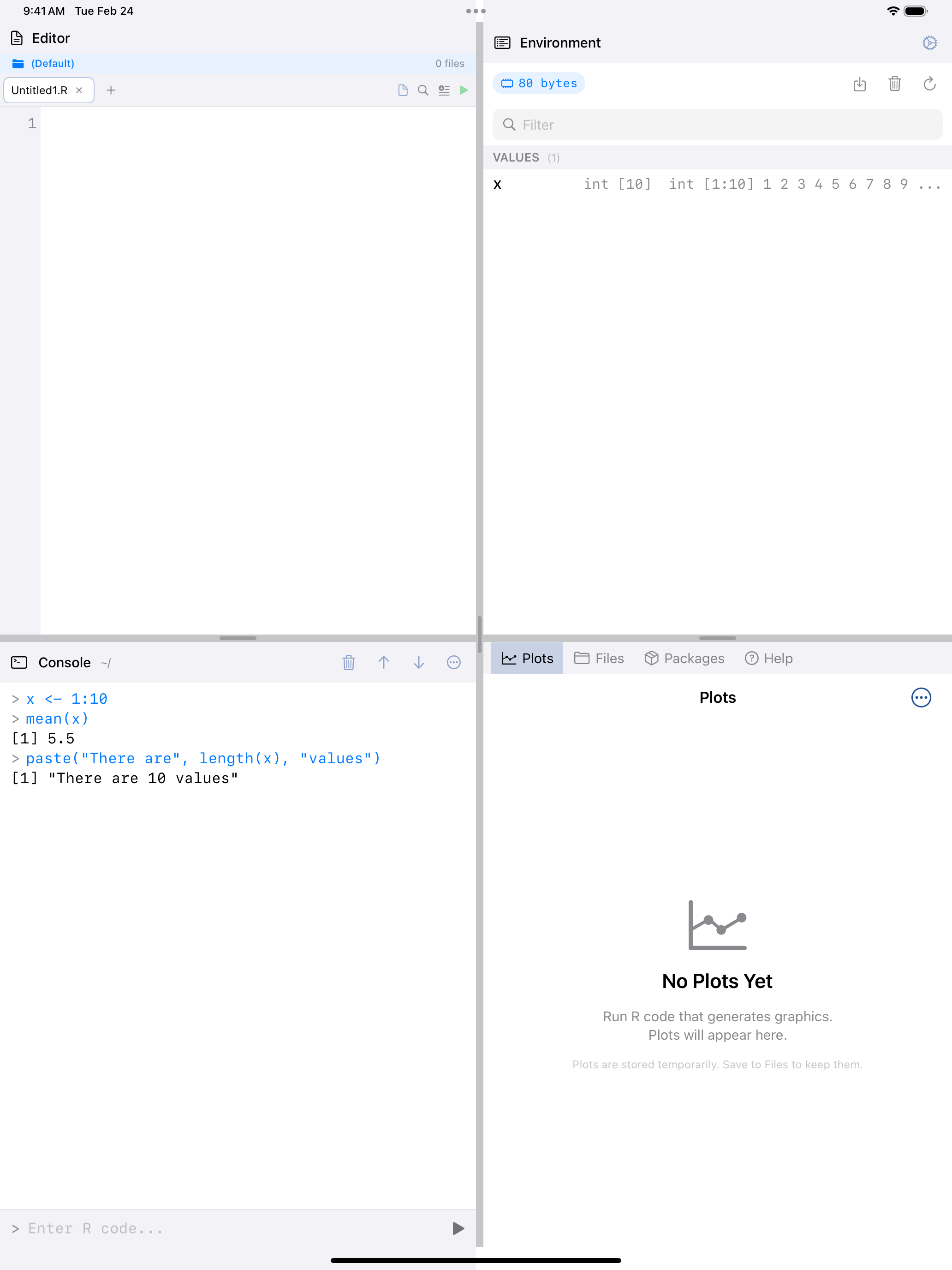
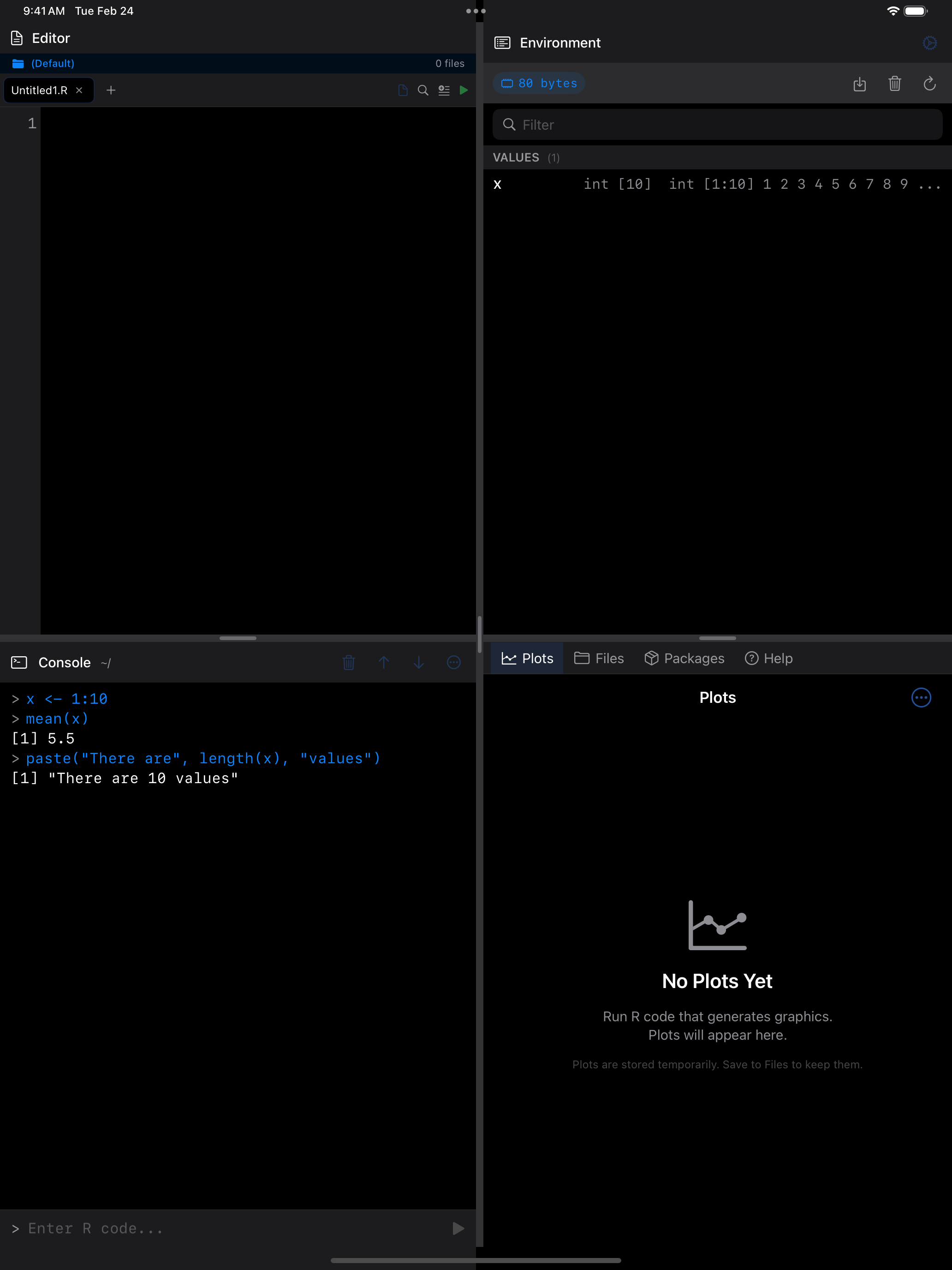
Your commands appear in blue, making them easy to distinguish from R’s output.
Understanding Output Colors
The Console color-codes output so you can scan results at a glance:
- Blue: your input, prefixed with
> - Default text color: normal R output (standard output)
- Green: result values returned by expressions
- Red: errors
- Orange: warnings
- Gray: informational messages from R or from packages
Here is an example showing each output type. Try running these commands one at a time:
x <- 1
x
print("hi there!")
message("hello")
warning("uh-oh")
stop("an error appears!")
y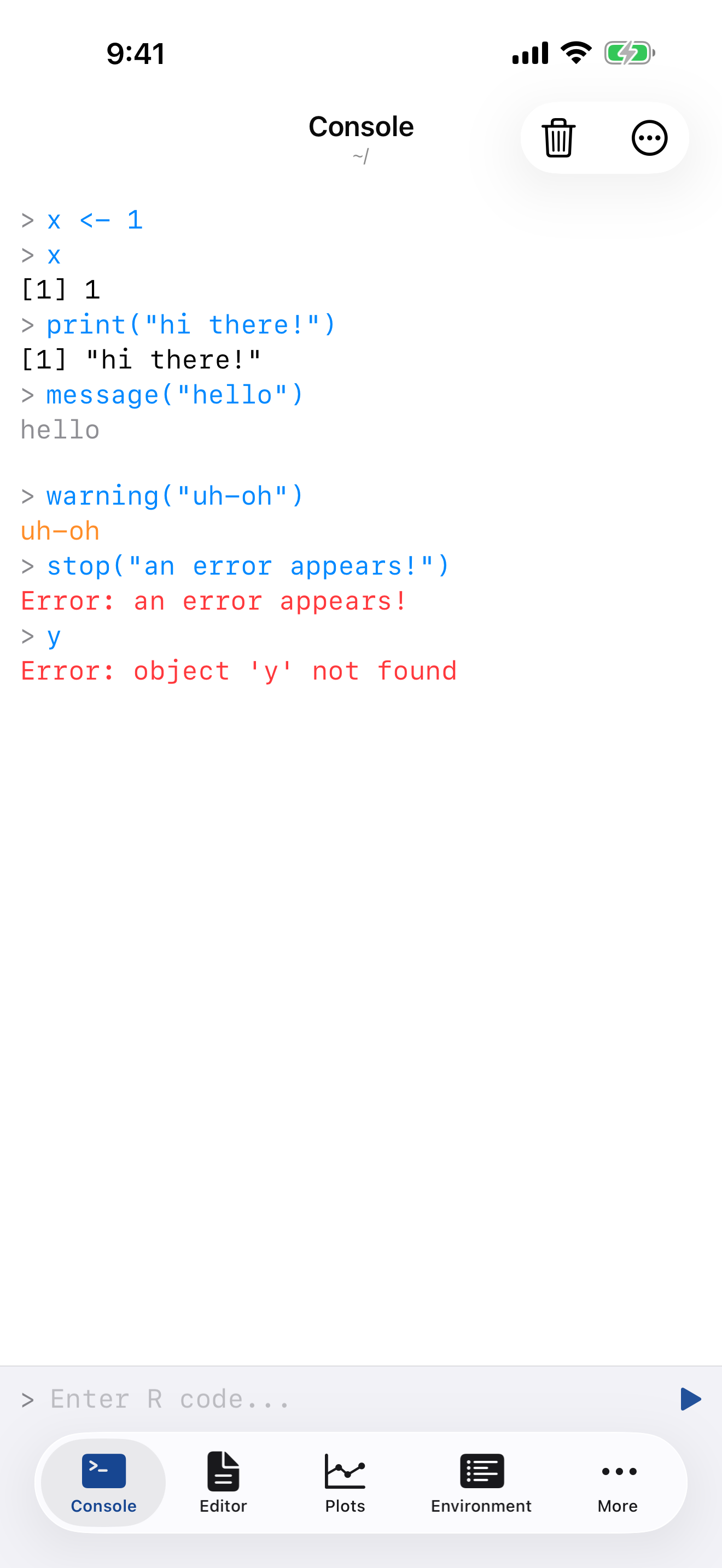
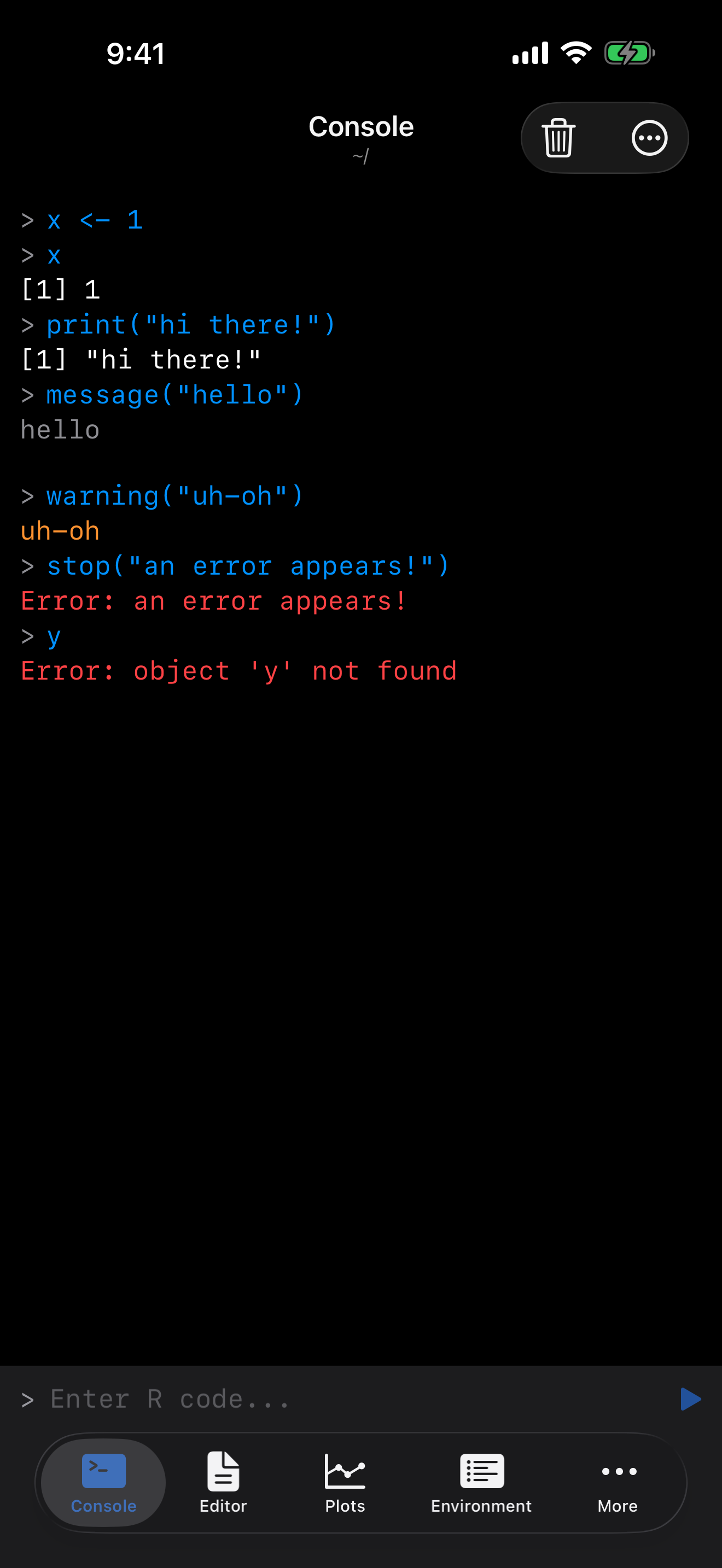
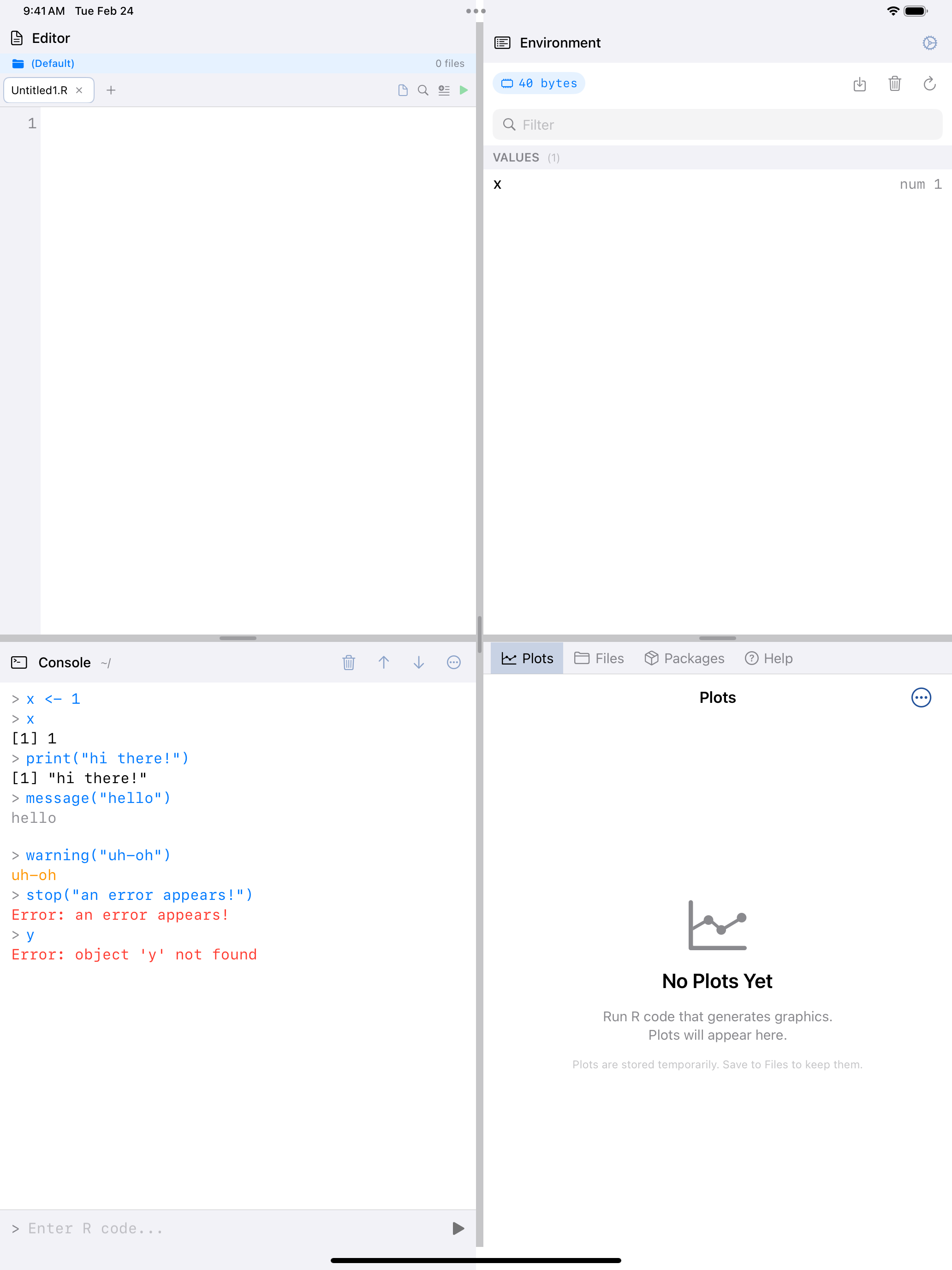
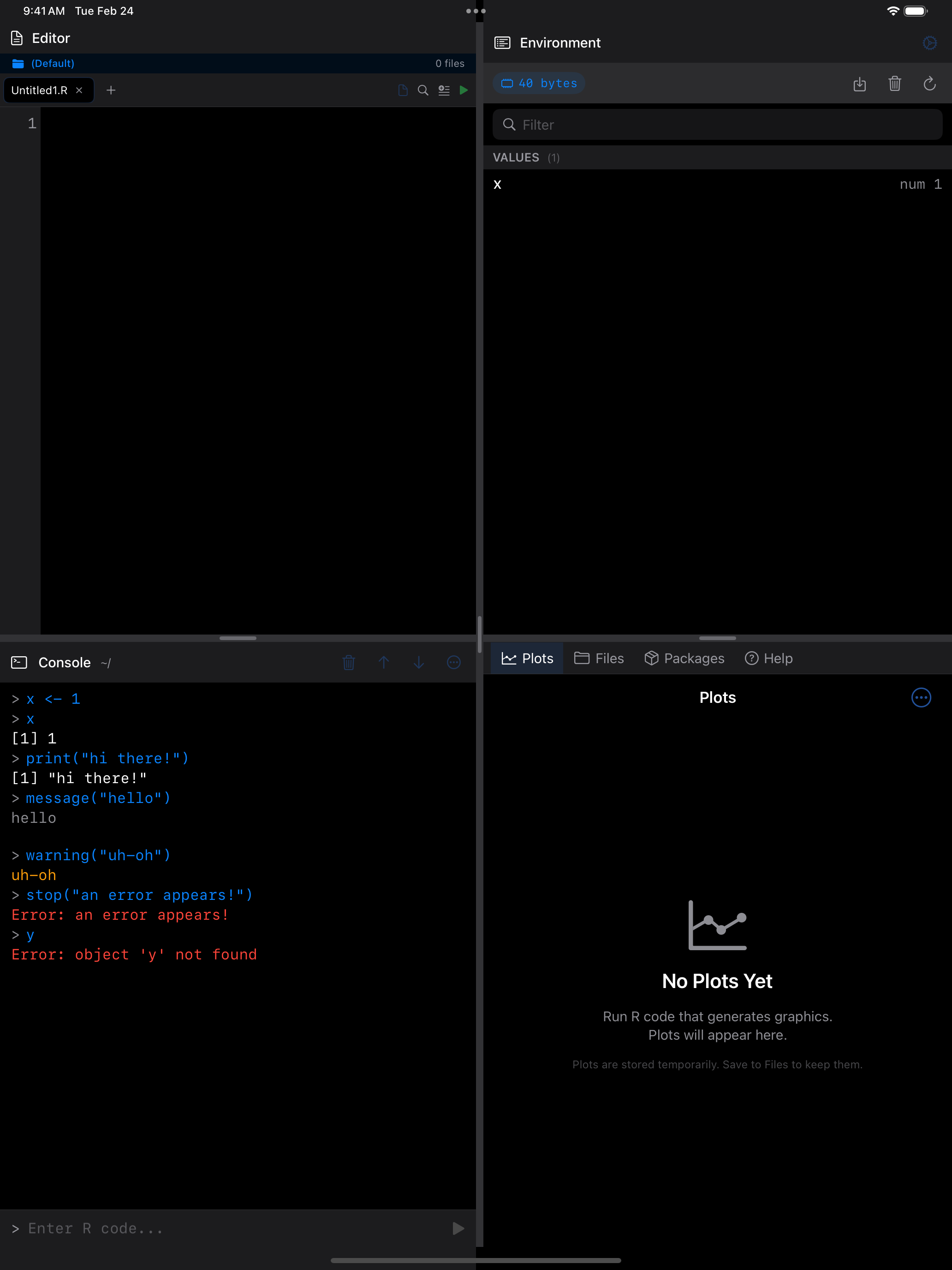
An error looks like this in practice. The message appears in red, directly under the call that caused it.
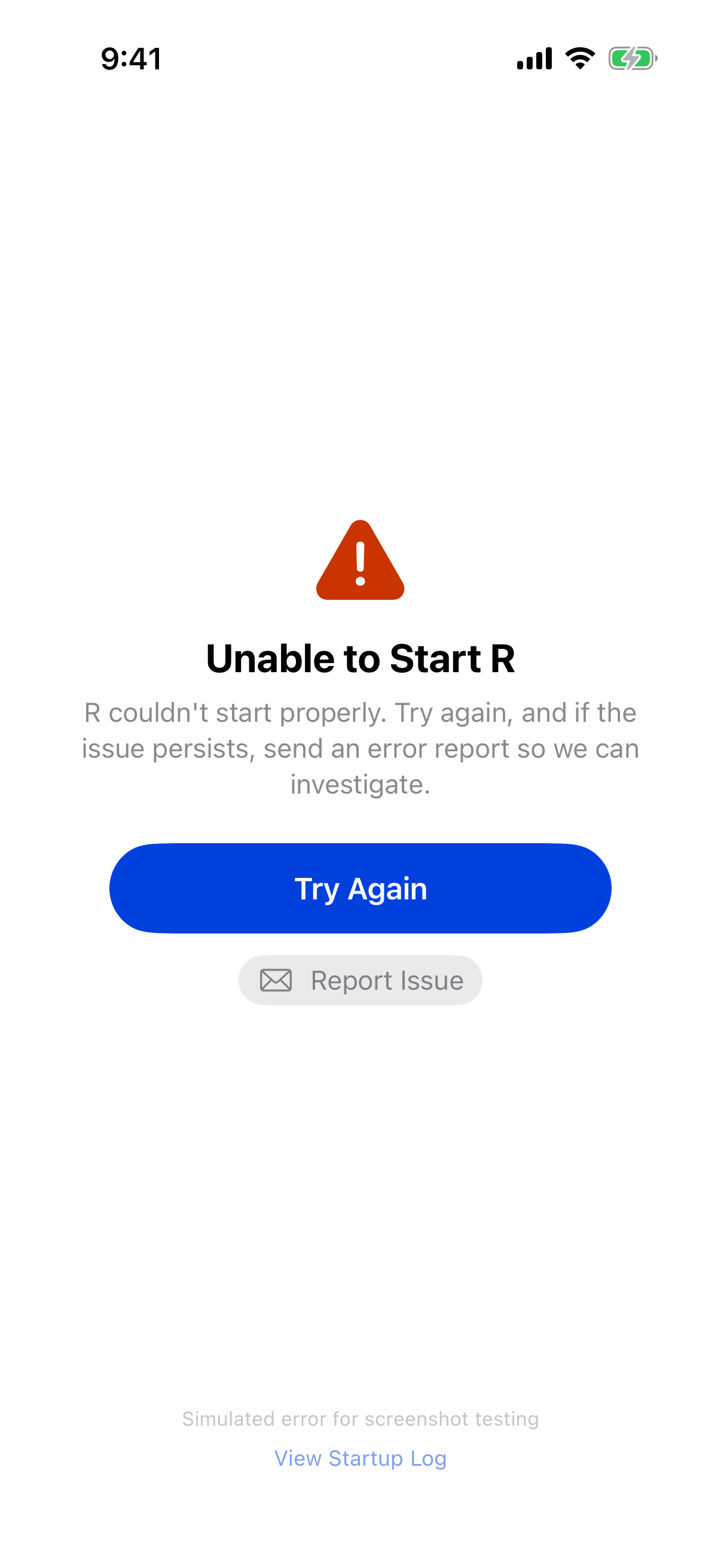
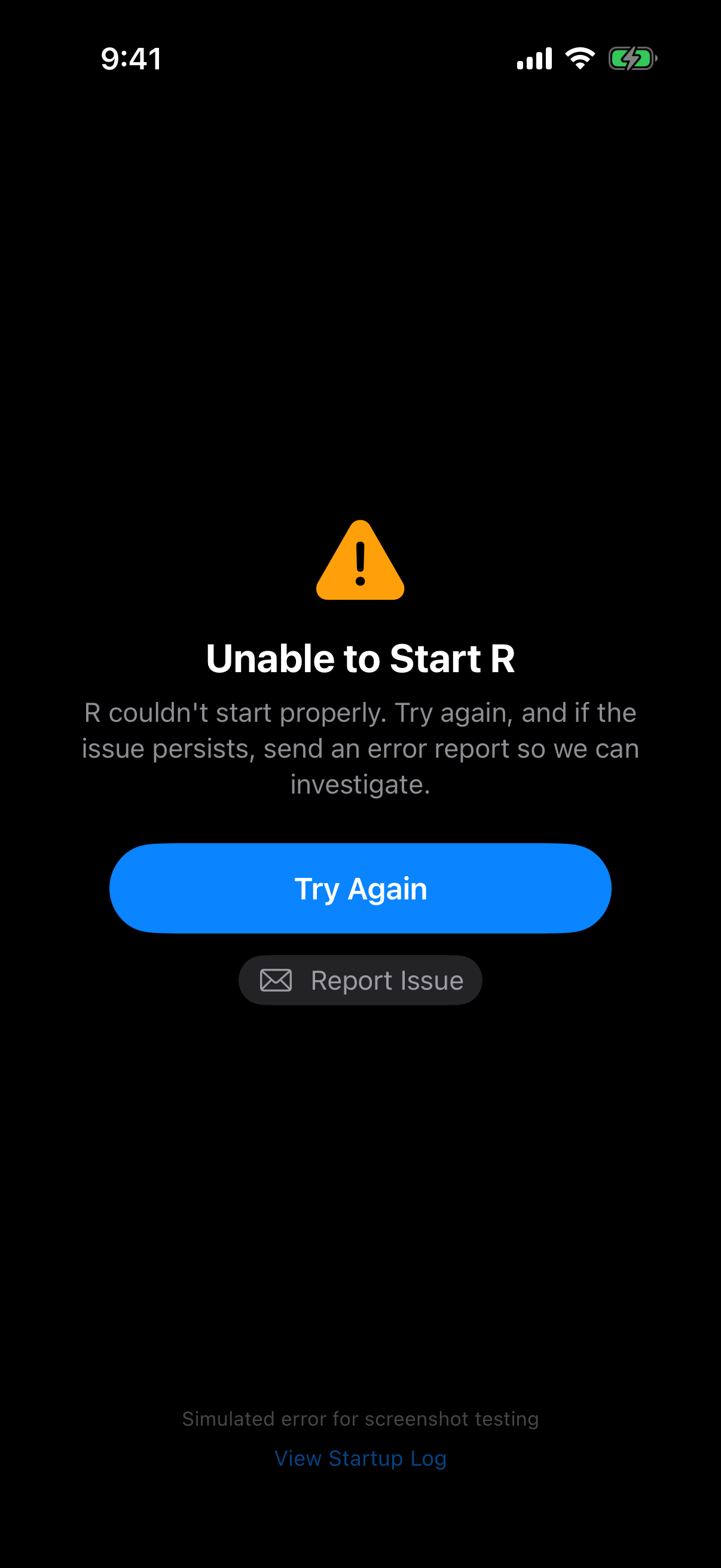
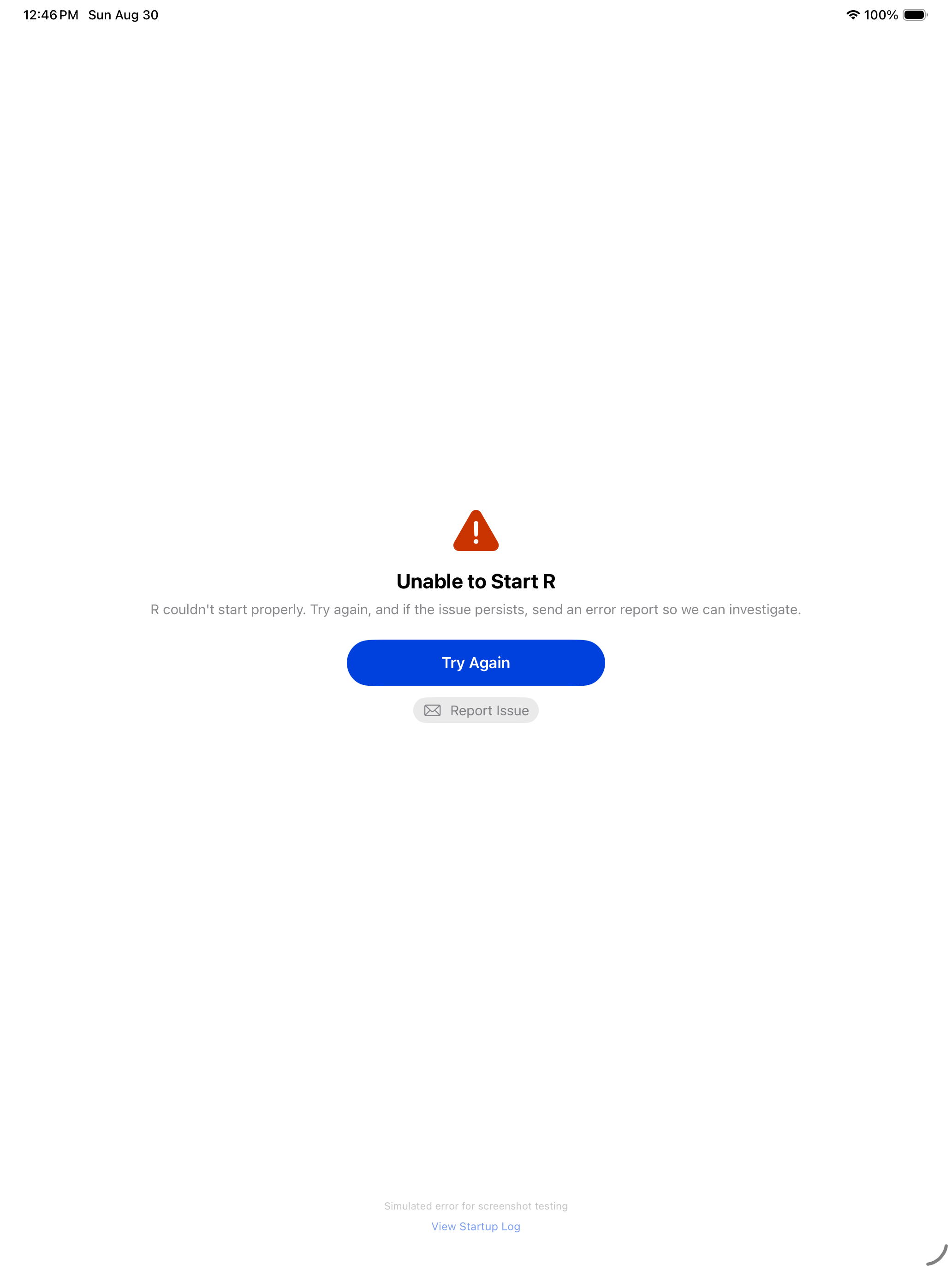
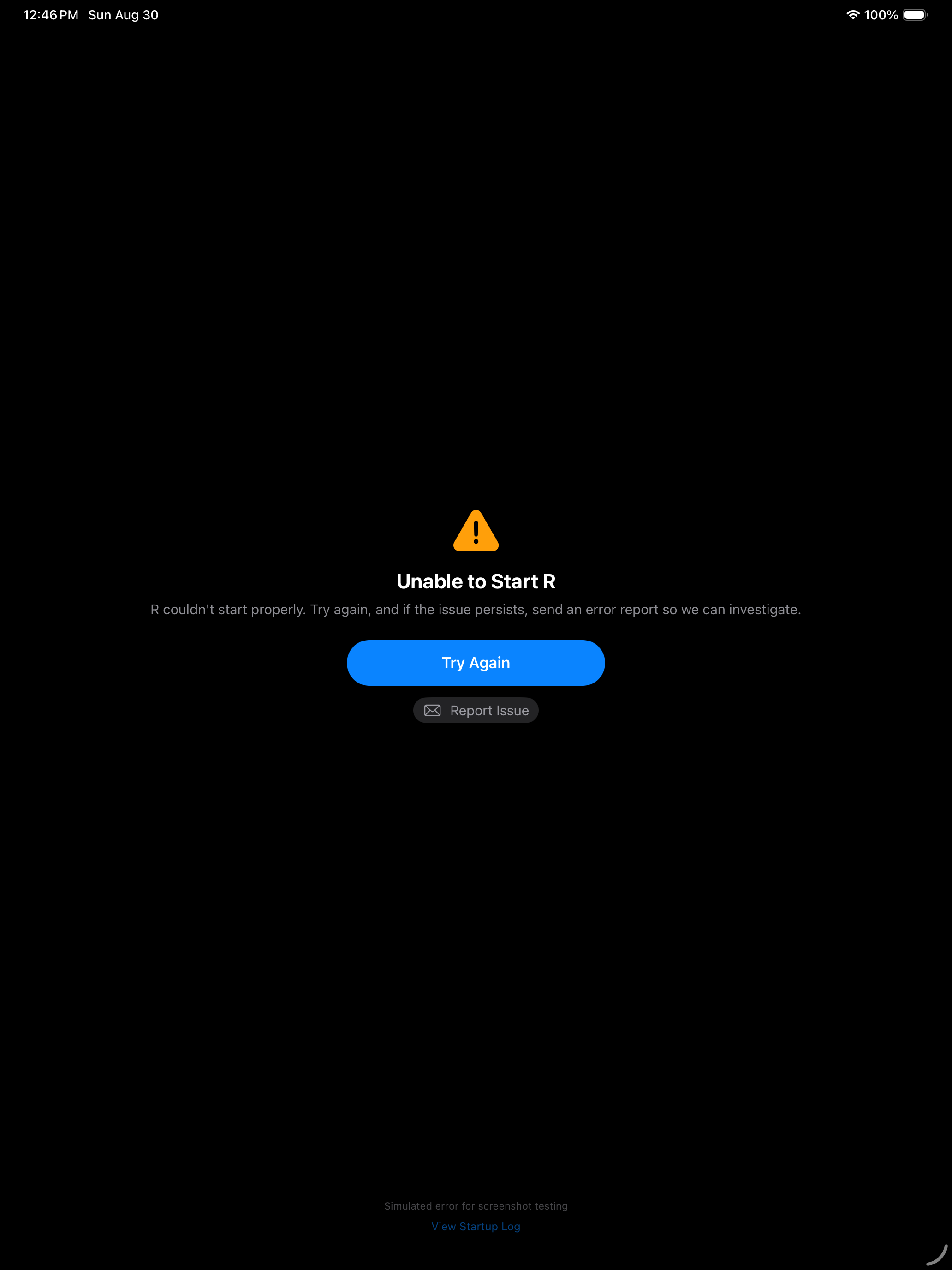
R’s error messages are usually informative. Error: object 'y' not found means exactly what it says.
When an error says a package is missing (there is no package called 'dplyr', usually from library()), the error row offers Install dplyr. Tapping it runs install.packages() in the Console, so you can watch the download, and saves the package for later launches. Whatever you had typed in the input field is put back afterwards.
Stopping Running Code
R runs one piece of code at a time. While it runs, a progress indicator and a Stop button appear beside the input field, whichever screen started the code: the Console, the Editor, a script run from Files, a command re-run from History, or a Help example. Tap Stop, or press Cmd+. on a keyboard, and R stops where it is. The run ends with one “Interrupted” line, and your variables are kept.
While R is busy, the Run button is disabled. A command you submit anyway stays in the input field, and the Console tells you R is busy, so you can run it once the current code finishes.
Most code stops within a moment. Some compiled code, such as a very large matrix calculation, only notices Stop when its current step returns. A banner at the top of the Console then explains what is happening:
| Banner | What it means |
|---|---|
| R has been running for over a minute | Shown for any long run. Offers Stop and Restart R. |
| R is still finishing a step it can’t interrupt. It stops when that step ends. | Stop has reached R, but the current step has to finish first. Wait, or tap Restart R, which clears your variables and loaded packages. |
| Stopped before it ran. | Your code was still waiting behind other work, such as a package install from the Packages tab. It was cancelled before R started it, and R carries on with the other work. |
| R ran out of stack space. | Very deep recursion in compiled code exhausted the stack. Later commands may fail until R restarts, so the banner offers Restart R (after asking) or Not Now. See Known Issues. |
The same banner appears in the Editor and in iPad editor windows. If R stops answering after a Stop, webRios restarts it for you and says why in the Console. Your plots are kept.
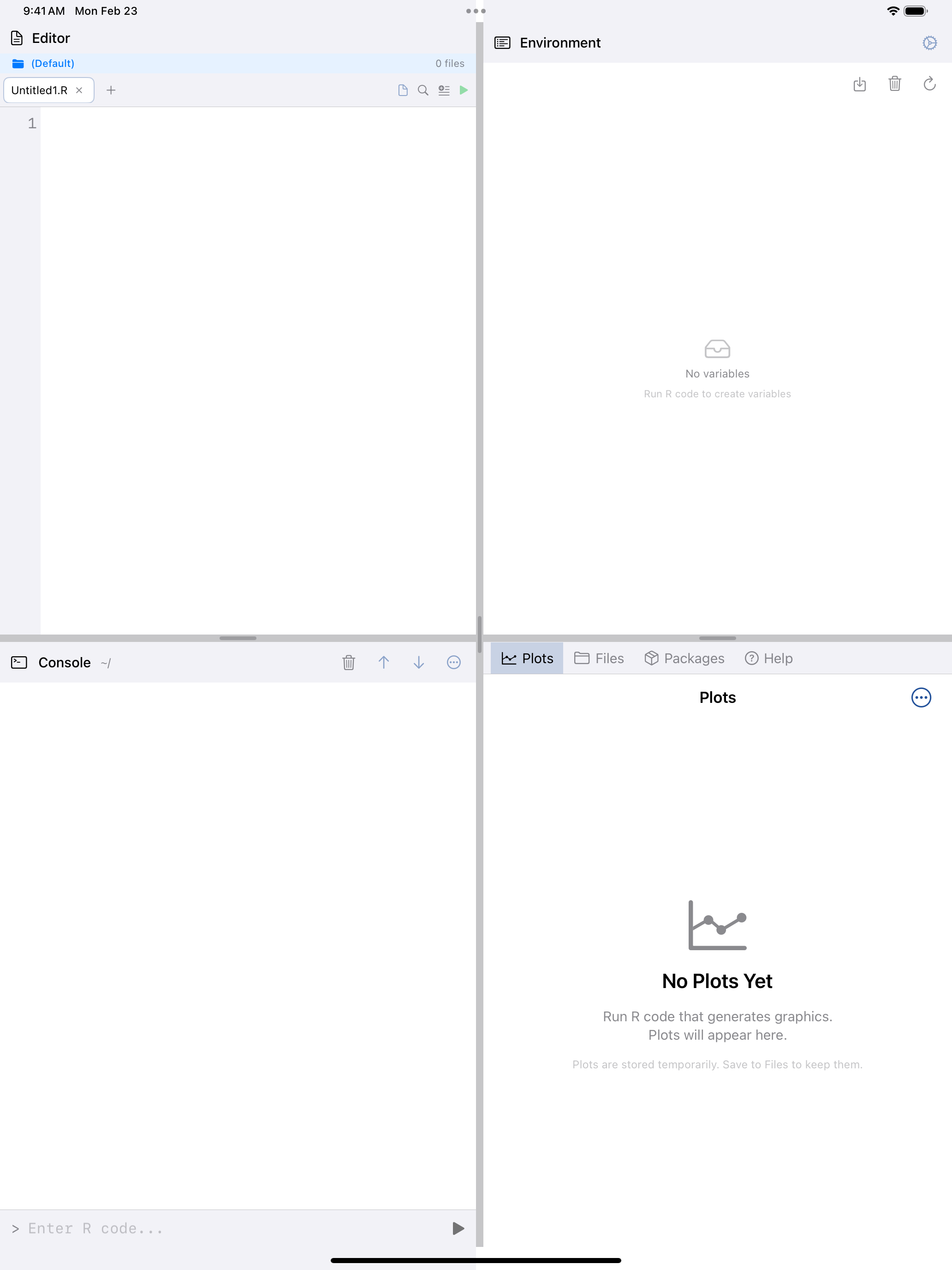
On iPad in the 4-Pane Workspace, the Console pane’s Stop is in its header, and it stops code run from the Editor pane too.
Command History
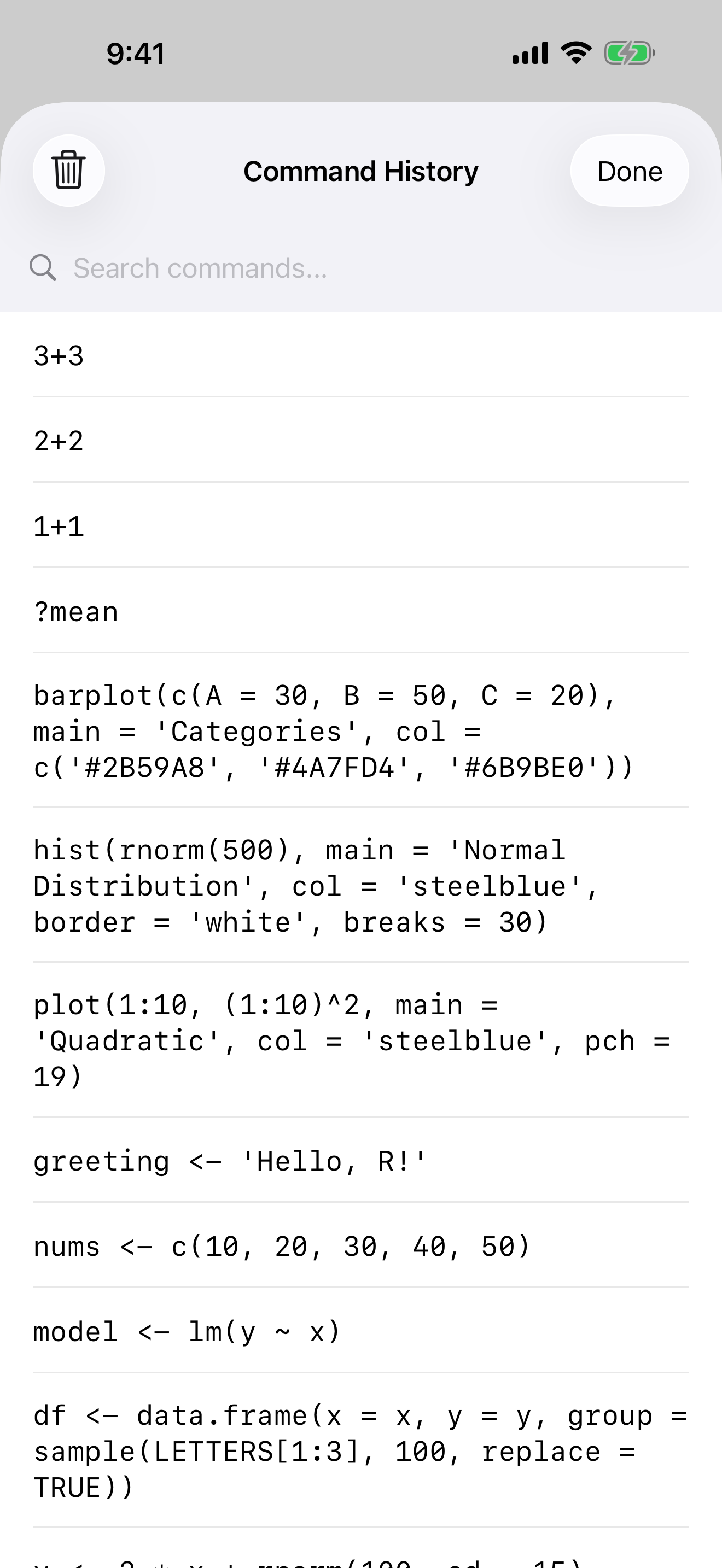
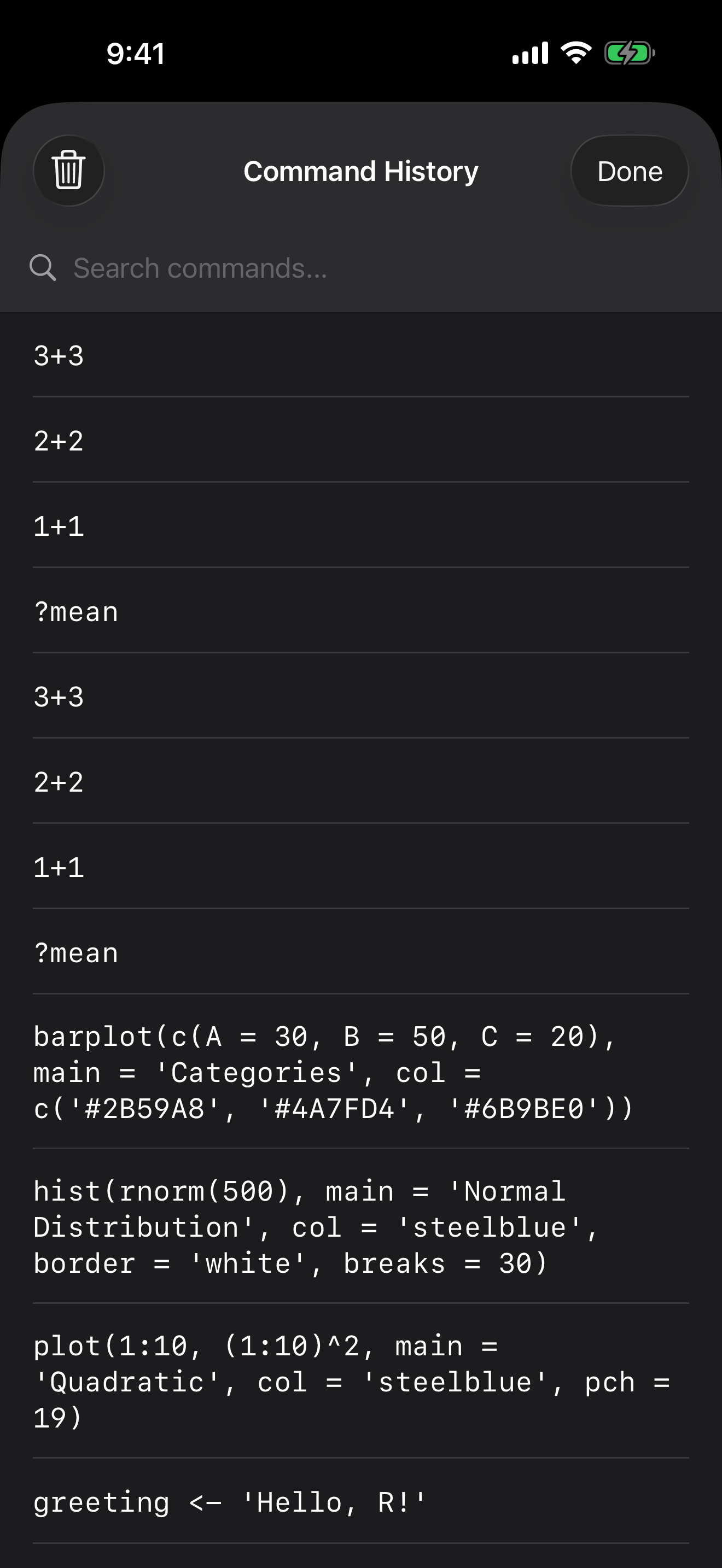
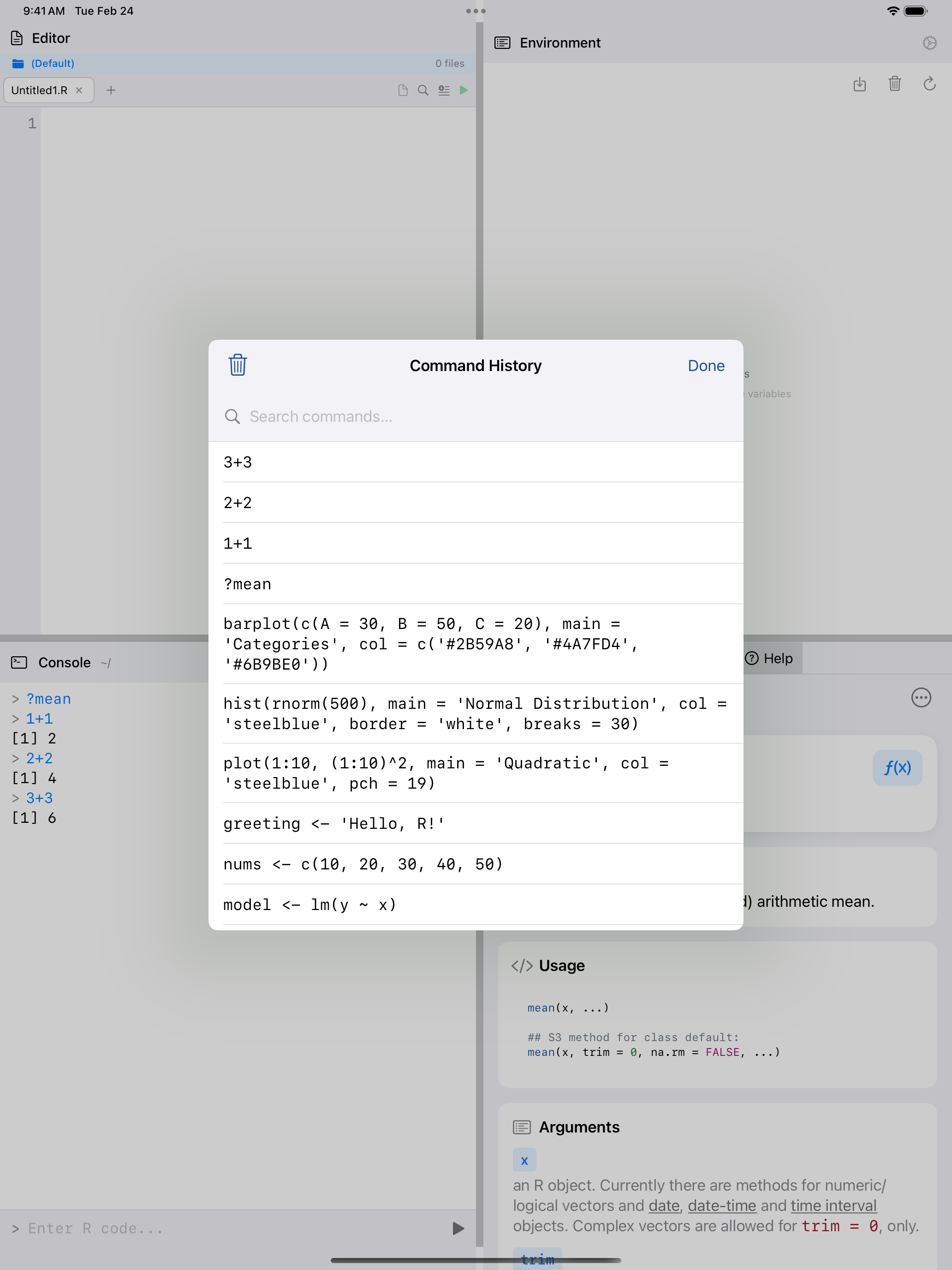
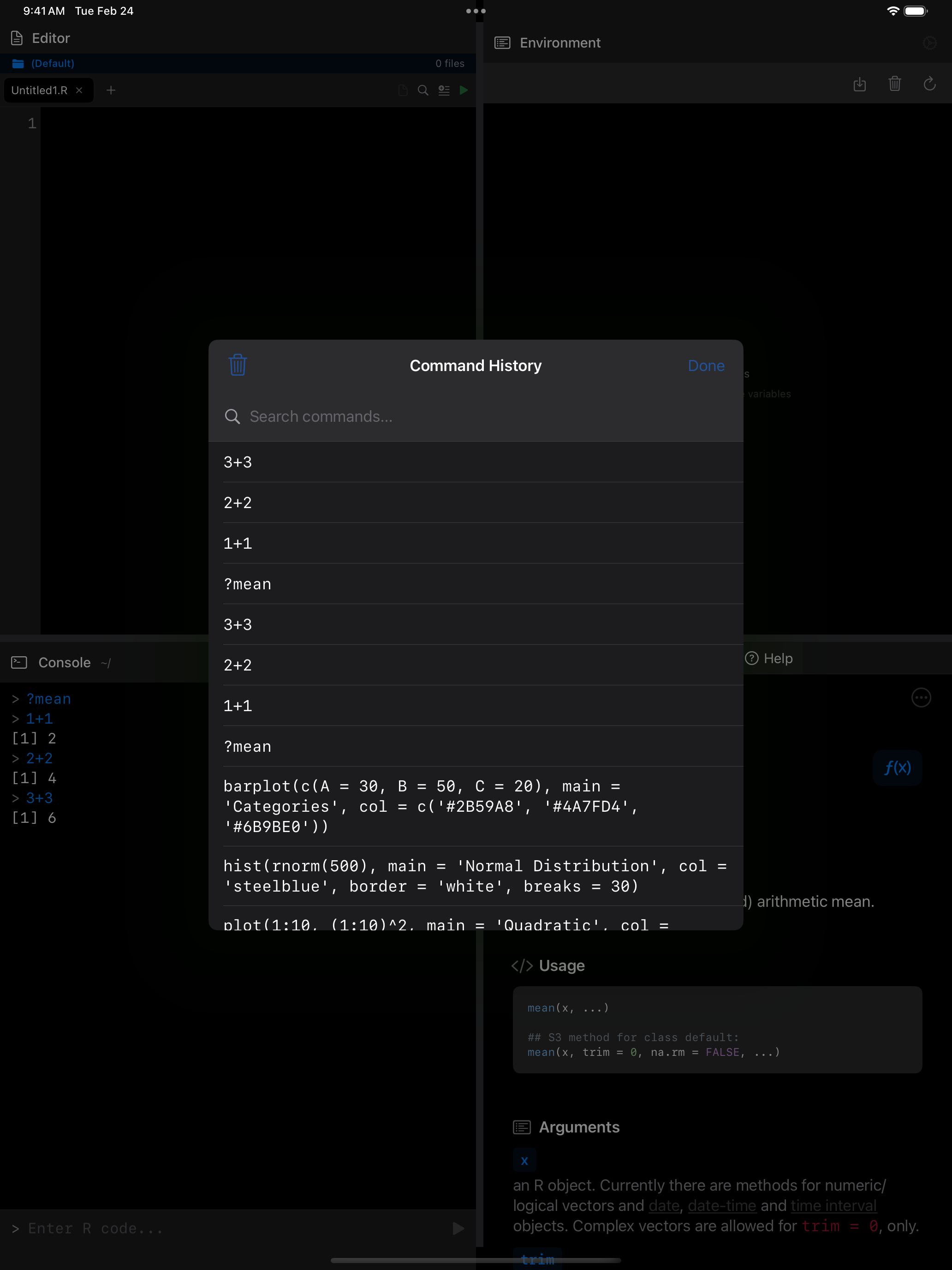
The Console keeps a history of everything you have entered. There are several ways to get at it.
Previous and next command. Tap the … menu and choose Previous Command or Next Command to step through what you have run, or press Cmd+Up and Cmd+Down on a keyboard. The recalled command lands in the input field with the cursor at its end, ready to edit.
Search history. Tap the … menu and choose Search History to filter past commands by keyword. Tap any result to load it back into the input field.
History Tab
The History tab logs every command you have run, across sessions. Unlike the console output, it shows only your commands, with timestamps, execution duration, and success or failure.
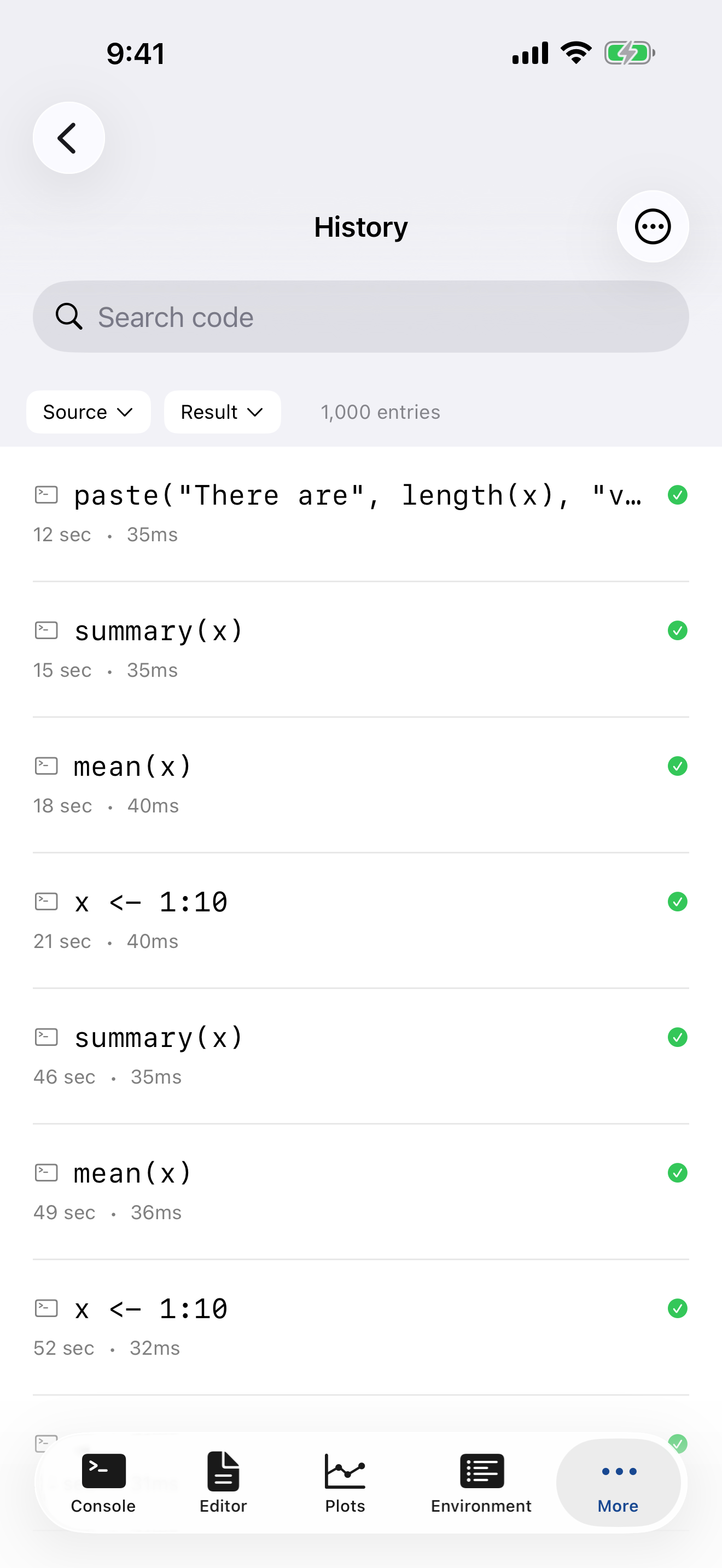
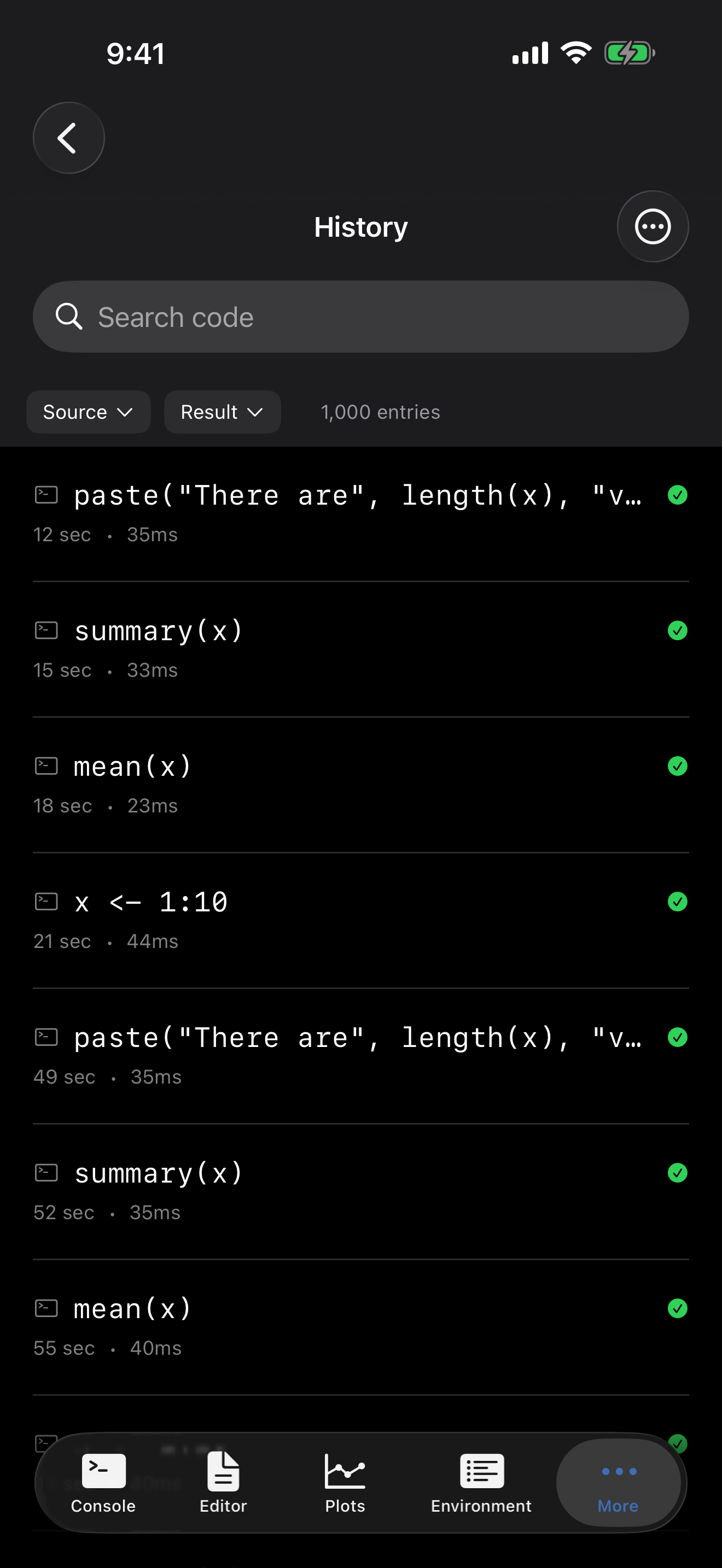
Each entry shows its source (Console, Editor, or Script), a code preview, the timestamp, duration, and a checkmark or X for the result. Failed commands also show the first line of the error.
Filtering and searching
Use the filter bar at the top to narrow the list:
- Source filter: show commands from All Sources, Console only, Editor only, or Script only
- Result filter: All Results, Success Only, or Failed Only
You can also use the search bar to find specific commands by searching code content, output, or error messages.
Re-running and managing entries
- Swipe right on an entry to re-run that command immediately
- Swipe left to delete an entry
- Tap an entry to see the full detail sheet with the complete code, output preview, and a Run Again button
A re-run is echoed into the Console first, so its output has a prompt to belong to, and it can be stopped like any other run. If R is already busy, the re-run is refused with a message rather than queued.
History is saved about a second after each run and again when you leave the app, so it survives a relaunch.
Export and statistics
Tap the menu button (⋯) for additional options:
- Statistics: see your total execution count, success rate, average duration, and last execution time
- Export as Text: a human-readable summary of your history
- Export as JSON: structured data for further analysis
- Clear All: delete all history entries
If you find yourself running the same sequence of commands repeatedly, consider writing them as a script in the Editor instead.
The R Keyboard Toolbar
When the keyboard is open, a scrollable toolbar of common R symbols appears above it (the same one used in the Editor):
<-: the assignment operator|>: the native pipe( )[ ]{ }"": matched pairs that insert both characters at once~: the formula operatorc(): quick vector wrapper::$@: namespace, list, and slot access%in%!&|: logical operators#: comment prefix- Tab: inserts two spaces for indentation
Each button inserts at the cursor, or over the selection, and leaves the cursor between a pair of brackets or quotes. You can change which buttons appear in Settings > Keyboard > Toolbar Buttons.
There is also a dismiss keyboard button at the far right of the toolbar so you can quickly hide the keyboard and see more of your output.
Code Completion
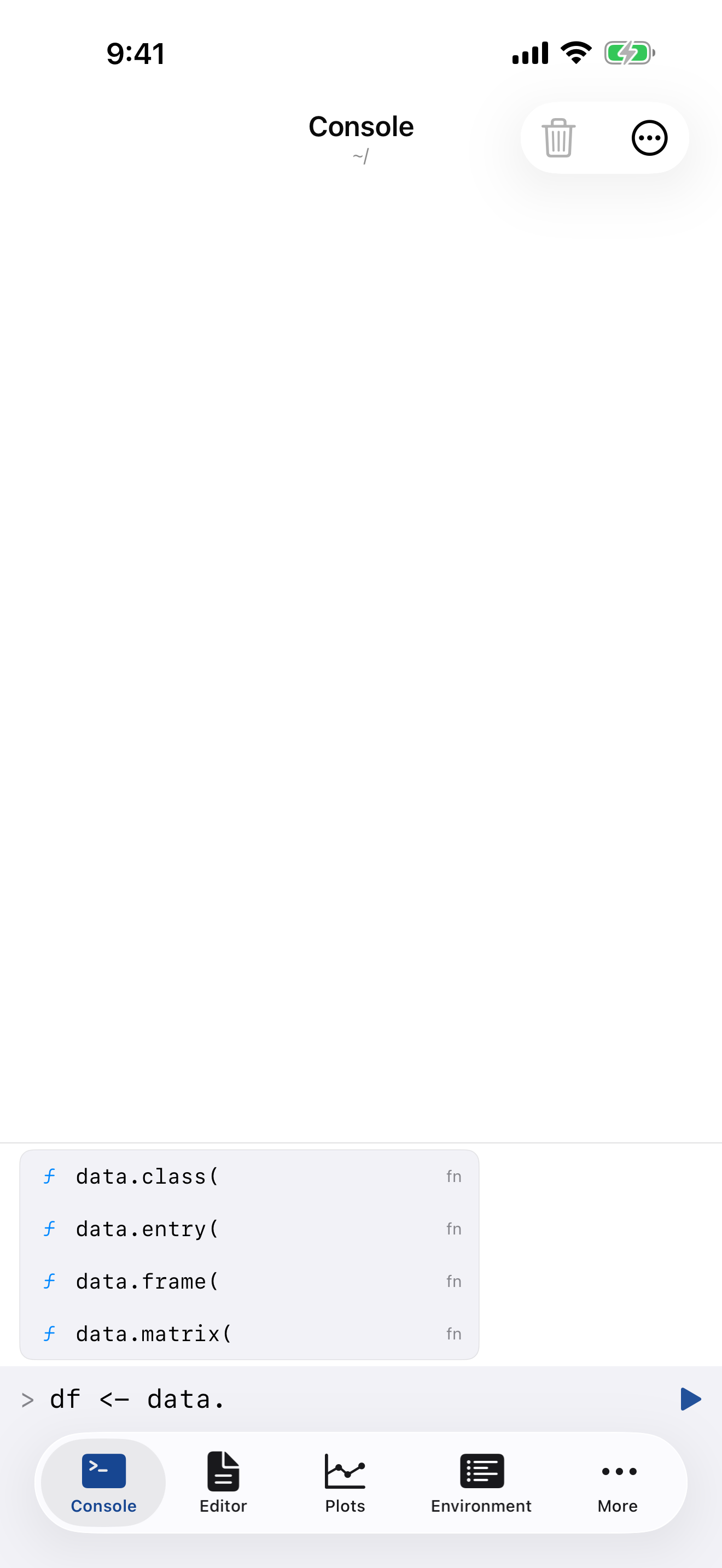
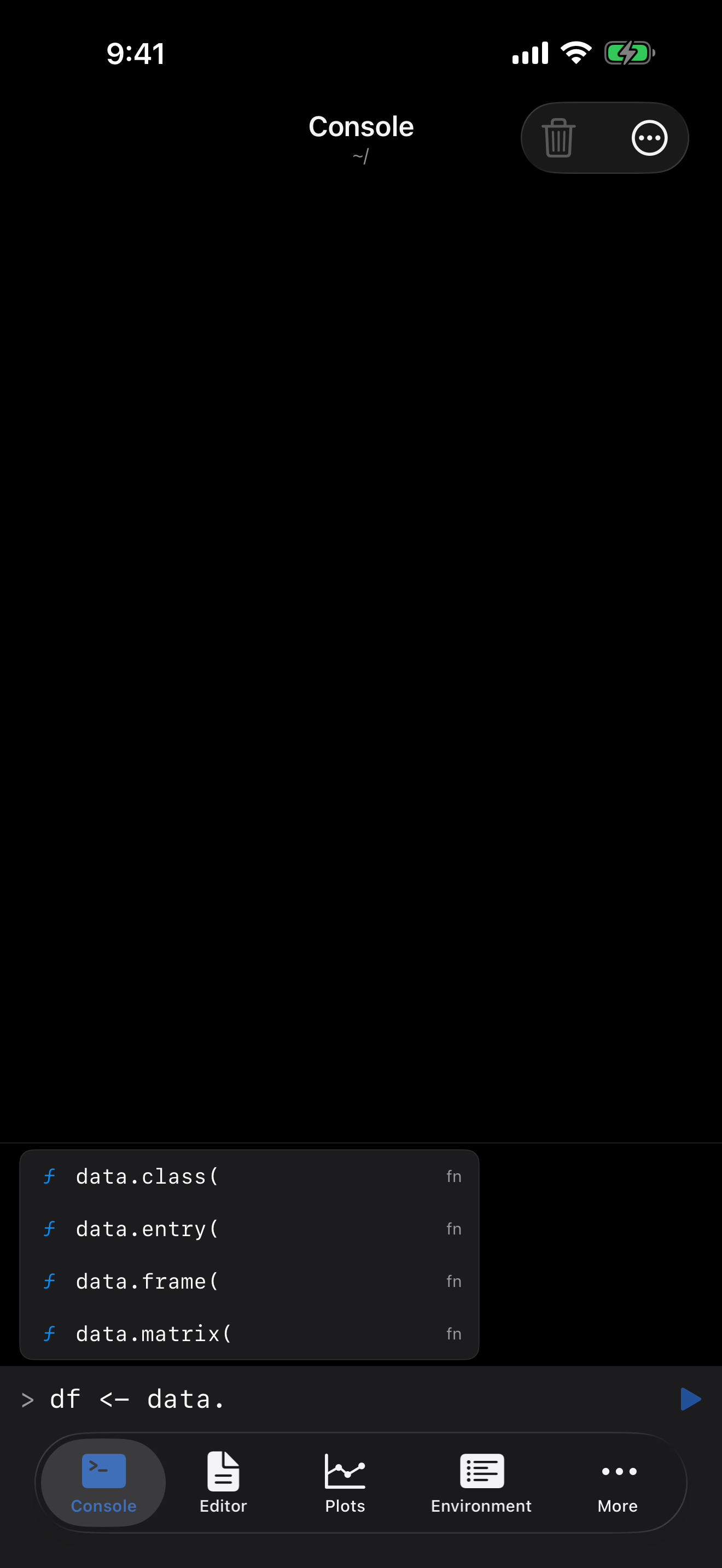
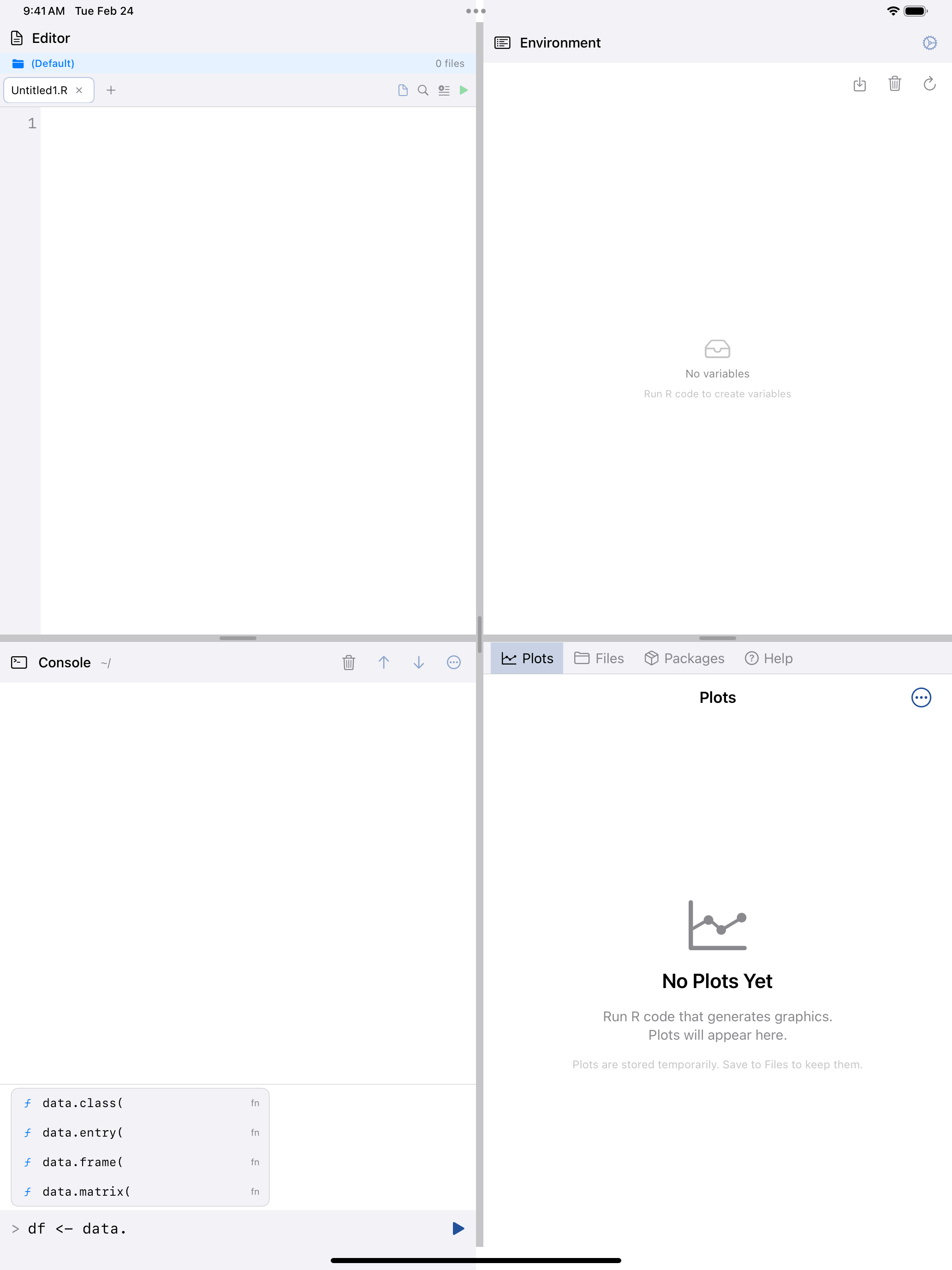
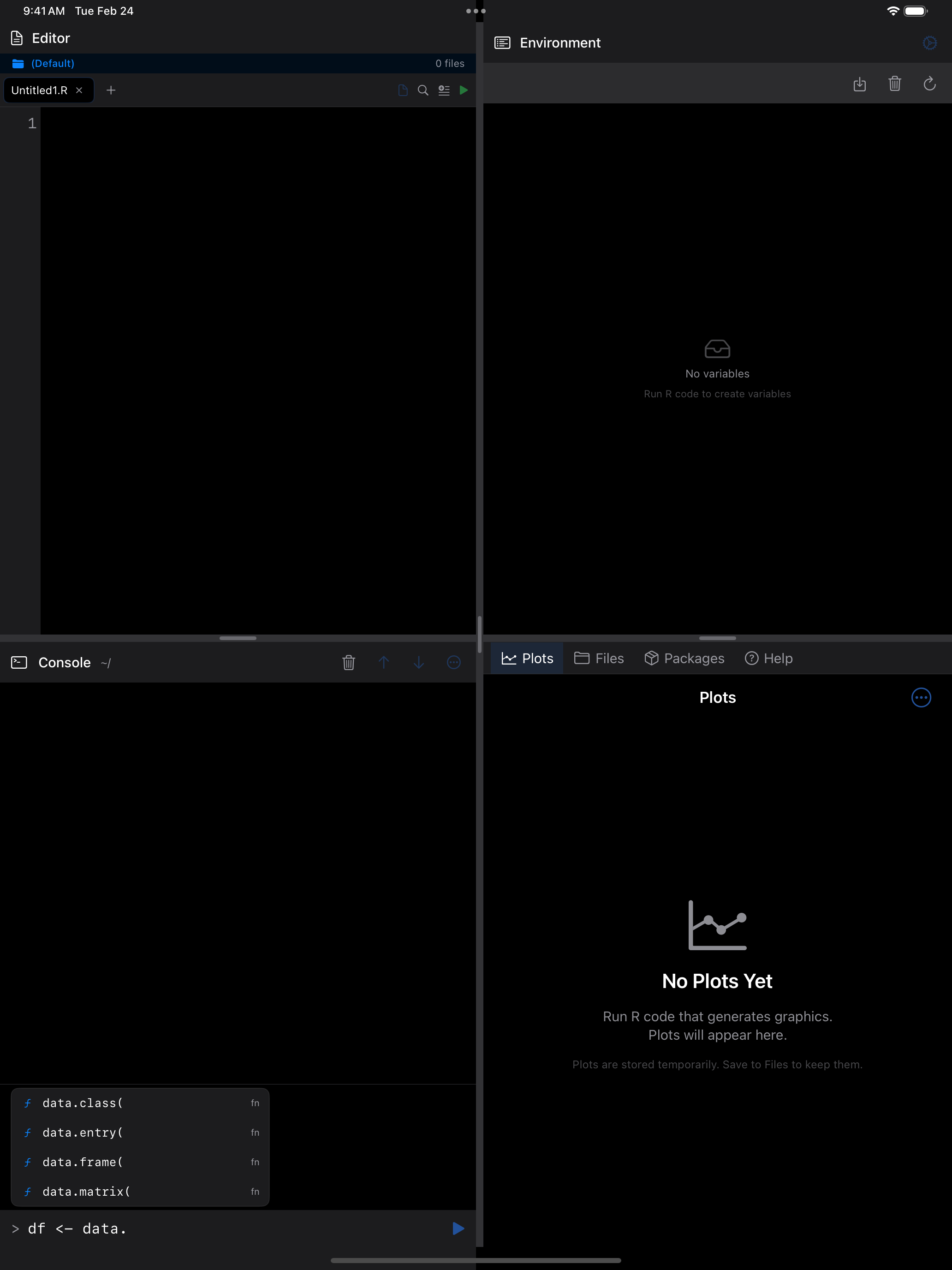
As you type, the Console suggests function names, variable names, and package members in a popup above the input field. Tap a suggestion to insert it.
With a hardware keyboard, Up and Down move a highlight through the list, Tab inserts the highlighted suggestion (or the first one), and Escape closes the list. The Run button always runs the line as typed. The list grows with your console font size, and VoiceOver announces how many completions there are when it opens.
Clearing the Console
Two ways to clear the output area:
- Tap the trash icon in the top-right toolbar for a quick clear
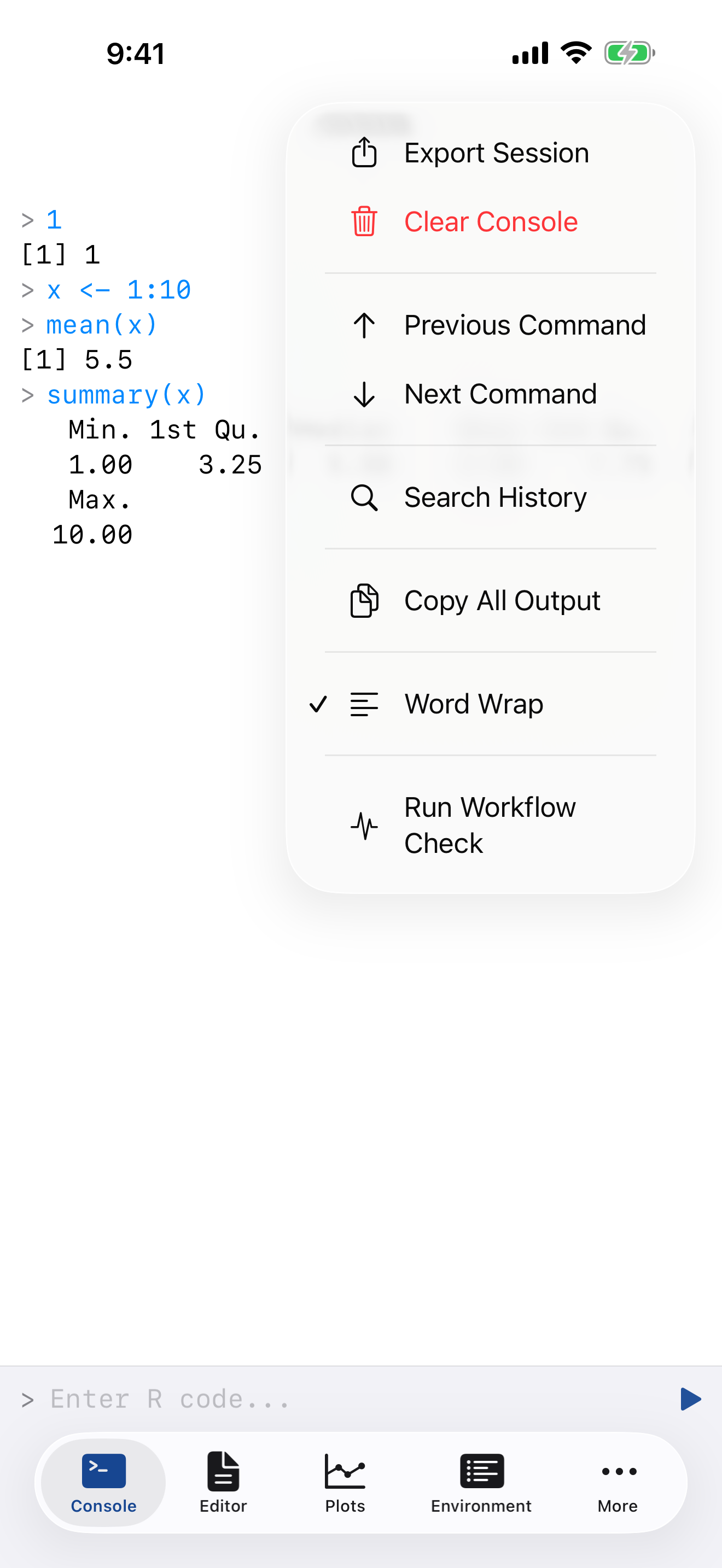
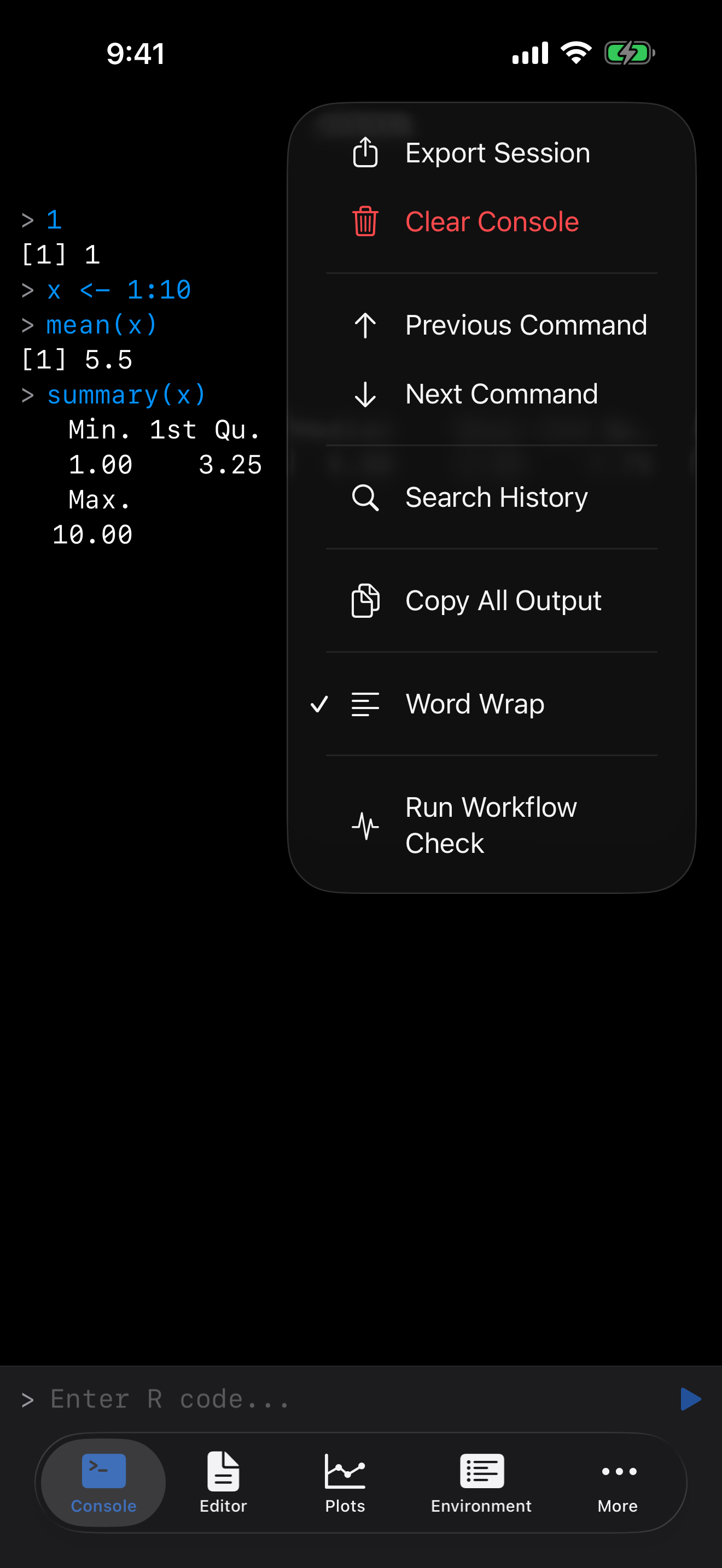
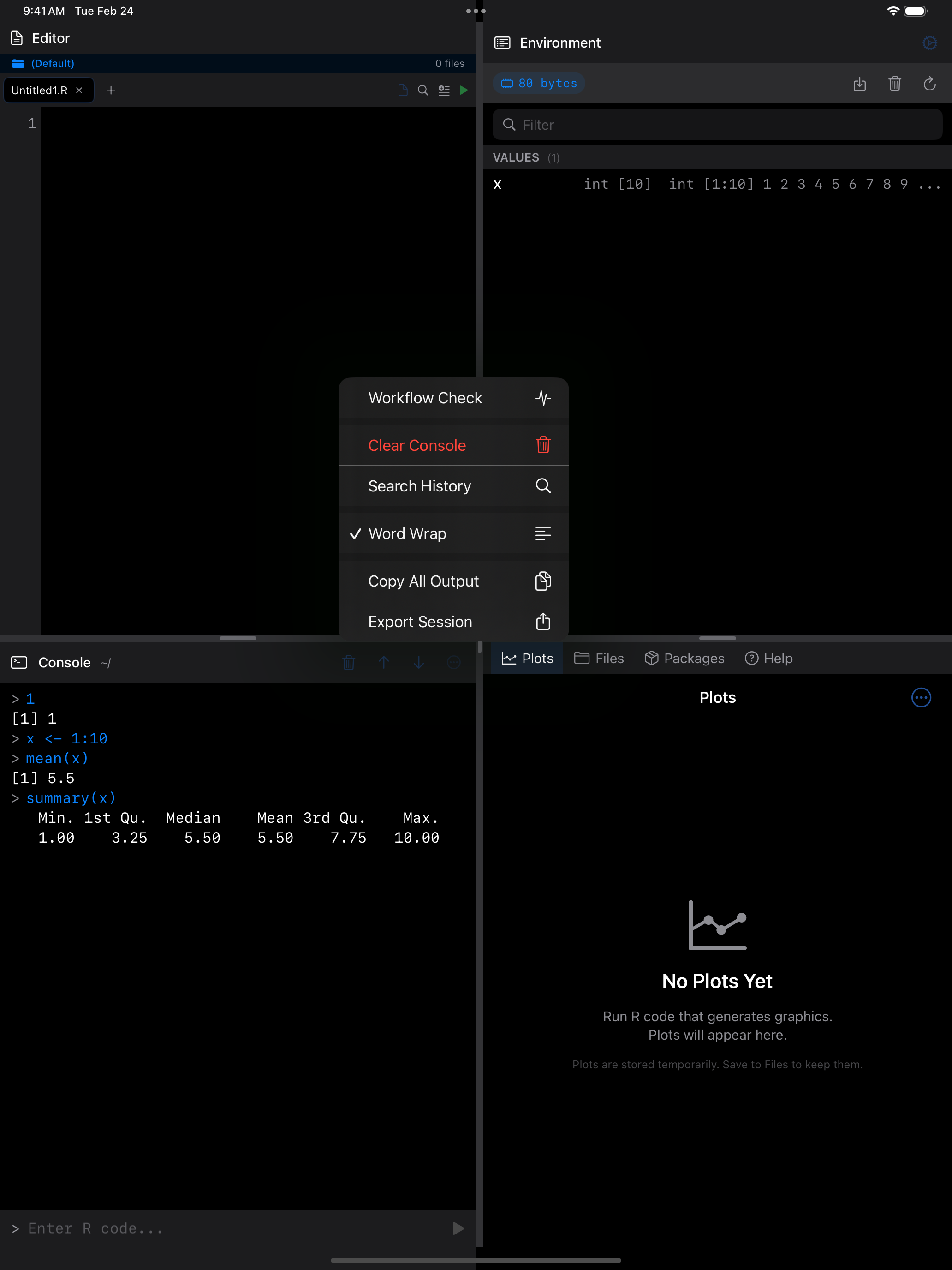
- Tap the … menu and choose Clear Console
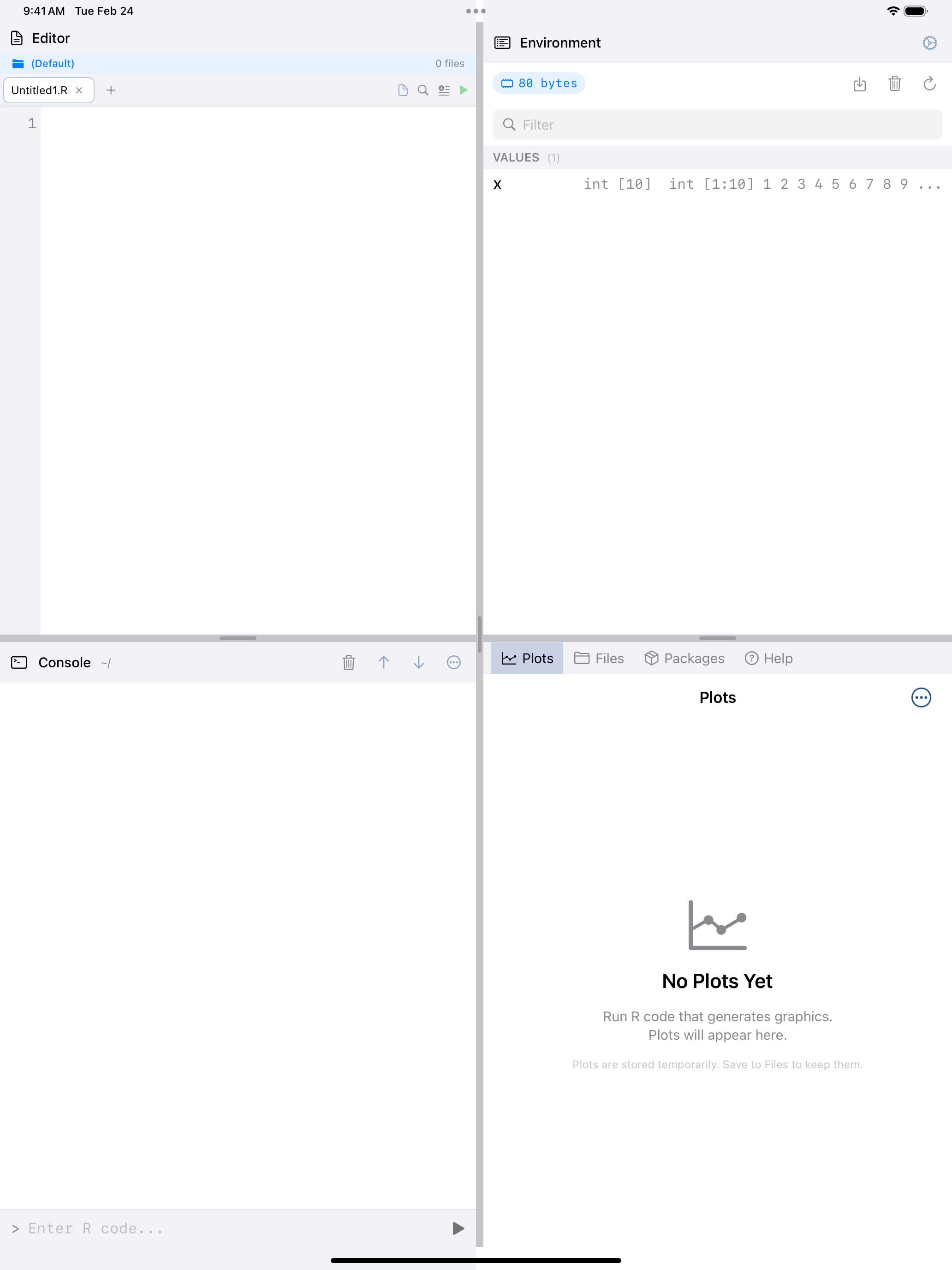
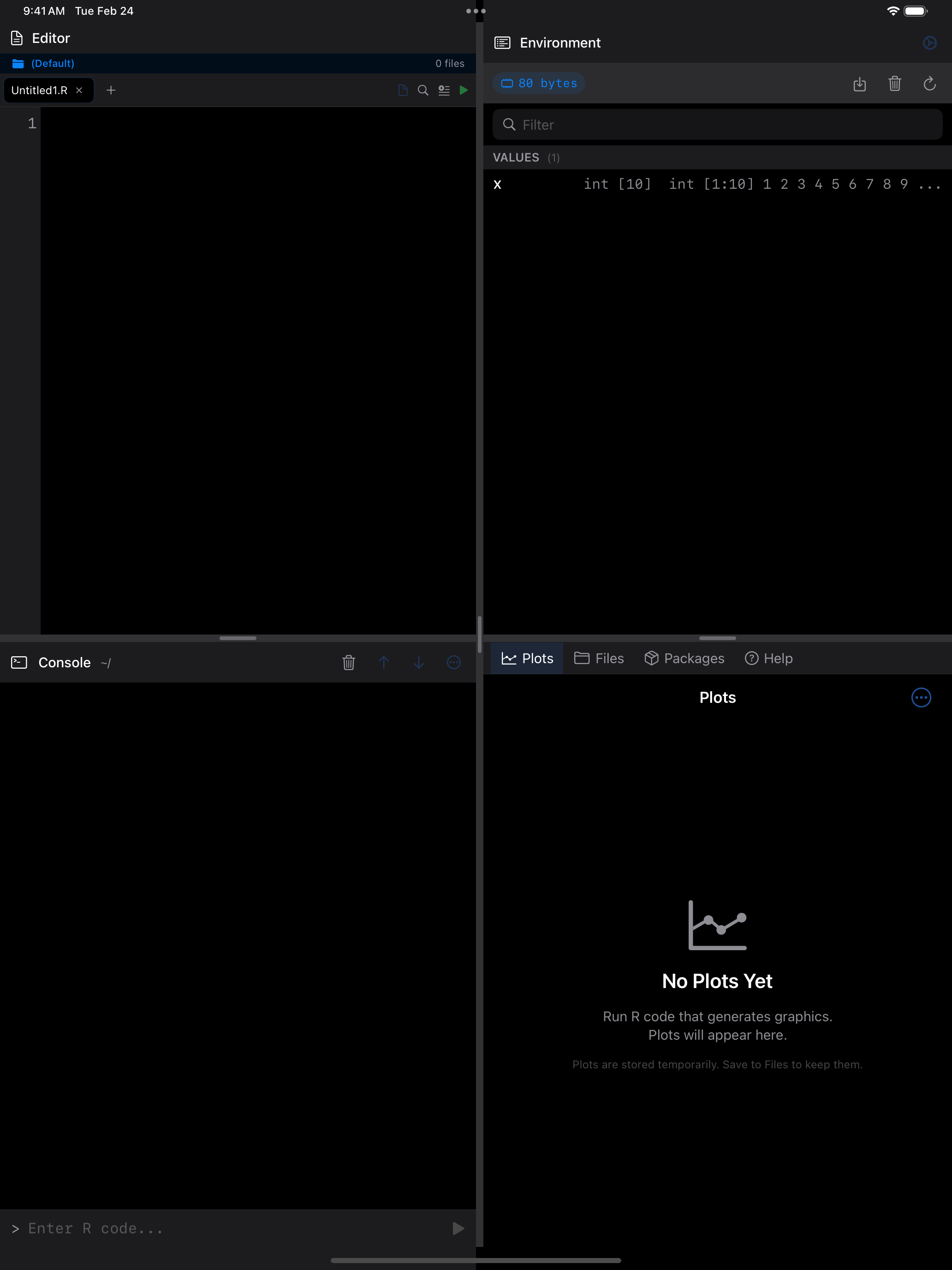
Clearing the console removes only the displayed text. Your variables, loaded packages, and data stay in memory.
More Console Features
The … menu provides a few more tools:
- Export Session: saves your entire console session as text
- Copy All Output: copies everything in the output area to the clipboard
- Word Wrap: toggles line wrapping for long output
- Previous/Next Command: step through your command history
- Inline Plots: also draw each new plot in the Console, under the command that made it (the same choice as Settings > Appearance > New Plots)
R’s output width follows the Console, so output wraps to fit whatever font size you choose in Settings > Appearance, down to 20 columns at the largest sizes.
Acting on a Line of Output
Long-press any line in the console to copy just that line, or the whole session.
The Startup Log
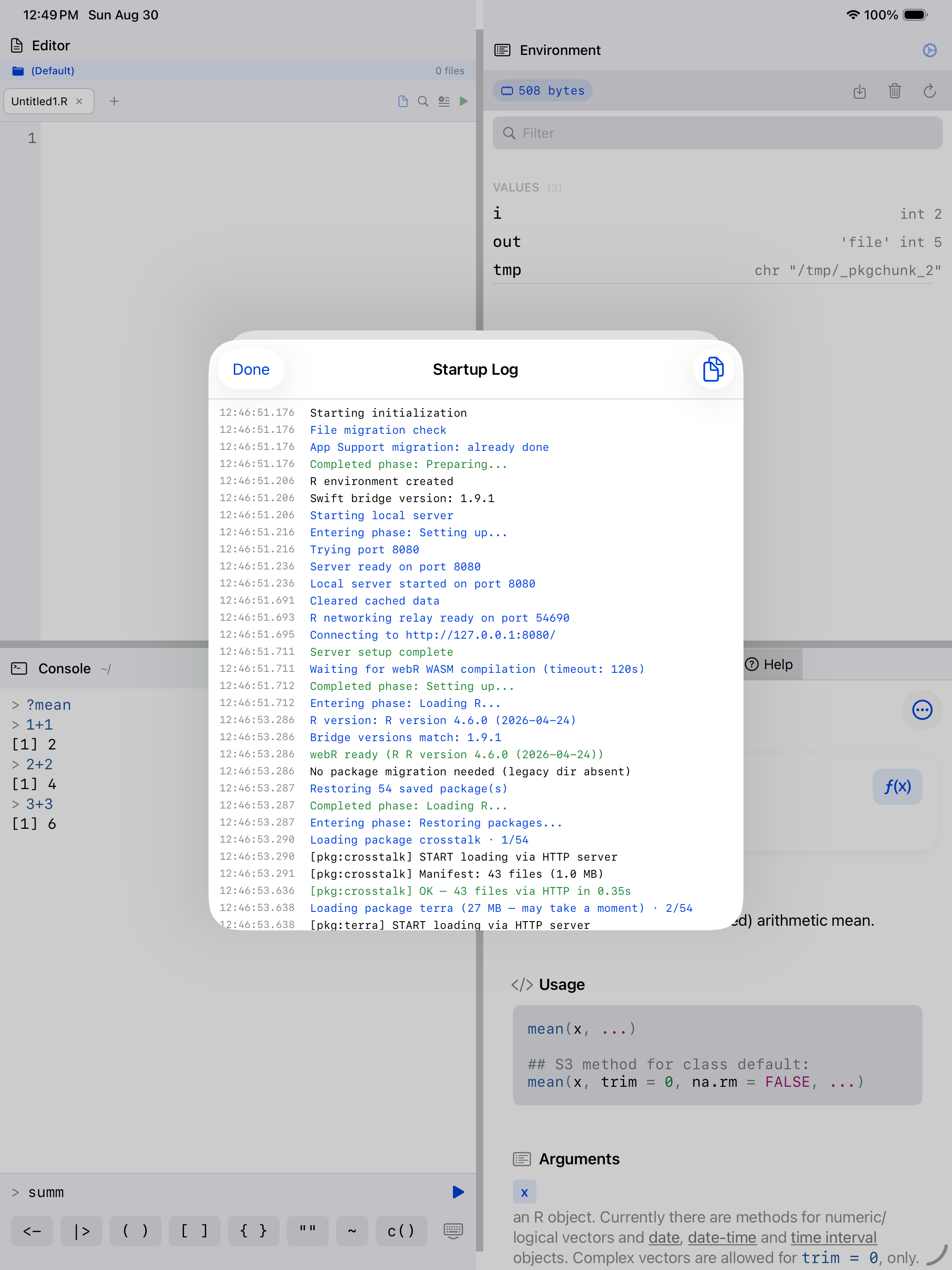
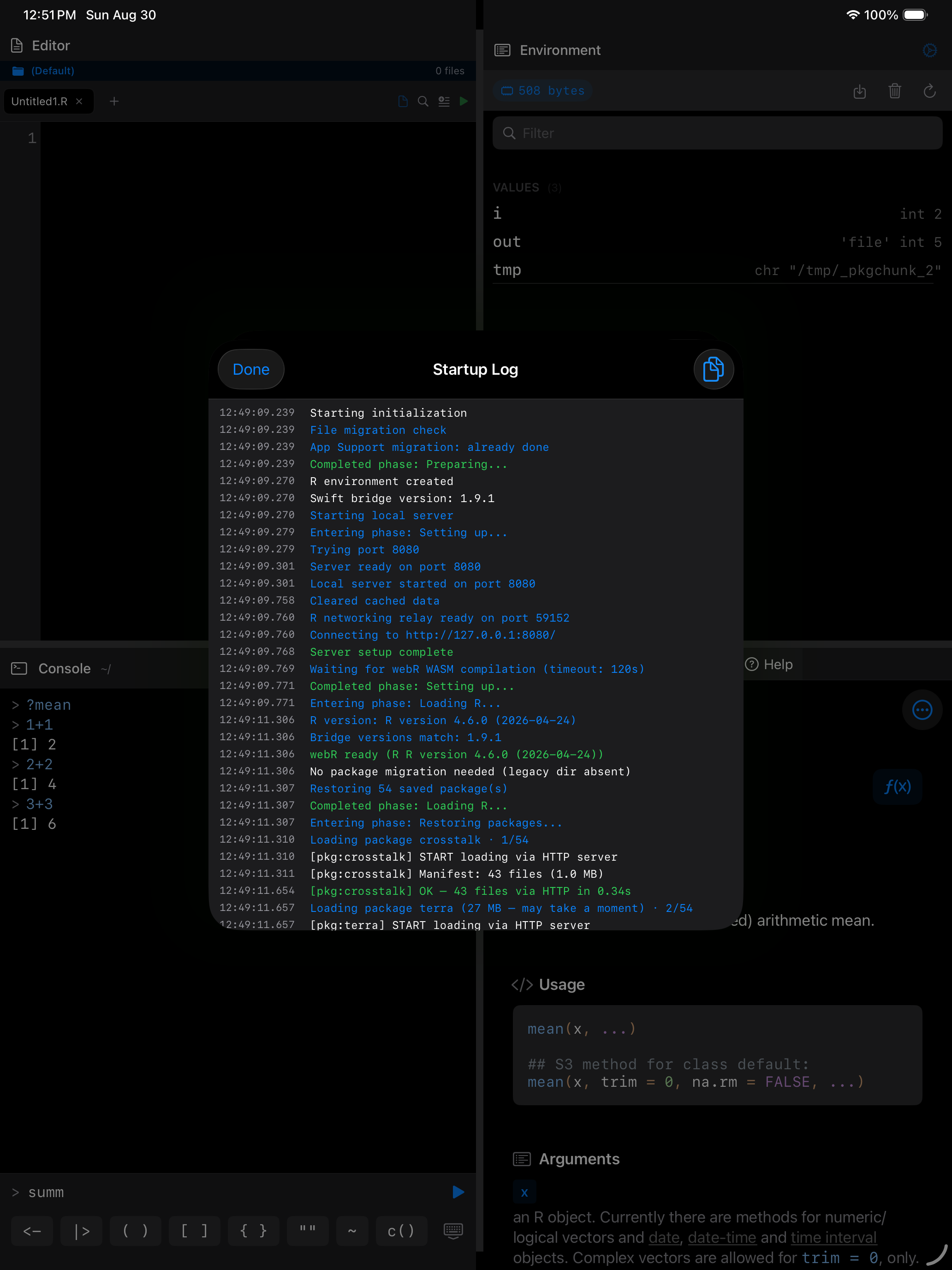
If R takes longer than expected to start, or fails to, Settings > Help & Resources > Startup Log records each stage of initialisation with timings. It is the first thing worth attaching to a bug report.
If you have an external keyboard connected, you can use Cmd+K to clear the console, Cmd+Up/Down to navigate history, Cmd+F to search through your command history, Cmd+. to stop running code, and Ctrl+Cmd+0 to restart R. On iPad these are also in the menu bar; see Keyboard Shortcuts.